Ouali Sana, Ben Salem Helmi, Hammas Sami, Neffeti Elyes, Remedi Fahmi, Mahdhaoui Abdallah, Boughzela Essia, Mankai Rafik
Department of Cardiology, Sahloul Hospital, Sousse, Tunisia.
Open Access J Sports Med. 2011 Apr 19;2:33-40. doi: 10.2147/OAJSM.S19029. eCollection 2011.
No data regarding the prevalence of the Brugada-type electrocardiogram (ECG) pattern and the early ventricular repolarization pattern (ERP) in the North African population were available. The aims of this study were to determine the frequency of Brugada-type ECG pattern and ERP in Tunisia and to evaluate ECG descriptors of ventricular repolarization in a population of athletes.
Over a 2-year period, resting 12-lead ECG recordings were analyzed from athletes (n = 540; 348 males; age 18.3 ± 2.4 years). Brugada-type ECG pattern was defined as Type 1, 2, or 3, and ERP was characterized by an elevation of the J point in the inferior and/or lateral leads. The population was divided into three groups of athletes: ERP group; Brugada-type ECG pattern group; and control group, with neither ERP nor Brugada ECG pattern. Clinical and electrocardiographic parameters were compared among the study groups.
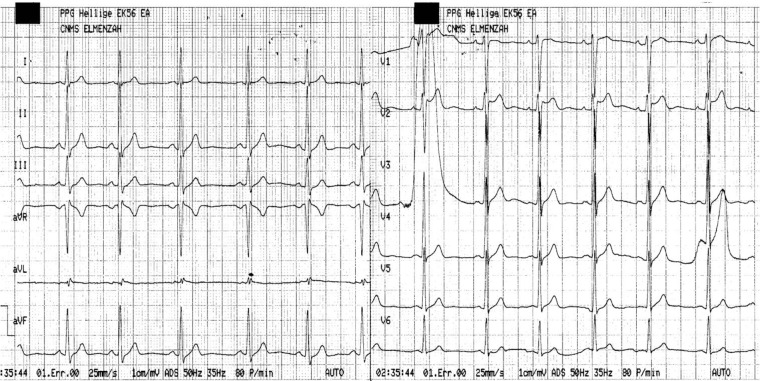
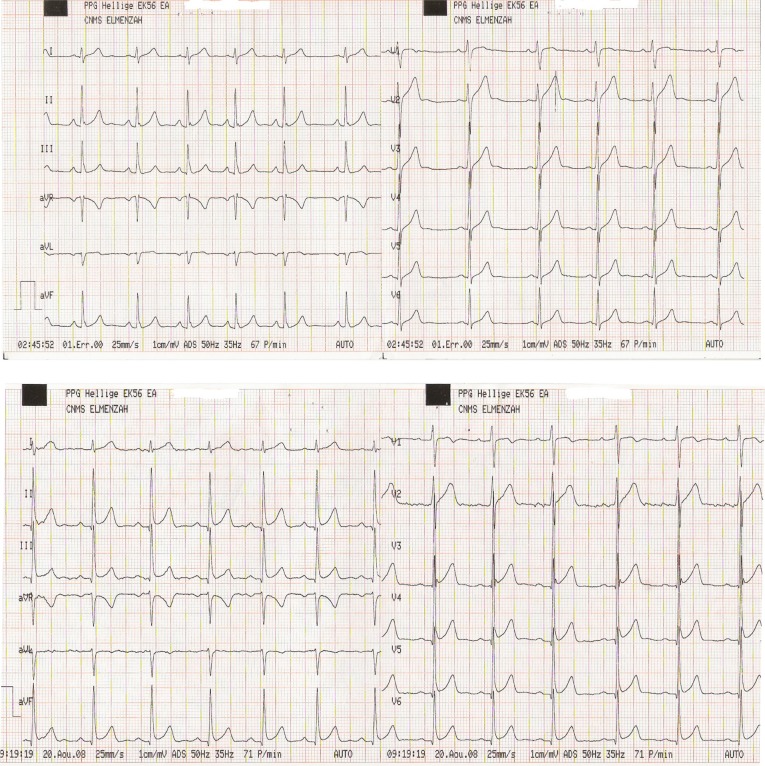
Nine subjects (1.66%) had a Brugada-type ECG pattern. None of them had the coved-type, 3 (0.6%) had the Type 2, and 6 (1.1%) had the Type 3. All subjects were asymptomatic. A Brugada-type ECG pattern was observed in seven males. No female had the Type 2 Brugada ECG pattern. ECG parameters were similar among Brugada-type ECG pattern and control athletes. ERP (119 subjects, 22%) was obtained in 98 males. Heart rate was lower, the QRS duration shorter and QT and Tpeak-Tend intervals were longer in ERP than control groups.
The results indicate that the frequency of the Brugada-type ECG pattern and ERP were respectively 1.66% and 22.00% in athletes, being more prevalent in males. The ERP group experienced shorter QRS duration and longer Tpeak-Tend interval than in the control population.
尚无关于北非人群中Brugada型心电图(ECG)模式和早期心室复极模式(ERP)患病率的数据。本研究的目的是确定突尼斯人群中Brugada型ECG模式和ERP的频率,并评估运动员群体中心室复极的ECG描述指标。
在两年时间里,对运动员(n = 540;348名男性;年龄18.3±2.4岁)的静息12导联ECG记录进行了分析。Brugada型ECG模式定义为1型、2型或3型,ERP的特征是下壁和/或侧壁导联J点抬高。将该人群分为三组运动员:ERP组;Brugada型ECG模式组;以及既无ERP也无Brugada ECG模式的对照组。对各研究组的临床和心电图参数进行了比较。
9名受试者(1.66%)有Brugada型ECG模式。他们均无穹窿型,3名(0.6%)有2型,6名(1.1%)有3型。所有受试者均无症状。在7名男性中观察到Brugada型ECG模式。没有女性有2型Brugada ECG模式。Brugada型ECG模式组和对照组运动员的心电图参数相似。ERP(119名受试者,22%)出现在98名男性中。与对照组相比,ERP组心率较低,QRS时限较短,QT和Tpeak-Tend间期较长。
结果表明,运动员中Brugada型ECG模式和ERP的频率分别为1.66%和22.00%,在男性中更为普遍。与对照组相比,ERP组的QRS时限较短,Tpeak-Tend间期较长。