Qu Xiaoyi, Felder Mildred A R, Perez Horta Zulmarie, Sondel Paul M, Rakhmilevich Alexander L
University of Wisconsin, Department of Human Oncology, Madison, WI, USA.
Int Immunopharmacol. 2013 Dec;17(4):1141-7. doi: 10.1016/j.intimp.2013.10.019. Epub 2013 Nov 4.
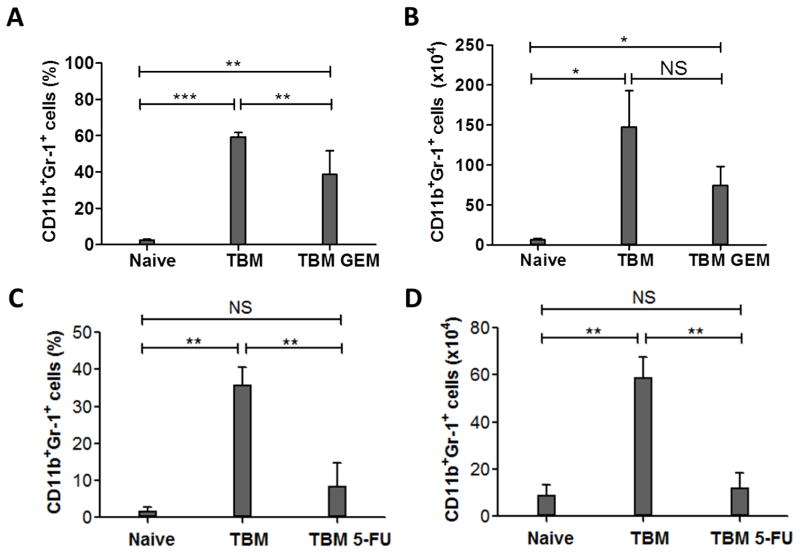
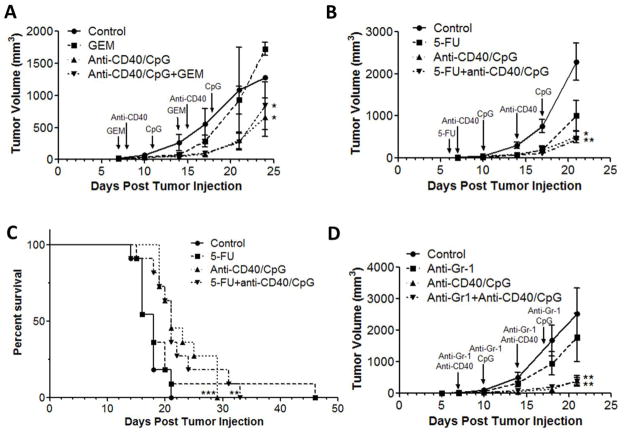
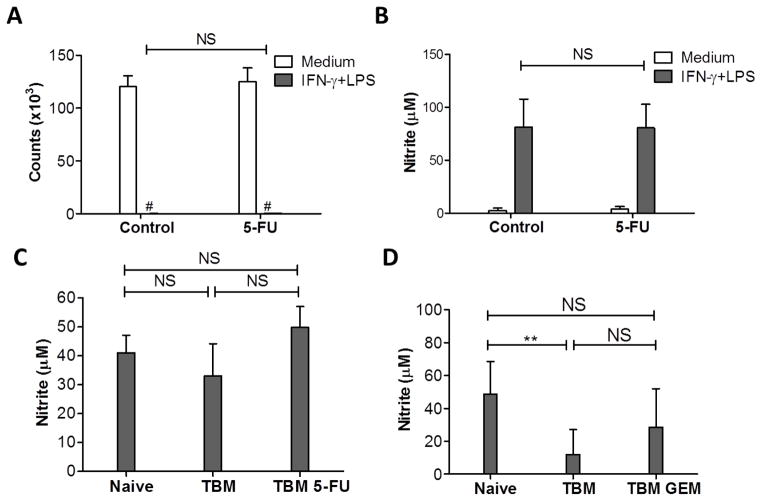
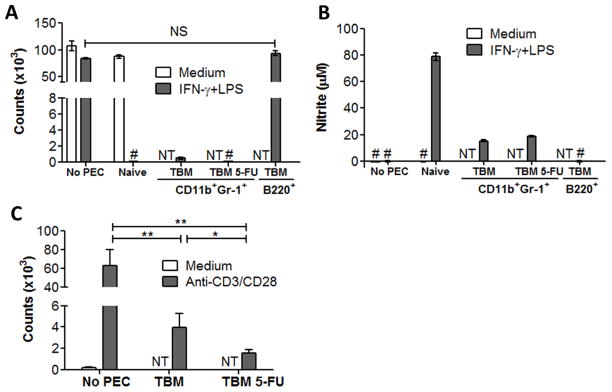
Our previous studies demonstrated that anti-CD40 mAb (anti-CD40) can synergize with CpG oligodeoxynucleotides (CpG) to mediate antitumor effects by activating myeloid cells, such as macrophages in tumor-bearing mice. Separate teams have shown that chemotherapy with gemcitabine (GEM) or 5-fluorouracil (5-FU) can reduce tumor-induced myeloid-derived suppressor cells (MDSC) in mice. In this study we asked if the same chemotherapy regimens with GEM or 5-FU will enhance the antitumor effect of anti-CD40 and CpG. Using the model of B16 melanoma growing intraperitoneally in syngeneic C57BL/6 mice, we show that these GEM or 5-FU treatment regimens reduced MDSC in the peritoneal cavity of tumor-bearing mice. Treatment of mice with GEM or 5-FU did not significantly affect the antitumor function of macrophages as assessed in vitro. In vivo, treatment with these GEM or 5-FU regimens followed by anti-CD40/CpG resulted in antitumor effects similar to those of anti-CD40/CpG in the absence of GEM or 5-FU. Likewise, reduction of MDSC by in vivo anti-Gr-1 mAb treatment did not significantly affect anti-CD40/CpG antitumor responses. Together, the results show that the GEM or 5-FU chemotherapy regimens did not substantially affect the antitumor effects induced by anti-CD40/CpG immunotherapy.
我们之前的研究表明,抗CD40单克隆抗体(抗CD40)可与CpG寡脱氧核苷酸(CpG)协同作用,通过激活髓样细胞(如荷瘤小鼠体内的巨噬细胞)来介导抗肿瘤效应。不同的研究团队已表明,吉西他滨(GEM)或5-氟尿嘧啶(5-FU)化疗可减少小鼠体内肿瘤诱导的髓源性抑制细胞(MDSC)。在本研究中,我们探究了使用GEM或5-FU的相同化疗方案是否会增强抗CD40和CpG的抗肿瘤效果。利用B16黑色素瘤在同基因C57BL/6小鼠腹腔内生长的模型,我们发现这些GEM或5-FU治疗方案可减少荷瘤小鼠腹腔内的MDSC。用GEM或5-FU处理小鼠对体外评估的巨噬细胞抗肿瘤功能没有显著影响。在体内,先用这些GEM或5-FU方案处理,然后给予抗CD40/CpG,所产生的抗肿瘤效果与未使用GEM或5-FU时抗CD40/CpG的效果相似。同样,体内抗Gr-1单克隆抗体处理导致的MDSC减少对抗CD40/CpG抗肿瘤反应没有显著影响。总之,结果表明GEM或5-FU化疗方案并未实质性影响抗CD40/CpG免疫疗法诱导的抗肿瘤效果。