1] Department of Gynecology and Obstetrics, Second West China Hospital; Cancer center, West China hospital, Sichuan University, Chengdu, China [2] State Key Laboratory of Biotherapy and Cancer Center, West China Hospital, West China Medical School, Sichuan University, Chengdu, China.
Cell Death Dis. 2013 Nov 7;4(11):e913. doi: 10.1038/cddis.2013.438.
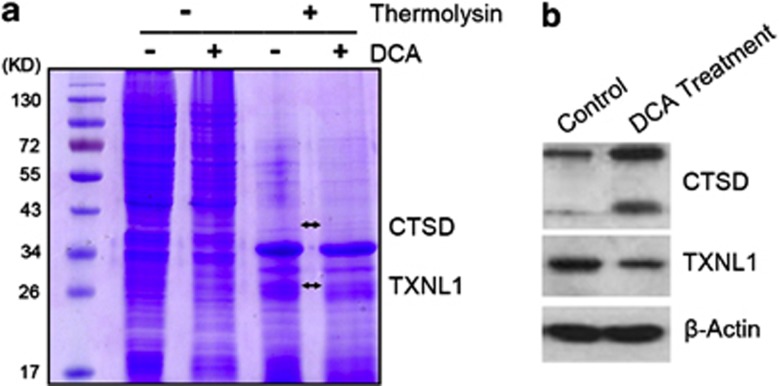
Dichloroacetate (DCA) is an inhibitor of pyruvate dehydrogenase kinase (PDK), and recently it has been shown as a promising nontoxic antineoplastic agent. In this study, we demonstrated that DCA could induce autophagy in LoVo cells, which were confirmed by the formation of autophagosomes, appearance of punctate patterns of LC3 immunoreactivity and activation of autophagy associated proteins. Moreover, autophagy inhibition by 3-methyladenine (3-MA) or Atg7 siRNA treatment can significantly enhance DCA-induced apoptosis. To determine the underlying mechanism of DCA-induced autophagy, target identification using drug affinity responsive target stability (DARTS) coupled with ESI-Q-TOF MS/MS analysis were utilized to profile differentially expressed proteins between control and DCA-treated LoVo cells. As a result, Cathepsin D (CTSD) and thioredoxin-like protein 1 (TXNL1) were identified with significant alterations compared with control. Further study indicated that DCA treatment significantly promoted abnormal reactive oxygen species (ROS) production. On the other hand, DCA-triggered autophagy could be attenuated by N-acetyl cysteine (NAC), a ROS inhibitor. Finally, we demonstrated that the Akt-mTOR signaling pathway, a major negative regulator of autophagy, was suppressed by DCA treatment. To our knowledge, it was the first study to show that DCA induced protective autophagy in LoVo cells, and the potential mechanisms were involved in ROS imbalance and Akt-mTOR signaling pathway suppression.
二氯乙酸(DCA)是丙酮酸脱氢酶激酶(PDK)的抑制剂,最近它被证明是一种有前途的无毒抗肿瘤药物。在这项研究中,我们证明 DCA 可以诱导 LoVo 细胞发生自噬,这可以通过自噬体的形成、LC3 免疫反应的点状模式的出现和自噬相关蛋白的激活来证实。此外,通过 3-甲基腺嘌呤(3-MA)或 Atg7 siRNA 处理抑制自噬可以显著增强 DCA 诱导的细胞凋亡。为了确定 DCA 诱导自噬的潜在机制,我们使用药物亲和反应靶标稳定性(DARTS)结合 ESI-Q-TOF MS/MS 分析来鉴定药物处理和未处理的 LoVo 细胞之间差异表达的蛋白质。结果表明,与对照组相比,组织蛋白酶 D(CTSD)和硫氧还蛋白样蛋白 1(TXNL1)的表达有显著变化。进一步的研究表明,DCA 处理显著促进了异常的活性氧(ROS)的产生。另一方面,ROS 抑制剂 N-乙酰半胱氨酸(NAC)可以减弱 DCA 触发的自噬。最后,我们证明 DCA 处理抑制了 Akt-mTOR 信号通路,这是自噬的主要负调控因子。据我们所知,这是第一项表明 DCA 在 LoVo 细胞中诱导保护性自噬的研究,其潜在机制涉及 ROS 失衡和 Akt-mTOR 信号通路的抑制。