Public Health England, HIV & STI Department, 61 Colindale Avenue, London NW9 5EQ, UK.
Public Health England, HIV & STI Department, 61 Colindale Avenue, London NW9 5EQ, UK.
Vaccine. 2013 Dec 17;32(1):26-32. doi: 10.1016/j.vaccine.2013.10.085. Epub 2013 Nov 6.
Reduction in the prevalence of vaccine type HPV infection in young women is an early indication of the impact of the HPV immunisation programme and a necessary outcome if the subsequent impact on cervical cancer is to be realised.
Residual vulva-vaginal swab (VVS) specimens from young women aged 16-24 years undergoing chlamydia screening in community sexual health services (formerly known as family planning clinics), general practice (GP), and youth clinics in 2010-2012 were submitted from 10 laboratories in seven regions around England. These specimens were linked to demographic and sexual behaviour data reported with the chlamydia test, anonymised, and tested for type-specific HPV DNA using a multiplex PCR and Luminex-based genotyping test. Estimated immunisation coverage was calculated and findings were compared to a baseline survey conducted prior to the introduction of HPV immunisation in 2008.
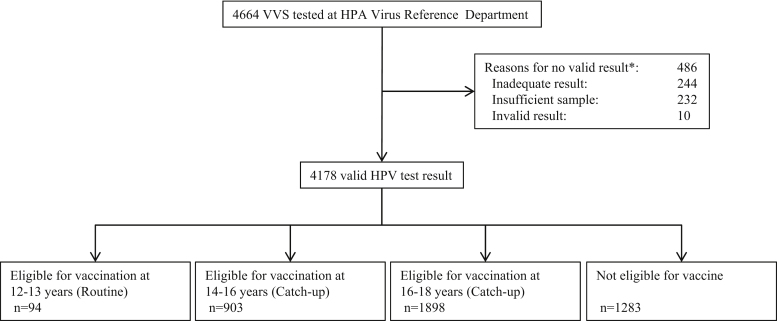
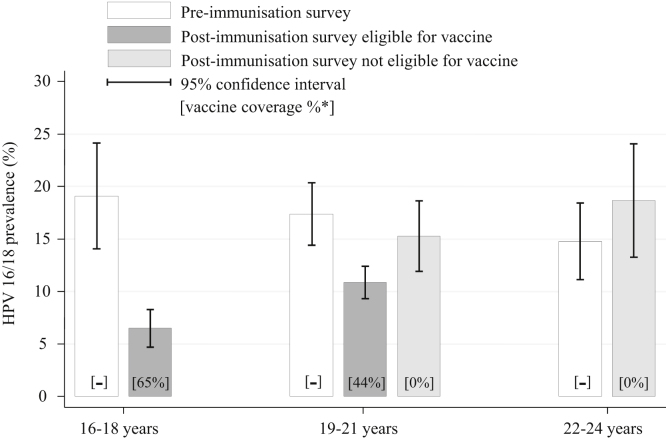
A total of 4664 eligible specimens were collected and 4178 had a valid test result. The post-immunisation prevalence of HPV 16/18 infection was lowest in this youngest age group (16-18 years) and increased with age. This increase with age was a reversal of the pattern seen prior to immunisation and was inversely associated with estimates of age-specific immunisation coverage (65% for 16-18 year olds). The prevalence of HPV 16/18 infection in the post-immunisation survey was 6.5% amongst 16-18 year olds, compared to 19.1% in the similar survey conducted prior to the introduction of HPV immunisation.
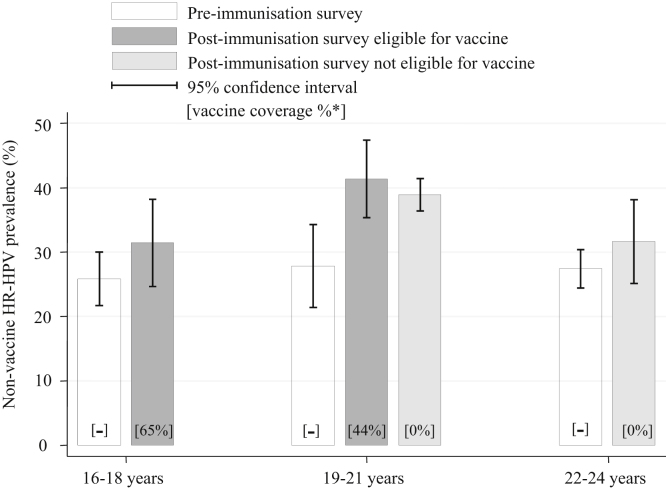
These findings are the first indication that the national HPV immunisation programme is successfully preventing HPV 16/18 infection in sexually active young women in England. The reductions seen suggest, for the estimated coverage, high vaccine effectiveness and some herd-protection benefits. Continued surveillance is needed to determine the effects of immunisation on non-vaccine HPV types.
年轻女性中疫苗型 HPV 感染率的降低是 HPV 免疫计划影响的早期指标,如果要实现对宫颈癌的后续影响,这也是必要的结果。
2010-2012 年,从英格兰 7 个地区的 10 个实验室收集了在社区性健康服务(原计划生育诊所)、全科医生(GP)和青年诊所接受衣原体筛查的 16-24 岁年轻女性的残留外阴阴道拭子(VVS)标本。这些标本与衣原体检测报告的人口统计学和性行为数据相关联,经过匿名处理,并使用多重 PCR 和基于 Luminex 的基因分型检测方法检测 HPV 特定类型的 DNA。计算了估计的免疫覆盖率,并将结果与 2008 年 HPV 免疫接种前进行的基线调查进行了比较。
共收集了 4664 份合格标本,其中 4178 份有有效检测结果。在这个最年轻的年龄组(16-18 岁)中,HPV 16/18 感染的疫苗接种后流行率最低,且随年龄增长而增加。这种随年龄增加的趋势与免疫接种前的模式相反,与年龄特异性免疫覆盖率的估计值呈负相关(16-18 岁人群为 65%)。在免疫接种后调查中,16-18 岁人群中 HPV 16/18 感染的流行率为 6.5%,而在 HPV 免疫接种前进行的类似调查中,流行率为 19.1%。
这些发现是 HPV 免疫计划成功预防英格兰性活跃年轻女性 HPV 16/18 感染的第一个迹象。所观察到的减少表明,对于估计的覆盖率,疫苗具有很高的有效性和一定的群体保护效益。需要继续进行监测,以确定免疫接种对非疫苗型 HPV 类型的影响。