Department of Pathology, University of Cambridge, Tennis Court Road, Cambridge CB2 1QP, UK.
Cavendish Laboratory, University of Cambridge, JJ Thomson Avenue, Cambridge CB3 OHE, UK.
Nature. 2013 Dec 12;504(7479):287-90. doi: 10.1038/nature12682. Epub 2013 Nov 10.
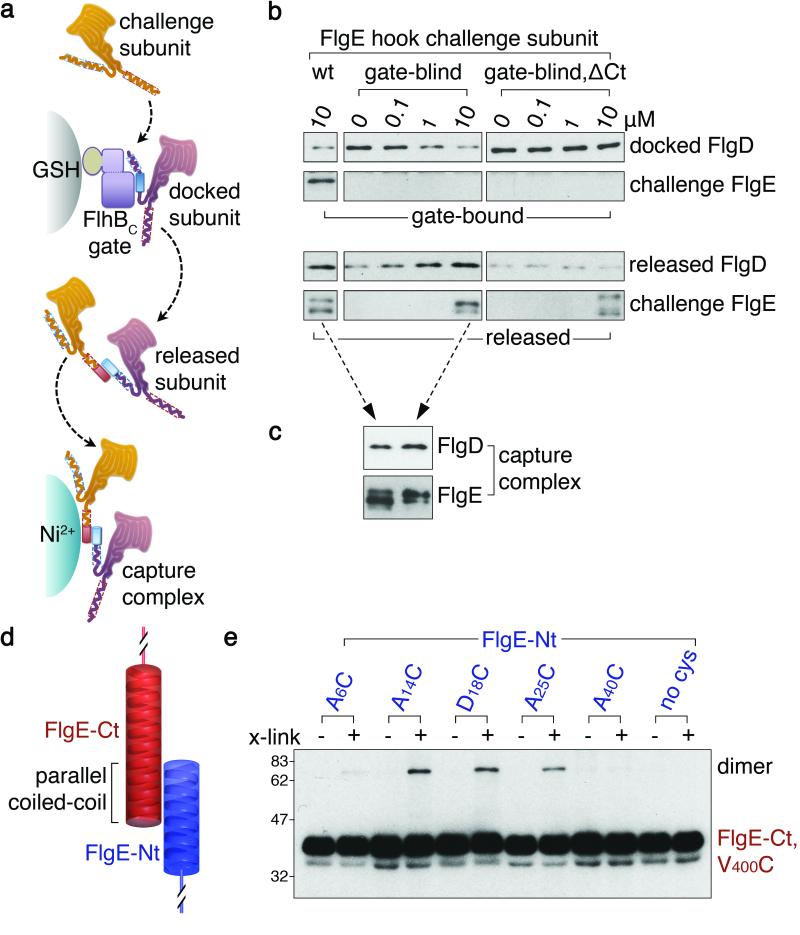
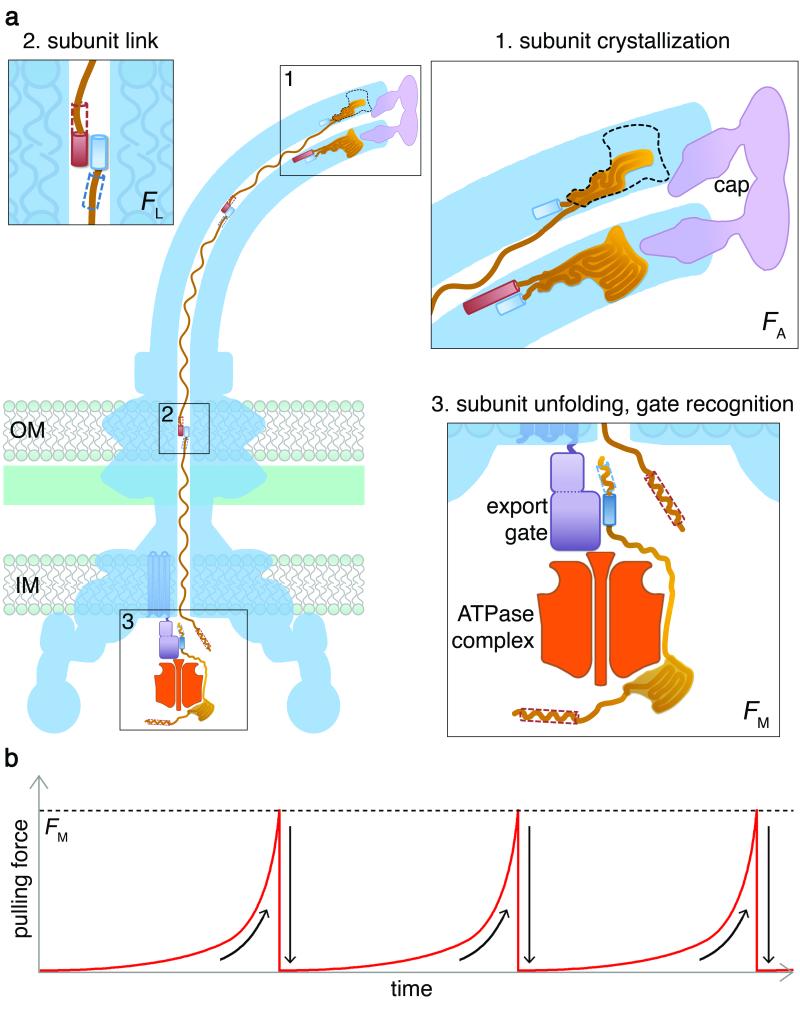
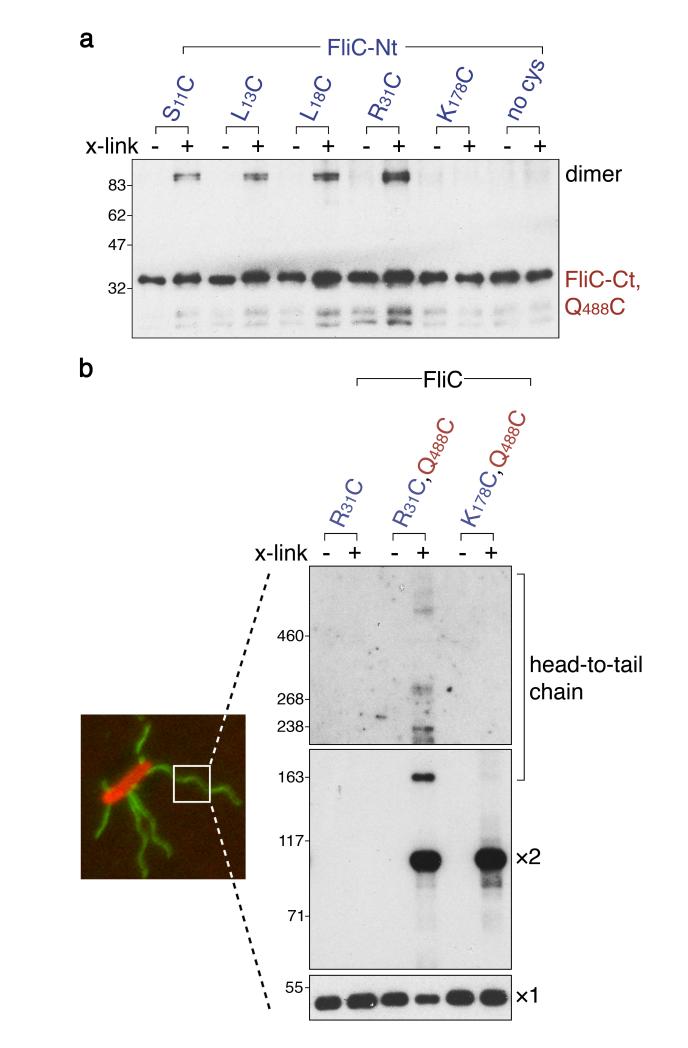
Bacteria swim by means of long flagella extending from the cell surface. These are assembled from thousands of protein subunits translocated across the cell membrane by an export machinery at the base of each flagellum. Unfolded subunits then transit through a narrow channel at the core of the growing flagellum to the tip, where they crystallize into the nascent structure. As the flagellum lengthens outside the cell, the rate of flagellum growth does not change. The mystery is how subunit transit is maintained at a constant rate without a discernible energy source in the channel of the external flagellum. We present evidence for a simple physical mechanism for flagellum growth that harnesses the entropic force of the unfolded subunits themselves. We show that a subunit docked at the export machinery can be captured by a free subunit through head-to-tail linkage of juxtaposed amino (N)- and carboxy (C)-terminal helices. We propose that sequential rounds of linkage would generate a multisubunit chain that pulls successive subunits into and through the channel to the flagellum tip, and by isolating filaments growing on bacterial cells we reveal the predicted chain of head-to-tail linked subunits in the transit channel of flagella. Thermodynamic analysis confirms that links in the subunit chain can withstand the pulling force generated by rounds of subunit crystallization at the flagellum tip, and polymer theory predicts that as the N terminus of each unfolded subunit crystallizes, the entropic force at the subunit C terminus would increase, rapidly overcoming the threshold required to pull the next subunit from the export machinery. This pulling force would adjust automatically over the increasing length of the growing flagellum, maintaining a constant rate of subunit delivery to the tip.
细菌通过从细胞表面伸出的长鞭毛游动。这些鞭毛由数千个蛋白质亚基组成,这些亚基通过位于每个鞭毛底部的出口机制穿过细胞膜转运。然后,未折叠的亚基通过生长中的鞭毛核心的狭窄通道转移到顶端,在那里它们结晶成初生结构。随着鞭毛在细胞外伸长,鞭毛的生长速度不变。奥秘在于,在外部鞭毛的通道中没有可识别的能量源的情况下,如何以恒定的速度维持亚基转运。我们提出了一种简单的物理机制来解释鞭毛的生长,该机制利用了未折叠亚基本身的熵力。我们表明,位于出口机制处的亚基可以通过相邻的氨基(N)和羧基(C)末端螺旋的头对头连接被游离亚基捕获。我们提出,连续的连接回合将产生一个多亚基链,将后续亚基拉入并通过通道到达鞭毛顶端,并且通过分离在细菌细胞上生长的细丝,我们揭示了预测的在鞭毛转运通道中头对头连接的亚基链。热力学分析证实,亚基链中的连接可以承受在鞭毛顶端进行的亚基结晶产生的拉力,并且聚合物理论预测,随着每个未折叠亚基的 N 末端结晶,亚基 C 末端的熵力会增加,迅速克服从出口机制中拉动下一个亚基所需的阈值。这种拉力会自动调整随着生长中的鞭毛的增加长度,保持向顶端输送亚基的恒定速率。