Nephrian Inc., 870 Paseo Santa Cruz, Thousand Oaks, CA, 91320-6779, USA,
Clin Drug Investig. 2014 Feb;34(2):107-15. doi: 10.1007/s40261-013-0151-4.
The IMPACT SHPT [Improved Management of Intact Parathyroid Hormone (iPTH) with Paricalcitol-Centered Therapy Versus Cinacalcet Therapy with Low-Dose Vitamin D in Hemodialysis Patients with Secondary Hyperparathyroidism] study compared the effectiveness of paricalcitol and cinacalcet in the management of secondary hyperparathyroidism in haemodialysis patients but did not report the costs or cost effectiveness of these treatments.
The aim of this study was to compare the cost effectiveness of a paricalcitol-based regimen versus cinacalcet with low-dose vitamin D for management of secondary hyperparathyroidism in haemodialysis patients from a US payer perspective, using a 1-year time horizon.
This was a post hoc cost-effectiveness analysis of data collected for US patients enrolled in the IMPACT SHPT study-a 28-week, randomized, open-label, phase 4, multinational study (ClinicalTrials.gov identifier: NCT00977080). Patients eligible for the IMPACT SHPT study were aged≥18 years with stage 5 chronic kidney disease, had been receiving maintenance haemodialysis three times weekly for at least 3 months before screening and were to continue haemodialysis during the study. Only US patients who reached the evaluation period (weeks 21-28) were included in this secondary analysis. US subjects in the IMPACT SHPT study were randomly assigned to receive intravenous paricalcitol, or oral cinacalcet plus fixed-dose intravenous doxercalciferol, for 28 weeks. Patients in the paricalcitol group could also receive supplemental cinacalcet for hypercalcaemia. The primary effectiveness endpoint in the IMPACT SHPT study was the proportion of subjects who achieved a mean intact parathyroid hormone (iPTH) level of 150-300 pg/mL during the evaluation period. In this secondary analysis, we estimated the incremental cost-effectiveness ratio (ICER), comparing paricalcitol-treated patients with cinacalcet-treated patients on the basis of this primary endpoint and several secondary endpoints. Costs were estimated by examining the dosage of the study drug (paricalcitol or cinacalcet) and phosphate binders used by each participant during the trial. Nonparametric bootstrap analysis was used to examine the accuracy of the ICER point estimates.
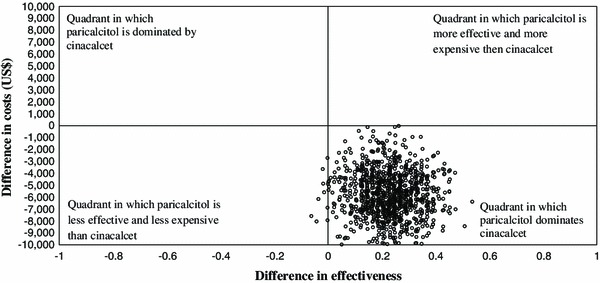
The percentages of patients achieving the treatment goal of a mean iPTH level between 150-300 pg/mL during weeks 21-28 of therapy were 56.9% in the paricalcitol group and 34.0% in the cinacalcet group (a difference of 23%, p=0.0235). Paricalcitol was also more effective for each of the secondary endpoints. When annualized, the total drug costs were US$10,153 in the paricalcitol group and US$15,967 in the cinacalcet group, a difference of US$5,814 (57.3%, p=0.0053). Because the paricalcitol-based treatment was less expensive and more effective, it was 'dominant', compared with cinacalcet, in this cost-effectiveness analyses. In our bootstrap analysis, 99.1% of bootstrap replicates for the ICER of the primary endpoint fell within the lower right quadrant of the cost-effectiveness plane-where paricalcitol is considered dominant. For all of the other endpoints, paricalcitol was dominant in 100% of replicates.
On the basis of dosing and effectiveness data from US patients in the IMPACT SHPT study, we found that a regimen of intravenous paricalcitol was more cost effective than cinacalcet plus low-dose vitamin D in the management of iPTH in patients with SHPT requiring haemodialysis.
IMPACT SHPT 研究[甲状旁腺素完整制剂(iPTH)治疗中帕立骨化醇与西那卡塞联合低剂量维生素 D 对继发性甲状旁腺功能亢进症血液透析患者的影响]比较了帕立骨化醇和西那卡塞在治疗需要血液透析的继发性甲状旁腺功能亢进症患者中的有效性,但没有报告这些治疗的成本或成本效益。
本研究旨在从美国支付者的角度比较帕立骨化醇为基础的方案与西那卡塞联合低剂量维生素 D 治疗血液透析患者继发性甲状旁腺功能亢进症的成本效益,使用 1 年的时间范围。
这是一项基于 IMPACT SHPT 研究数据的事后成本效益分析-一项为期 28 周的随机、开放标签、4 期、多国研究(ClinicalTrials.gov 标识符:NCT00977080)。有资格参加 IMPACT SHPT 研究的患者年龄≥18 岁,患有终末期肾病 5 期,在筛选前至少接受每周 3 次维持性血液透析 3 个月,并在研究期间继续接受血液透析。只有达到评估期(第 21-28 周)的美国患者才包括在这项二次分析中。IMPACT SHPT 研究中的美国受试者被随机分配接受静脉内帕立骨化醇或口服西那卡塞加固定剂量静脉内 doxercalciferol,为期 28 周。帕立骨化醇组的患者也可以接受补充西那卡塞治疗高钙血症。IMPACT SHPT 研究的主要有效性终点是在评估期内达到平均 iPTH 水平 150-300 pg/mL 的患者比例。在这项二次分析中,我们根据这一主要终点和几个次要终点,估计了帕立骨化醇治疗组与西那卡塞治疗组的增量成本效益比(ICER)。成本是通过检查每位参与者在试验期间使用的研究药物(帕立骨化醇或西那卡塞)和磷酸盐结合剂的剂量来估计的。非参数引导分析用于检查 ICER 点估计的准确性。
在治疗的第 21-28 周,帕立骨化醇组有 56.9%的患者达到平均 iPTH 水平在 150-300 pg/mL 的治疗目标,而西那卡塞组为 34.0%(差异为 23%,p=0.0235)。帕立骨化醇对每个次要终点也更有效。当按年计算时,帕立骨化醇组的总药物成本为 10153 美元,西那卡塞组为 15967 美元,差异为 5814 美元(57.3%,p=0.0053)。由于帕立骨化醇治疗方案更便宜且更有效,与西那卡塞相比,它在这项成本效益分析中是“优势”的。在我们的引导分析中,主要终点的 ICER 的 99.1%的引导复制落在成本效益平面的右下象限-帕立骨化醇被认为是优势的。对于所有其他终点,帕立骨化醇在 100%的复制中都是优势的。
根据 IMPACT SHPT 研究中美国患者的用药和有效性数据,我们发现帕立骨化醇方案在需要血液透析的继发性甲状旁腺功能亢进症患者的 iPTH 管理中比西那卡塞联合低剂量维生素 D 更具成本效益。
