Nagarajan Mahesh B, Huber Markus B, Schlossbauer Thomas, Leinsinger Gerda, Krol Andrzej, Wismüller Axel
Departments of Imaging Sciences and Biomedical Engineering, University of Rochester, Rochester NY 14627, USA.
J Med Biol Eng. 2013 Jan 1;33(1). doi: 10.5405/jmbe.1183.
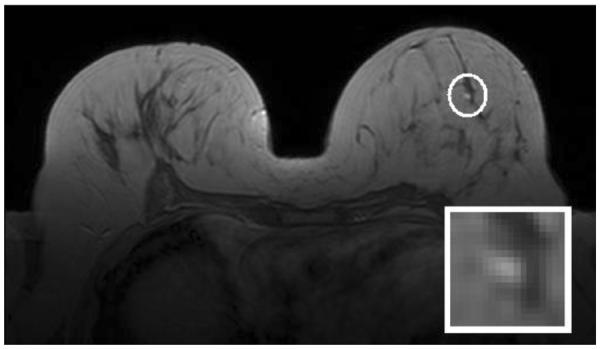
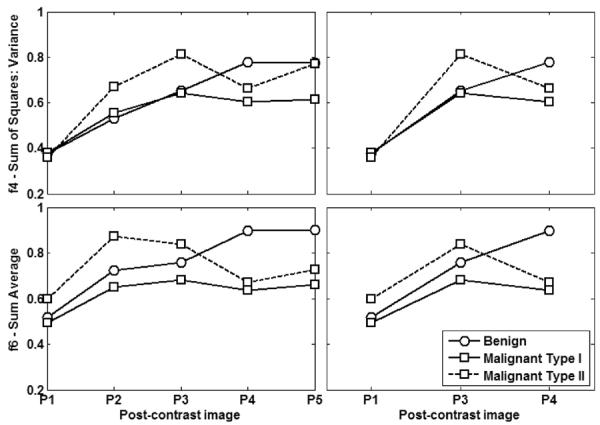
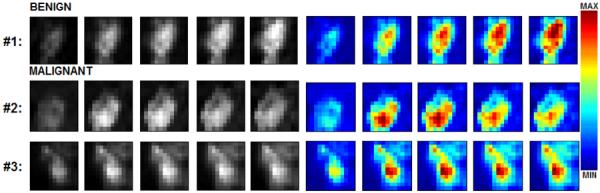
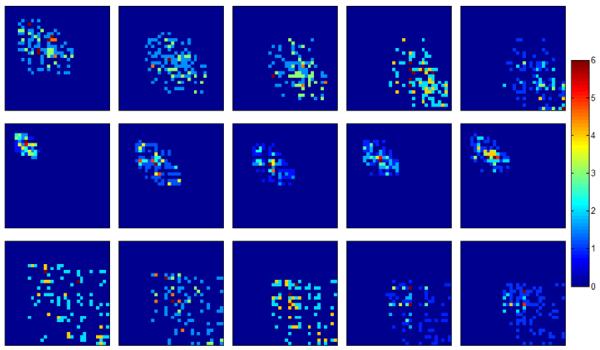
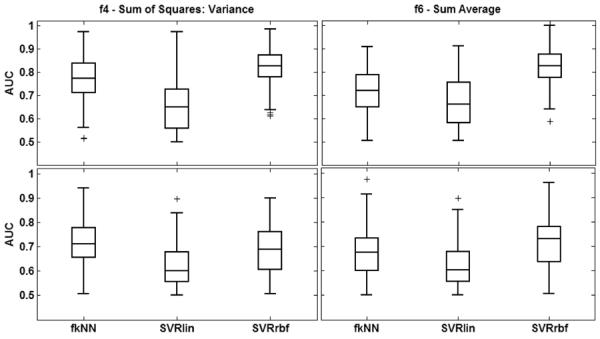
Dynamic texture quantification, i.e., extracting texture features from the lesion enhancement pattern in all available post-contrast images, has not been evaluated in terms of its ability to classify small lesions. This study investigates the classification performance achieved with texture features extracted from all five post-contrast images of lesions (mean lesion diameter of 1.1 cm) annotated in dynamic breast magnetic resonance imaging exams. Sixty lesions are characterized dynamically using Haralick texture features. The texture features are then used in a classification task with support vector regression and a fuzzy k-nearest neighbor classifier; free parameters of these classifiers are optimized using random sub-sampling cross-validation. Classifier performance is determined through receiver-operator characteristic (ROC) analysis, specifically through computation of the area under the ROC curve (AUC). Mutual information is used to evaluate the contribution of texture features extracted from different post-contrast stages to classifier performance. Significant improvements (p < 0.05) are observed for six of the thirteen texture features when the lesion enhancement pattern is quantified using the proposed approach of dynamic texture quantification. The highest AUC value observed (0.82) is achieved with texture features responsible for capturing aspects of lesion heterogeneity. Mutual information analysis reveals that texture features extracted from the third and fourth post-contrast images contributed most to the observed improvement in classifier performance. These results show that the performance of automated character classification with small lesions can be significantly improved through dynamic texture quantification of the lesion enhancement pattern.
动态纹理量化,即从所有可用的增强后图像中的病变增强模式中提取纹理特征,尚未就其对小病变进行分类的能力进行评估。本研究调查了从动态乳腺磁共振成像检查中标注的病变(平均病变直径为1.1厘米)的所有五幅增强后图像中提取的纹理特征所实现的分类性能。使用哈氏纹理特征对60个病变进行动态特征描述。然后将纹理特征用于支持向量回归和模糊k近邻分类器的分类任务;使用随机子采样交叉验证对这些分类器的自由参数进行优化。通过接收者操作特征(ROC)分析,特别是通过计算ROC曲线下面积(AUC)来确定分类器性能。互信息用于评估从不同增强后阶段提取的纹理特征对分类器性能的贡献。当使用所提出的动态纹理量化方法对病变增强模式进行量化时,13个纹理特征中的6个有显著改善(p < 0.05)。观察到的最高AUC值(0.82)是通过负责捕捉病变异质性方面的纹理特征实现的。互信息分析表明,从第三和第四幅增强后图像中提取的纹理特征对观察到的分类器性能改善贡献最大。这些结果表明,通过对病变增强模式进行动态纹理量化,可以显著提高小病变自动特征分类的性能。