Yang Chih-Chang, Lin Cheng-Yu, Wang Hwai-Shi, Lyu Shaw-Ruey
Department of Anatomy, National Yang-Ming University, Taipei, Taiwan, R.O.C.
PLoS One. 2013 Nov 4;8(11):e79662. doi: 10.1371/journal.pone.0079662. eCollection 2013.
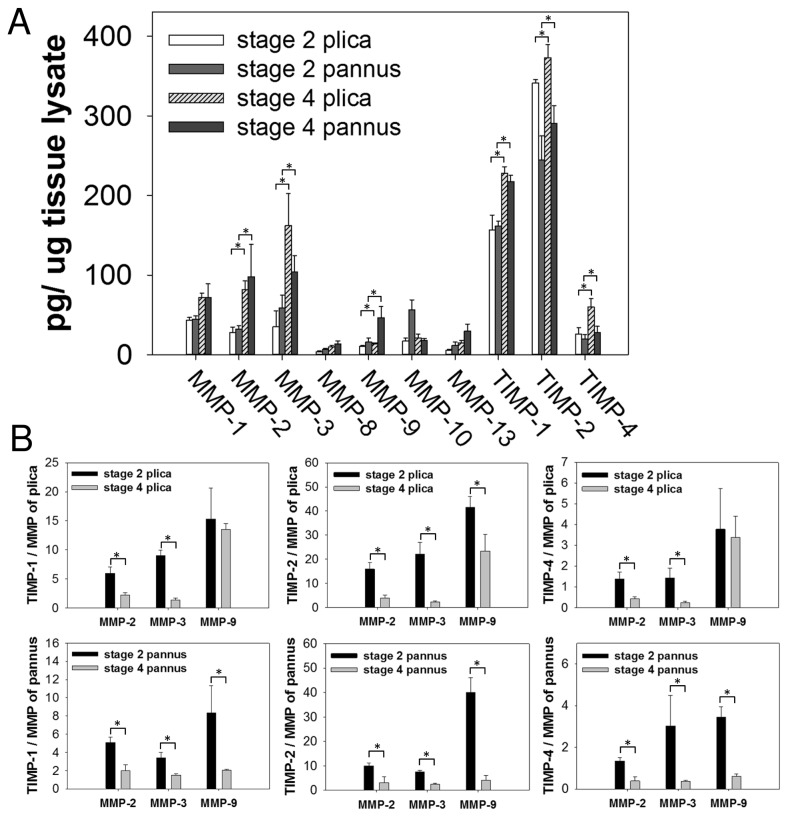
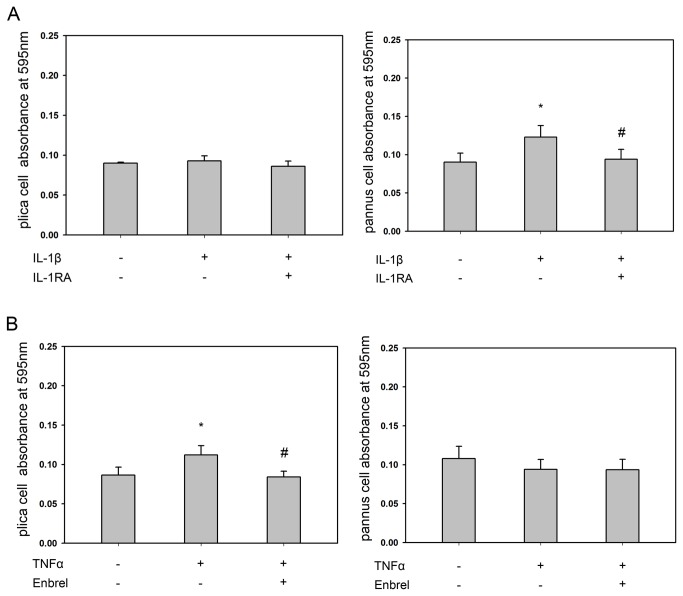
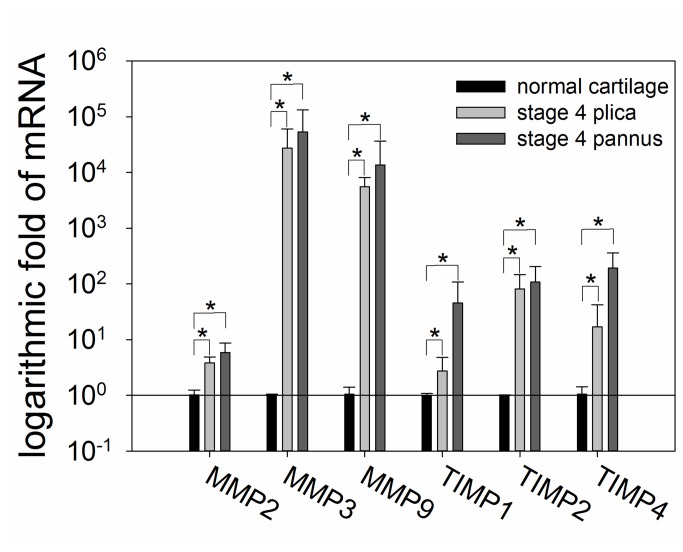
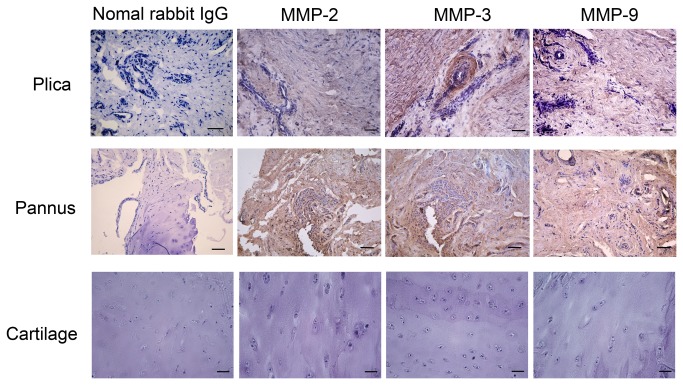
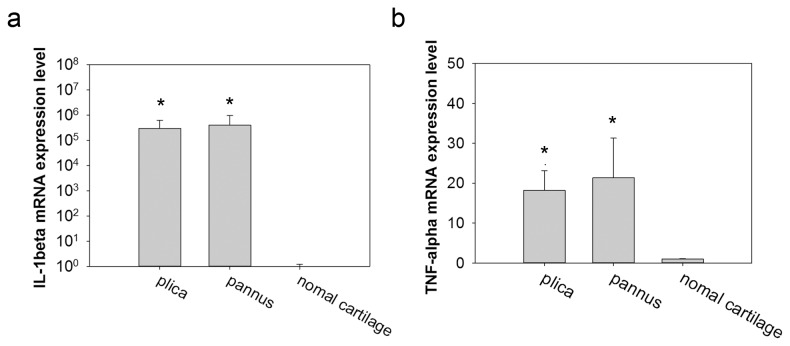
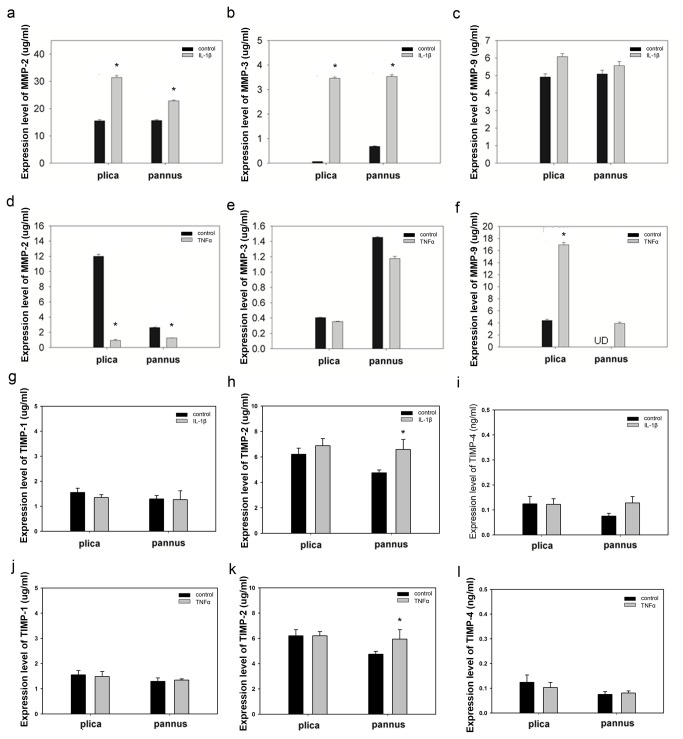
Osteoarthritis (OA) is characterized by degradation of the cartilage matrix, leading to pathologic changes in the joints. However, the pathogenic effects of synovial tissue inflammation on OA knees are not clear. To investigate whether the inflammation caused by the medial plica is involved in the pathogenesis of osteoarthritis, we examined the expression of matrix metalloproteinases (MMPs), tissue inhibitors of metalloproteinases (TIMPs), interleukin (IL)-1β, and tumor necrosis factor (TNF)-α in the medial plica and pannus-like tissue in the knees of patients with medial compartment OA who underwent either arthroscopic medial release (stage II; 15 knee joints from 15 patients) or total knee replacement (stage IV; 18 knee joints from 18 patients). MMP-2, MMP-3, MMP-9, IL-1β, and TNF-α mRNA and protein levels measured, respectively, by quantitative real-time PCR and Quantibody human MMP arrays, were highly expressed in extracts of medial plica and pannus-like tissue from stage IV knee joints. Immunohistochemical staining also demonstrated high expression of MMP-2, MMP-3, and MMP-9 in plica and pannus-like tissue of stage IV OA knees and not in normal cartilage. Some TIMP/MMP ratios decreased significantly in both medial plica and pannus-like tissue as disease progressed from stage II to stage IV. Furthermore, the migration of cells from the pannus-like tissue was enhanced by IL-1β, while plica cell migration was enhanced by TNF-α. The results suggest that medial plica and pannus-like tissue may be involved in the process of cartilage degradation in medial compartment OA of the knee.
骨关节炎(OA)的特征是软骨基质降解,导致关节发生病理变化。然而,滑膜组织炎症对OA膝关节的致病作用尚不清楚。为了研究内侧皱襞引起的炎症是否参与骨关节炎的发病机制,我们检测了接受关节镜下内侧松解术(II期;15例患者的15个膝关节)或全膝关节置换术(IV期;18例患者的18个膝关节)的内侧间室OA患者膝关节内侧皱襞和血管翳样组织中基质金属蛋白酶(MMPs)、金属蛋白酶组织抑制剂(TIMPs)、白细胞介素(IL)-1β和肿瘤坏死因子(TNF)-α的表达。分别通过定量实时PCR和定量抗体人MMP阵列检测的MMP-2、MMP-3、MMP-9、IL-1β和TNF-α的mRNA和蛋白水平,在IV期膝关节内侧皱襞和血管翳样组织提取物中高表达。免疫组织化学染色也显示IV期OA膝关节的皱襞和血管翳样组织中MMP-2、MMP-3和MMP-9高表达,而正常软骨中不表达。随着疾病从II期发展到IV期,内侧皱襞和血管翳样组织中的一些TIMP/MMP比值显著降低。此外,IL-1β增强了血管翳样组织中细胞的迁移,而TNF-α增强了皱襞细胞的迁移。结果表明,内侧皱襞和血管翳样组织可能参与膝关节内侧间室OA的软骨降解过程。