Arizona State University.
Dev Psychopathol. 2013 Nov;25(4 Pt 1):1137-53. doi: 10.1017/S0954579413000424.
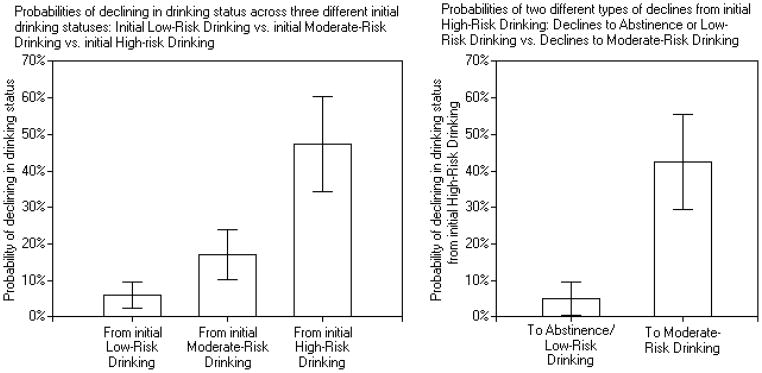
Research has shown a developmental process of "maturing out" of alcohol involvement beginning in young adulthood, but the precise nature of changes characterizing maturing out is unclear. We used latent transition analysis to investigate these changes in a high-risk sample from a longitudinal study of familial alcoholism (N = 844; 51% children of alcoholics; 53% male, 71% non-Hispanic Caucasian, 27% Hispanic). Analyses classified participants into latent drinking statuses during late adolescence (ages 17-22), young adulthood (ages 23-28), and adulthood (ages 29-40), and characterized transitions among these statuses over time. The resulting four statuses were abstainers, low-risk drinkers who typically drank less than weekly and rarely binged or showed drinking problems, moderate-risk drinkers who typically binged less than weekly and showed moderate risk for drinking problems, and high-risk drinkers who typically binged at least weekly and showed high risk for drinking problems. Maturing out between late adolescence and young adulthood was most common among initial high-risk drinkers, but they typically declined to moderate-risk drinking rather than to nonrisky drinking statuses. This suggests that the developmental phenomenon of maturing out pertains primarily to relatively high-risk initial drinkers and that many high-risk drinkers who mature out merely reduce rather than eliminate their risky drinking.
研究表明,酒精摄入的“成熟”过程始于成年早期,但成熟过程中特征变化的确切性质尚不清楚。我们使用潜在转变分析,对家族性酗酒纵向研究中的一个高风险样本(N=844;51%为酗酒者的子女;53%为男性,71%为非西班牙裔白种人,27%为西班牙裔)进行了这些变化的研究。分析将参与者分为青少年后期(17-22 岁)、成年早期(23-28 岁)和成年期(29-40 岁)的潜在饮酒状态,并描述了这些状态在时间上的转变。由此产生的四种状态是:不饮酒者、低风险饮酒者,通常每周饮酒少于一次,很少狂饮或出现饮酒问题;中度风险饮酒者,通常每周狂饮少于一次,且存在中度饮酒问题风险;高风险饮酒者,通常每周狂饮至少一次,且存在高饮酒问题风险。在青少年后期到成年早期之间,最初的高风险饮酒者最常见的是成熟,但是他们通常会下降到中度风险饮酒者,而不是非风险饮酒者。这表明成熟这一发展现象主要适用于相对高风险的初始饮酒者,许多成熟的高风险饮酒者只是减少而不是消除其危险饮酒行为。