Ekundi-Valentim Eduardo, Mesquita Filiphe Pn, Santos Karen T, de Paula Marco A Vieira, Florenzano Juliana, Zanoni Cristiane I, Rodrigues Leandro, de Nucci Gilberto, Teixeira Simone A, Ferreira Heloisa Ha, Wallace John L, Costa Soraia Kp, Muscará Marcelo N
Department of Pharmacology, Institute of Biomedical Sciences, University of Sao Paulo, Av, Prof, Lineu Prestes, 1524, São Paulo 05508-000, SP, Brazil.
Med Gas Res. 2013 Nov 16;3(1):24. doi: 10.1186/2045-9912-3-24.
Non-steroidal antiinflammatory drugs (NSAIDs) are the most commonly prescribed agents for arthritic patients, although gastric effects limit their long-term use. Considering the reported gastric safety of hydrogen sulfide (H2S)-releasing NSAIDs, in addition to the anti-inflammatory effects of H2S administration to rats with synovitis, we decided to evaluate the effects of the H2S-releasing naproxen derivative ATB-346 in this animal model.
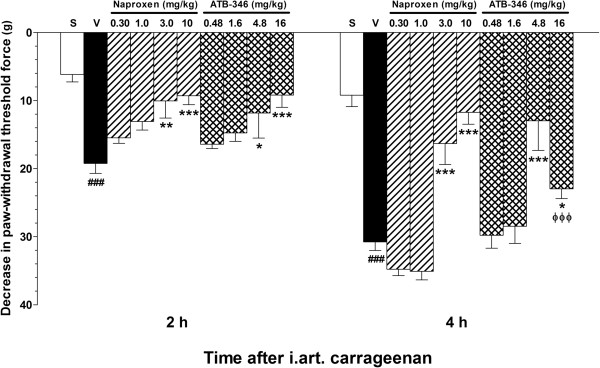
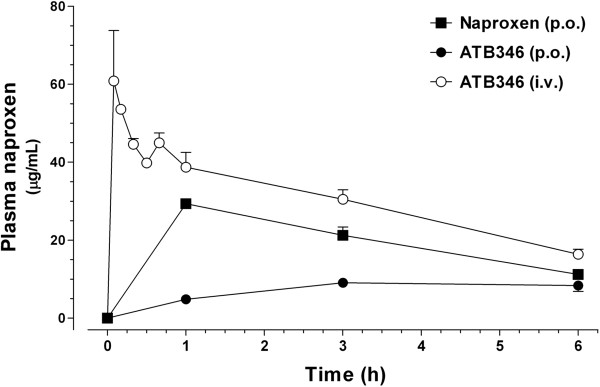
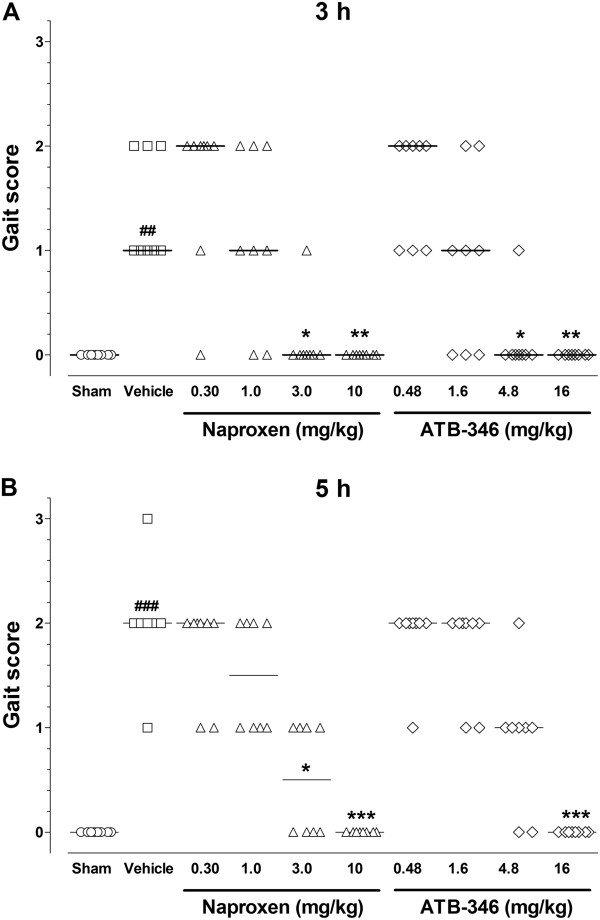
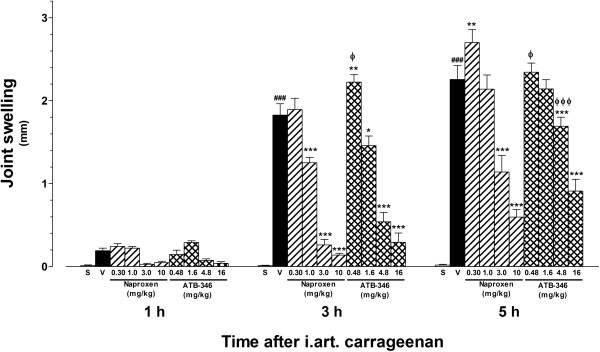
Male Wistar rats were anesthetized with inhalatory halothane and pre-treated with equimolar oral doses of either naproxen (0.3, 1, 3 or 10 mg/kg) or ATB-346 (0.48, 1.6, 4.8, or 16 mg/kg) 30 min before the i.art. injection of 7.5 mg of carrageenan (CGN) into the right knee joint cavity. Joint swelling and pain score were assessed after 1, 3 and 5 h, and tactile allodynia after 2 and 4 h. After the last measurement, the joint cavity lavages were performed for counting of the recruited leukocytes. The drugs (at the highest doses) were also tested for their gastric effects by evaluating macroscopical damage score and neutrophil recruitment (measured as myeloperoxidase - MPO activity) in the stomachs 5 h after administration of the drugs. In addition, the serum naproxen pharmacokinetic profiles of both compounds, administered at the highest equimolar doses, were obtained during the first 6 h after dosing.
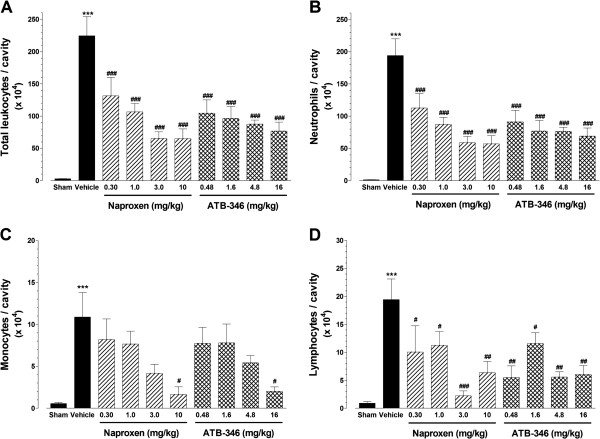
At the two highest tested doses, both naproxen and ATB-346 reduced edema and pain score (measured 3 and 5 h after CGN; P < 0.001). Tactile allodynia was similarly inhibited by ~45% 4 h after CGN by both naproxen (at 1, 3 and 10 mg/kg) and ATB-346 (at 1.6 and 4.8 mg/kg; P < 0.001), as well as leukocyte infiltration. Naproxen (but not ATB-346) induced significant gastric damage and, despite the increased gastric MPO activity by ~130% in the naproxen-, but not in the ATB-346-treated rats, this effect was of no statistical significance.
The presence of a H2S-releasing moiety in the ATB-346 structure does not impair the antiinflammatory activity of the parent compound in rats with CGN-induced synovitis. In addition, released H2S may account for the absence of deleterious gastric effects, thus making of ATB-346 a potentially useful therapeutic alternative to traditional naproxen for treatment of patients with arthritis.
非甾体抗炎药(NSAIDs)是关节炎患者最常用的处方药,但其胃肠道副作用限制了长期使用。鉴于已报道的释放硫化氢(H₂S)的NSAIDs的胃肠道安全性,以及向患滑膜炎的大鼠体内施用H₂S的抗炎作用,我们决定在该动物模型中评估释放H₂S的萘普生衍生物ATB - 346的作用。
雄性Wistar大鼠用吸入性氟烷麻醉,并在右膝关节腔内关节内注射7.5mg角叉菜胶(CGN)前30分钟,口服等摩尔剂量的萘普生(0.3、1、3或10mg/kg)或ATB - 346(0.48、1.6、4.8或16mg/kg)进行预处理。在1、3和5小时后评估关节肿胀和疼痛评分,在2和4小时后评估触觉异常性疼痛。在最后一次测量后,进行关节腔灌洗以计数募集的白细胞。还通过评估给药5小时后胃的宏观损伤评分和中性粒细胞募集(以髓过氧化物酶 - MPO活性衡量)来测试药物(最高剂量)的胃肠道作用。此外,在给药后的前6小时内获得两种化合物以最高等摩尔剂量给药后的血清萘普生药代动力学曲线。
在两个最高测试剂量下,萘普生和ATB - 346均降低了水肿和疼痛评分(在CGN注射后3和5小时测量;P < 0.001)。萘普生(1、3和10mg/kg)和ATB - 346(1.6和4.8mg/kg;P < 0.001)在CGN注射后4小时均类似地抑制了约45%的触觉异常性疼痛以及白细胞浸润。萘普生(而非ATB - 346)引起了明显的胃损伤,尽管萘普生处理组大鼠胃MPO活性增加了约130%,而ATB - 346处理组大鼠未增加,但这种作用无统计学意义。
ATB - 346结构中存在释放H₂S的部分并不损害其在CGN诱导的滑膜炎大鼠中母体化合物的抗炎活性。此外,释放的H₂S可能是其无有害胃肠道作用的原因,因此使ATB - 346成为治疗关节炎患者的传统萘普生的潜在有用治疗替代品。