Division of Hematology/Oncology, Department of Internal Medicine, Southwestern Medical Center, University of Texas, Dallas, TX, USA.
University of Michigan, Ann Arbor, MI, USA.
Oncogene. 2014 Nov 13;33(46):5379-90. doi: 10.1038/onc.2013.484. Epub 2013 Nov 18.
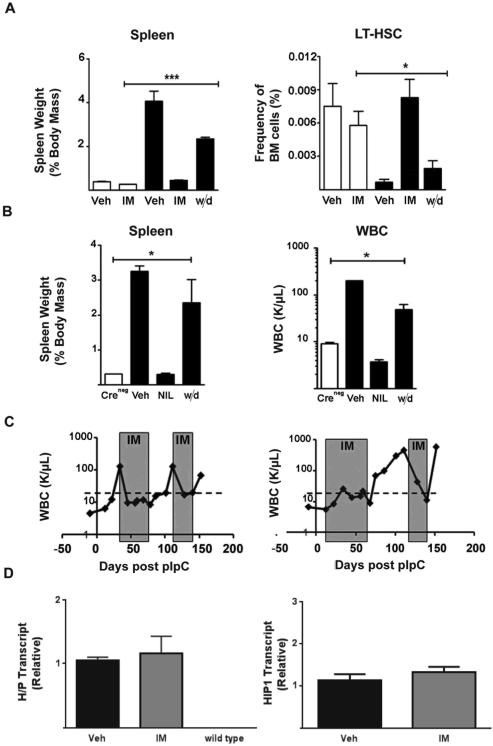
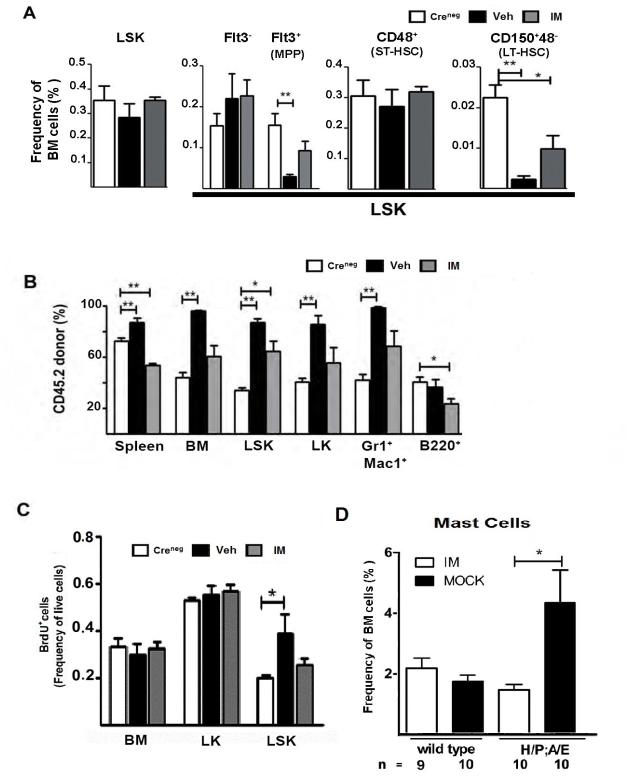
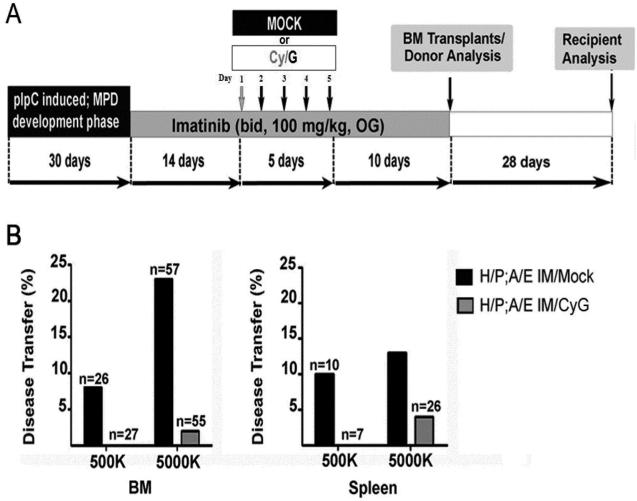
Myeloproliferative neoplasms (MPNs) such as chronic myelogenous (CML) and chronic myelomonocytic leukemias (CMML) are frequently induced by tyrosine kinase oncogenes. Although these MPNs are sensitive to tyrosine kinase inhibitors such as imatinib, patients often relapse upon withdrawal of therapy. We used a model of MPN, which is induced by co-expression of the oncoproteins HIP1/PDGFβR (H/P) and AML1/ETO from their endogenous loci, to examine the mechanisms of disease development and recurrence following imatinib withdrawal. Although the MPN displayed a full hematologic response to imatinib, 100% of the diseased mice relapsed upon drug withdrawal. MPN persistence was not due to imatinib resistance mutations in the H/P oncogene or massive gene expression changes. Within 1 week of imatinib treatment, more than 98% of gene expression changes induced by the oncogenes in isolated hematopoietic stem and progenitor cells (lineage(-)Sca-1(+)c-Kit(+) immunophenotype) normalized. Supplementation of imatinib with granulocyte colony-stimulating factor or arsenic trioxide reduced MPN-initiating cell frequencies and the combination of imatinib with arsenic trioxide cured a large fraction of mice with MPNs. In contrast, no mice in the imatinib-treated control cohorts were cured. These data suggest that treatment with a combination of arsenic trioxide and imatinib can eliminate refractory MPN-initiating cells and reduce disease relapse.
骨髓增殖性肿瘤(MPNs),如慢性髓性白血病(CML)和慢性髓单核细胞白血病(CMML),常由酪氨酸激酶癌基因诱导。尽管这些 MPNs 对伊马替尼等酪氨酸激酶抑制剂敏感,但患者在停药后常复发。我们使用一种由内源性位点表达的癌蛋白 HIP1/PDGFβR(H/P)和 AML1/ETO 共表达诱导的 MPN 模型,研究了伊马替尼停药后疾病发展和复发的机制。尽管 MPN 对伊马替尼表现出完全的血液学反应,但 100%的患病小鼠在停药后复发。MPN 的持续存在不是由于 H/P 癌基因中的伊马替尼耐药突变或大量基因表达变化。在伊马替尼治疗 1 周内,分离的造血干细胞和祖细胞(谱系(-)Sca-1(+)c-Kit(+)免疫表型)中由癌基因诱导的超过 98%的基因表达变化正常化。用粒细胞集落刺激因子或三氧化二砷补充伊马替尼可降低 MPN 起始细胞频率,并用三氧化二砷联合伊马替尼治疗可治愈很大一部分 MPN 小鼠。相比之下,伊马替尼治疗对照组中没有小鼠被治愈。这些数据表明,用三氧化二砷和伊马替尼联合治疗可以消除难治性 MPN 起始细胞并减少疾病复发。