Department of Entomology, Center for Pollinator Research, Center for Chemical Ecology, Huck Institutes of the Life Sciences, Pennsylvania State University, University Park, USA.
BMC Genomics. 2013 Nov 18;14(1):799. doi: 10.1186/1471-2164-14-799.
Chronic infections can profoundly affect the physiology, behavior, fitness and longevity of individuals, and may alter the organization and demography of social groups. Nosema apis and Nosema ceranae are two microsporidian parasites which chronically infect the digestive tract of honey bees (Apis mellifera). These parasites, in addition to other stressors, have been linked to increased mortality of individual workers and colony losses in this key pollinator species. Physiologically, Nosema infection damages midgut tissue, is energetically expensive and alters expression of immune genes in worker honey bees. Infection also accelerates worker transition from nursing to foraging behavior (termed behavioral maturation). Here, using microarrays, we characterized global gene expression patterns in adult worker honey bee midgut and fat body tissue in response to Nosema infection.
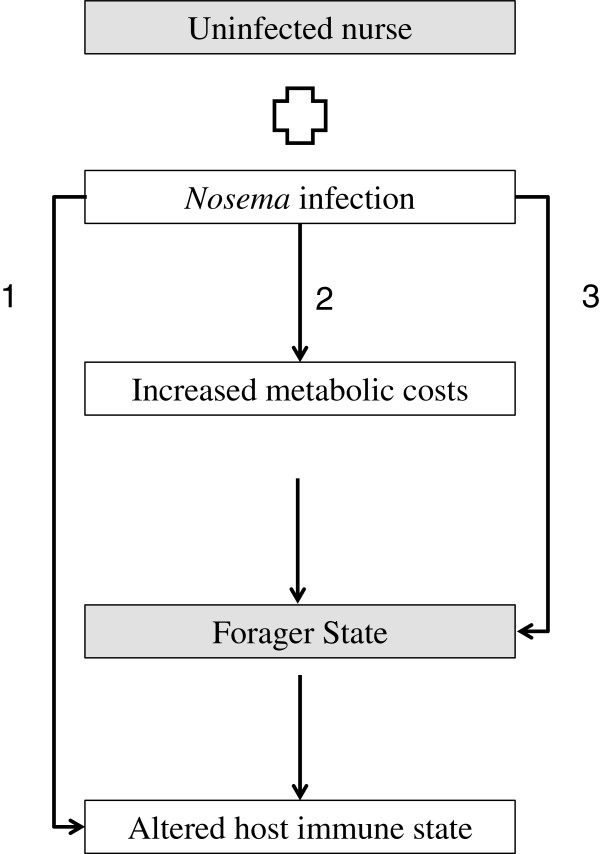
Our results indicate that N. apis infection in young workers (1 and 2 days old) disrupts midgut development. At 2 and 7 days post-infection in the fat body tissue, N. apis drives metabolic changes consistent with energetic costs of infection. A final experiment characterizing gene expression in the fat bodies of 14 day old workers parasitized with N. apis and N. ceranae demonstrated that Nosema co-infection specifically alters conserved nutritional, metabolic and hormonal pathways, including the insulin signaling pathway, which is also linked to behavioral maturation in workers. Interestingly, in all experiments, Nosema infection did not appear to significantly regulate overall expression of canonical immune response genes, but infection did alter expression of acute immune response genes identified in a previous study. Comparative analyses suggest that changes in nutritional/metabolic processes precede changes in behavioral maturation and immune processes.
These genome-wide studies of expression patterns can help us disentangle the direct and indirect effects of chronic infection, and understand the molecular pathways that regulate disease symptoms.
慢性感染会深刻影响个体的生理机能、行为、健康和寿命,并可能改变社会群体的组织和人口结构。蜜蜂微孢子虫(Nosema apis 和 Nosema ceranae)是两种慢性感染蜜蜂消化道的微孢子寄生虫。除了其他应激源之外,这些寄生虫与个体工蜂死亡率增加以及这种关键传粉媒介物种的蜂群损失有关。从生理上讲,感染微孢子虫会损害中肠组织,消耗大量能量,并改变工蜂免疫基因的表达。感染还会加速工蜂从护理到觅食行为的转变(称为行为成熟)。在这里,我们使用微阵列技术,研究了成年工蜂中肠和脂肪体组织对 Nosema 感染的全球基因表达模式。
我们的结果表明,年轻工蜂(1 天和 2 天龄)中 Nosema 感染会破坏中肠发育。在感染后 2 天和 7 天的脂肪体组织中,Nosema 感染会引起与感染能量成本一致的代谢变化。最后一项实验描述了感染 N. apis 和 N. ceranae 的 14 天龄工蜂脂肪体的基因表达,结果表明 Nosema 共感染特异性改变了保守的营养、代谢和激素途径,包括与工蜂行为成熟相关的胰岛素信号通路。有趣的是,在所有实验中,Nosema 感染似乎并没有显著调节经典免疫反应基因的整体表达,但感染确实改变了之前研究中鉴定的急性免疫反应基因的表达。比较分析表明,营养/代谢过程的变化先于行为成熟和免疫过程的变化。
这些全基因组表达模式研究可以帮助我们理清慢性感染的直接和间接影响,并了解调节疾病症状的分子途径。