Department of Adult Health, Cohn Bldg, Rm 344, Wayne State University, 5557 Cass Avenue, Detroit, MI 48202, USA.
Acta Neuropathol Commun. 2013 Sep 6;1:57. doi: 10.1186/2051-5960-1-57.
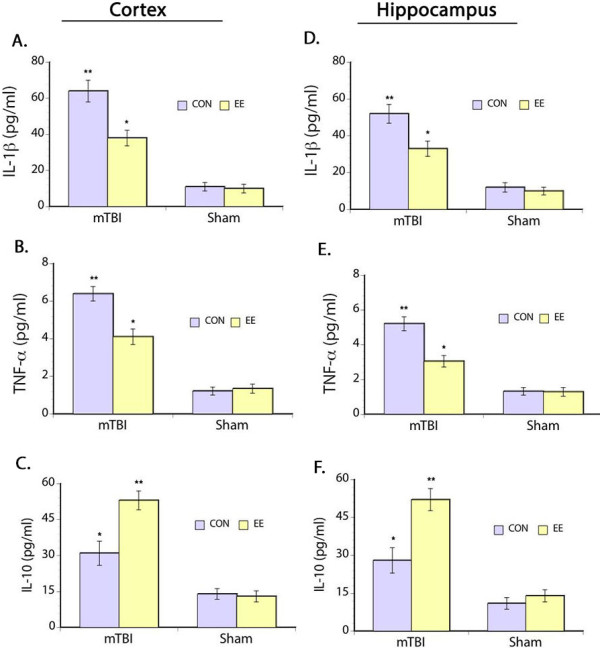
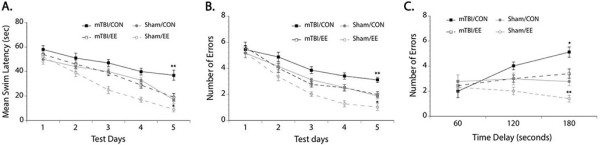
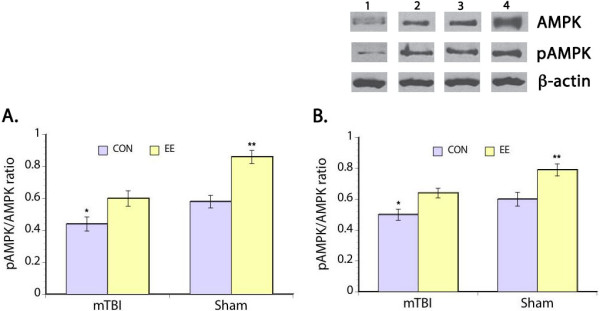
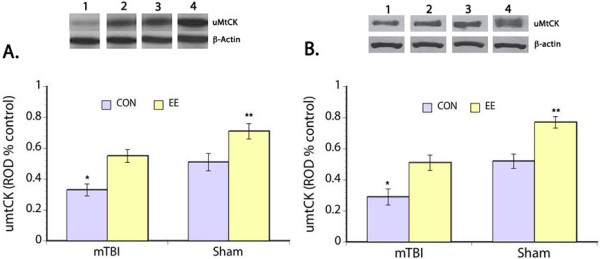
Persistent neuroinflammation and disruptions in brain energy metabolism is commonly seen in traumatic brain injury (TBI). Because of the lack of success of most TBI interventions and the documented benefits of environmental enrichment (EE) in enhancing brain plasticity, here we focused our study on use of EE in regulating injury-induced neuroinflammation and disruptions in energy metabolism in the prefrontal cortex and hippocampus. Adult male Wistar rats were used in the study and randomly assigned to receive either: mild TBI (mTBI) using the controlled cortical injury model or sham surgery. Following surgery, rats from each group were further randomized to either: EE housing or standard laboratory housing (CON). After 4 weeks of recovery, cognitive testing was performed using the non-matching-to-sample and delayed non-matching-to-sample tasks. After completion of behavioral testing, levels of the pro-inflammatory cytokines IL-1β and TNF-α and the anti-inflammatory cytokine IL-10 were measured. In addition, levels of AMPK (adenosine monophosphate-activated protein kinase), phosphorylated AMPK and uMtCK (ubiquitous mitochondrial creatine kinase) were assessed as measures of brain energy homeostasis.
Our results showed that EE: (1) decreased the pro-inflammatory cytokines IL-1β and TNF-α and enhanced levels of the anti-inflammatory cytokine IL-10 after mTBI; (2) mitigated mTBI-induced cognitive impairment; and (3) attenuated mTBI-induced downregulation in pAMPK/AMPK ratio and uMtCK levels.
Our data demonstrated the potential of EE to modulate the persistent: (1) neuroinflammatory response seen following mTBI, and (2) persistent disturbance in brain energy homeostasis. It is possible that through the mechanism of modulating neuroinflammation, EE housing was able to restore the disruption in energy metabolism and enhanced functional recovery after mTBI.
创伤性脑损伤(TBI)通常会出现持续的神经炎症和大脑能量代谢紊乱。由于大多数 TBI 干预措施的效果不佳,以及环境丰富(EE)在增强大脑可塑性方面的益处已得到证实,因此我们在此研究中专注于使用 EE 来调节前额叶皮层和海马体中的损伤诱导性神经炎症和能量代谢紊乱。研究使用成年雄性 Wistar 大鼠,随机分为接受轻度 TBI(mTBI)的组和接受假手术的组。手术后,每组大鼠进一步随机分为接受 EE 饲养或标准实验室饲养(CON)的组。在 4 周的恢复后,使用非匹配样本和延迟非匹配样本任务进行认知测试。完成行为测试后,测量促炎细胞因子 IL-1β和 TNF-α以及抗炎细胞因子 IL-10 的水平。此外,还评估了 AMPK(腺苷单磷酸激活蛋白激酶)、磷酸化 AMPK 和 uMtCK(普遍线粒体肌酸激酶)的水平,作为大脑能量平衡的指标。
我们的结果表明,EE:(1)降低 mTBI 后的促炎细胞因子 IL-1β和 TNF-α的水平,并增强抗炎细胞因子 IL-10 的水平;(2)减轻 mTBI 引起的认知障碍;(3)减轻 mTBI 诱导的 pAMPK/AMPK 比值和 uMtCK 水平的下调。
我们的数据表明,EE 具有调节以下方面的潜力:(1)mTBI 后持续存在的神经炎症反应,以及(2)大脑能量稳态的持续紊乱。通过调节神经炎症的机制,EE 饲养可能能够恢复能量代谢的紊乱,并增强 mTBI 后的功能恢复。