Department of Health and Welfare Service Research, National Institute of Public Health, Saitama 351-0197 2-3-6 Minami, Wako-shi, Japan.
Infect Dis Poverty. 2013 Nov 19;2(1):28. doi: 10.1186/2049-9957-2-28.
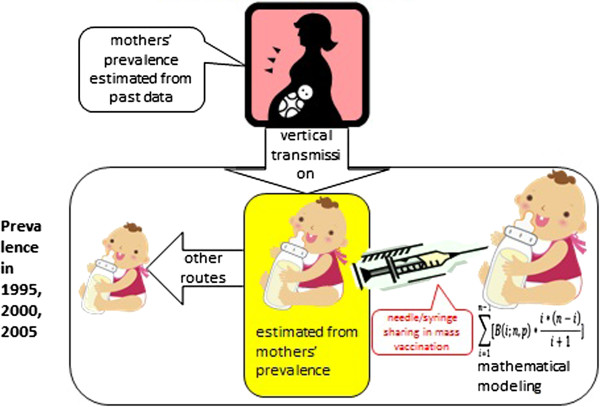
The Japanese Government settled a class litigation case with hepatitis B virus (HBV) carriers who claim to have been infected through needle/syringe sharing in childhood mass vaccination with a blanket compensation agreement. However, it is difficult to estimate how many of the present HBV carriers were infected horizontally from mass vaccination and how many were infected vertically from mothers.
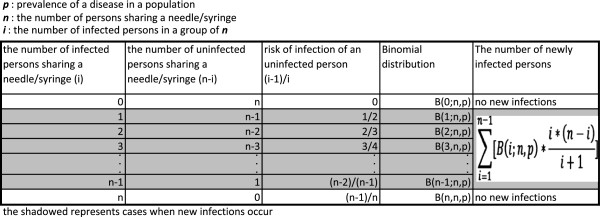
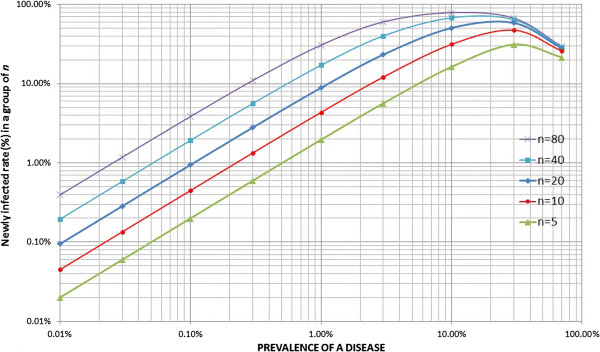
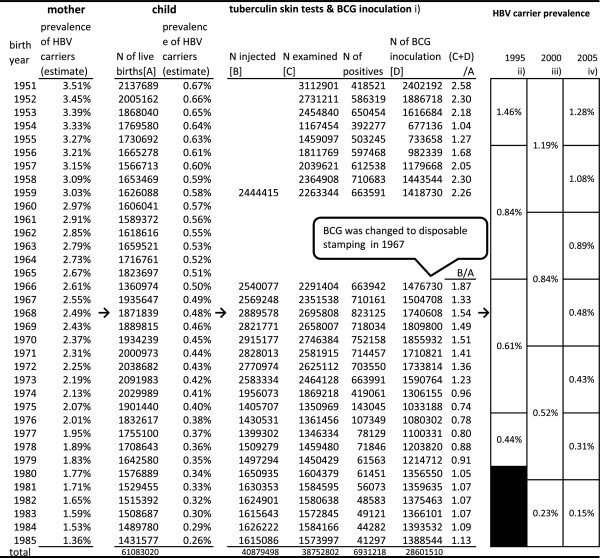
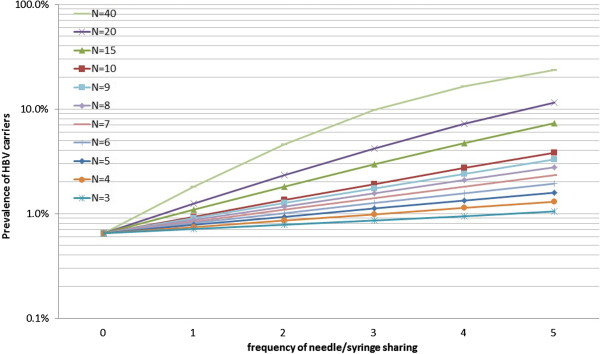
A mathematical model to predict the risk of infection through needle/syringe sharing in mass vaccination was proposed and a formula was developed. The formula was presented in a logarithmic graph enabling users to estimate how many people will be infected if a needle/syringe is shared by how many people for how many times under certain probability of infection. The formula was then applied to the historical data of mass tuberculin skin tests (TSTs) and BCG inoculation, from which a best estimate of how much needle/syringe sharing was practiced in different birth cohorts was determined.
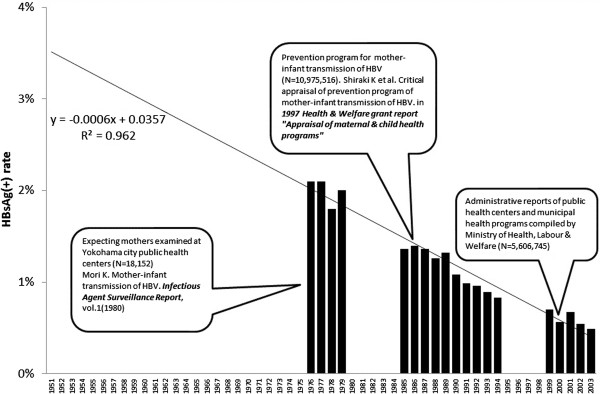
For the oldest cohort born between 1951 and 1955, the prevalence of HBV carriers-0.65% at birth through vertical transmission-more than doubled in 1995 (1.46%) through horizontal transmission. If the probability of infection through needle/syringe sharing is assumed to be 10%, it is theoretically likely that an average of five or more people shared a needle/syringe four times to achieve the prevalence of HBV carriers in 1995. However, for the youngest cohort born between 1981 and 1985, the effects of needle/syringe sharing were negligible because the later prevalence of HBV carriers was lower than the prevalence at birth.
More than half of the HBV carriers born in the early 1950s might have contracted the disease by mass vaccinations. Japan's experience needs to be shared with other countries as a caution in conducting mass vaccination programs under scarce needle/syringe supply (291 words).
日本政府与声称在儿童时期大规模接种乙肝疫苗时通过共用针头/注射器而感染乙肝病毒 (HBV) 的携带者达成了一项集体诉讼和解协议,给予了全面赔偿。然而,很难估计目前有多少 HBV 携带者是通过大规模接种疫苗而水平感染的,有多少是通过母婴垂直传播感染的。
提出了一种预测大规模疫苗接种中通过共用针头/注射器感染风险的数学模型,并开发了一个公式。该公式以对数图的形式呈现,使用户能够根据一定的感染概率,估算在一定次数下,有多少人共用一个针头/注射器时,会有多少人被感染。然后,将该公式应用于历史上大规模结核菌素皮肤试验(TST)和卡介苗接种的数据,确定了不同出生队列中实际共用针头/注射器的次数。
对于出生于 1951 年至 1955 年的最年长队列,通过垂直传播,乙肝病毒携带者的流行率在出生时为 0.65%,而在 1995 年通过水平传播则翻了一番(1.46%)。如果假设通过共用针头/注射器感染的概率为 10%,那么理论上平均有五人或更多人共用针头/注射器四次,就有可能达到 1995 年乙肝病毒携带者的流行率。然而,对于出生于 1981 年至 1985 年的最年轻队列,共用针头/注射器的影响可以忽略不计,因为后来乙肝病毒携带者的流行率低于出生时的流行率。
在 20 世纪 50 年代早期出生的乙肝病毒携带者中,有一半以上可能是通过大规模疫苗接种而感染的。日本的经验需要与其他国家分享,以提醒在注射器供应短缺的情况下进行大规模疫苗接种计划时需要谨慎(291 字)。