Safdar Nauman, Zahid Raana, Shah Sarwat, Cameron Ian, Fatima Razia, Qureshi Huma, Siddiqi Kamran
Social and Health Inequalities Network, 862, St 13-C, E-11/4, Islamabad, 44000 Pakistan.
Springerplus. 2013 Oct 24;2:556. doi: 10.1186/2193-1801-2-556. eCollection 2013.
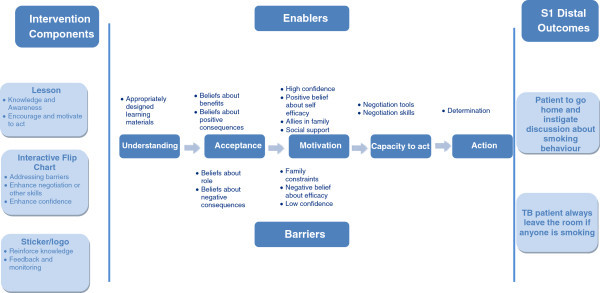
Living with a smoker is a key determinant of exposure to Second Hand Smoke (SHS) and its exposure mainly occurs at home. Exposure to SHS from tobacco in the household predisposes to the development of tuberculosis (TB) and outcome of the disease gets worse. We aim to develop and evaluate a behavioural intervention 'Smoke Free Homes' (SFH) for TB patients that encourages them to negotiate a smoke free environment within their homes.
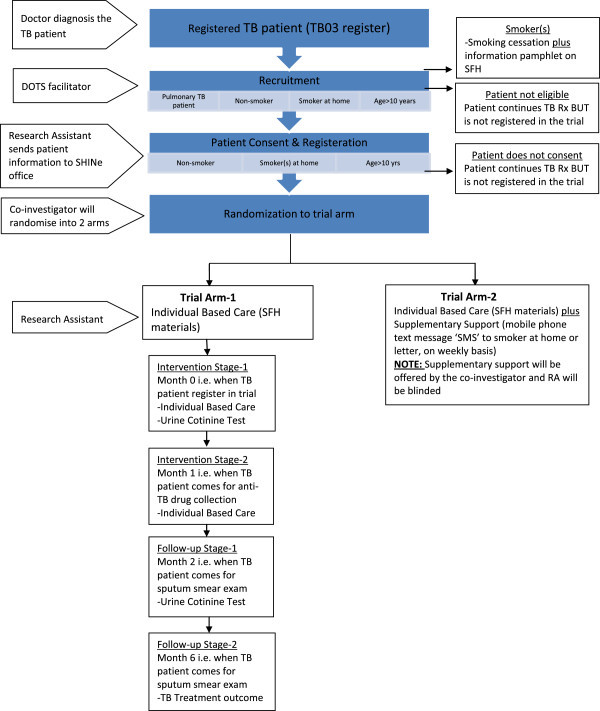
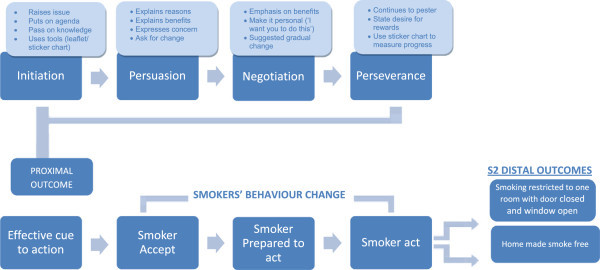
The pilot individual randomised controlled trial of SFH will inform the design of a future definitive trial. We will first develop SFH intervention using taxonomy of behaviour change techniques aimed at encouraging families of non-smoking TB patients to implement smoking restrictions at home following a logic model of the intervention. This will be followed by conducting a pilot randomised controlled trial of intervention within the context of routine TB control programme. The eligible non-smoking TB patients will be randomised and allocated to one of the two trial arms consisting of "individual based care" and "individual based care" plus "supplementary support". We aim to recruit 150 newly registered pulmonary TB patients from two selected TB centres with 75 cases in each arm. The Primary outcome measure will be SFH of non-smoker TB patient by validating through 'Urine Cotinine' test. We will also determine qualitatively the barriers and key drivers to the creation of smoke free homes followed by developing a definitive trial.
The male to female distribution of TB cases in Pakistan is almost equal whereas, tobacco use among males is much high as compared to females in Pakistan. This reflects a strong possibility that women health can be affected by men behaviour. Appropriate storage, restricted access and disposal arrangements for participant's personal details will be implemented. All ethical issues will be addressed. There will be no extra burden, financial or otherwise, on the participants. They will not receive any financial incentive to participate in the study.
ISRCTN83630841.
与吸烟者共同生活是接触二手烟(SHS)的关键决定因素,且这种接触主要发生在家中。家庭中接触烟草产生的二手烟会增加患结核病(TB)的风险,并且疾病的预后会更差。我们旨在为结核病患者开发并评估一种行为干预措施“无烟家庭”(SFH),鼓励他们在家中营造无烟环境。
SFH的初步个体随机对照试验将为未来的确定性试验设计提供依据。我们将首先利用行为改变技术分类法开发SFH干预措施,旨在鼓励非吸烟结核病患者的家庭按照干预逻辑模型在家中实施吸烟限制。接下来,将在常规结核病控制项目的背景下进行干预的初步随机对照试验。符合条件的非吸烟结核病患者将被随机分配到两个试验组之一,即“基于个体的护理”组和“基于个体的护理”加“补充支持”组。我们的目标是从两个选定的结核病中心招募150名新登记的肺结核患者,每组75例。主要结局指标将通过“尿可替宁”测试验证非吸烟结核病患者的无烟家庭情况。我们还将定性确定创建无烟家庭的障碍和关键驱动因素,随后开展确定性试验。
在巴基斯坦,结核病病例的男女分布几乎相等,然而,与女性相比,男性的烟草使用率要高得多。这反映出女性健康很可能受到男性行为影响的强烈可能性。将对参与者的个人详细信息实施适当的存储、限制访问和处理安排。将解决所有伦理问题。参与者不会有任何额外负担,无论是经济上还是其他方面。他们不会因参与研究而获得任何经济激励。
ISRCTN83630841。