Saito Kuniaki, Mukasa Akitake, Narita Yoshitaka, Tabei Yusuke, Shinoura Nobusada, Shibui Soichiro, Saito Nobuhito
Department of Neurosurgery, The University of Tokyo Hospital.
Neurol Med Chir (Tokyo). 2014;54(4):272-9. doi: 10.2176/nmc.oa2012-0441. Epub 2013 Nov 20.
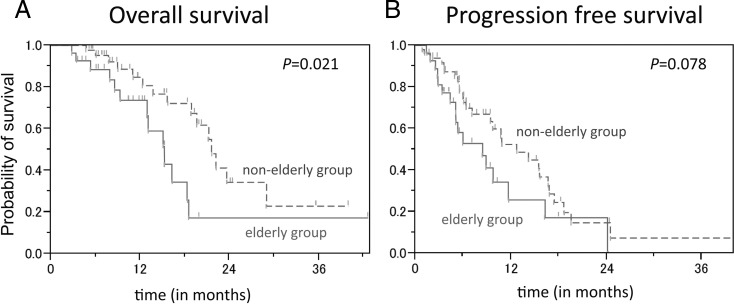
Radiation therapy with concomitant and adjuvant temozolomide (TMZ) is the standard therapy for nonelderly patients with glioblastoma. However, TMZ-based chemoradiotherapy for elderly patients with glioblastoma is controversial. The aim of this study was to investigate the benefits and adverse effects of this combined therapy in elderly patients with glioblastoma. Of the 76 newly diagnosed glioblastoma patients who were treated with standard radiotherapy (60 Gy/30 fractions) and TMZ, treatment toxicity and therapeutic outcome were evaluated in 27 elderly patients (age 65 years or older) and compared with those of 49 nonelderly counterparts (age younger than 65 years). The incidence of common toxicity criteria Grade 4 adverse events during the concomitant course was higher in the elderly group than that in the nonelderly group (26% versus 8%; p = 0.046). Cognitive dysfunction was observed only in the elderly group (p = 0.042). The median overall survival (OS) and median progression-free survival in the elderly group were 15.2 months (95% confidence interval [CI]; 12.9-18.5) and 8.4 months (95% CI; 5.1-11.7), respectively. OS was significantly shorter in the elderly group than in the nonelderly group (p = 0.021). The recursive partitioning analysis score was a prognostic factor for OS. TMZ-based chemoradiotherapy was associated with an increased risk of Grade 4 adverse events in the elderly patients during concomitant use. Thus, elderly patients who undergo a concomitant course of TMZ must be closely monitored for adverse events. Treatment of glioblastoma in elderly patients must be optimized to reduce toxicity to acceptable levels and to maintain efficacy.
同步和辅助使用替莫唑胺(TMZ)进行放射治疗是胶质母细胞瘤非老年患者的标准治疗方法。然而,基于TMZ的放化疗用于老年胶质母细胞瘤患者存在争议。本研究的目的是调查这种联合治疗对老年胶质母细胞瘤患者的益处和不良反应。在76例接受标准放疗(60 Gy/30次分割)和TMZ治疗的新诊断胶质母细胞瘤患者中,对27例老年患者(年龄65岁及以上)的治疗毒性和治疗结果进行了评估,并与49例非老年患者(年龄小于65岁)进行了比较。同步治疗期间老年组常见毒性标准4级不良事件的发生率高于非老年组(26%对8%;p = 0.046)。仅在老年组观察到认知功能障碍(p = 0.042)。老年组的中位总生存期(OS)和中位无进展生存期分别为15.2个月(95%置信区间[CI];12.9 - 18.5)和8.4个月(95% CI;5.1 - 11.7)。老年组的OS显著短于非老年组(p = 0.021)。递归划分分析评分是OS的一个预后因素。基于TMZ的放化疗在同步使用期间与老年患者发生4级不良事件的风险增加相关。因此,接受TMZ同步治疗的老年患者必须密切监测不良事件。老年胶质母细胞瘤患者的治疗必须进行优化,以将毒性降低到可接受水平并维持疗效。