The Laboratory for Molecular Infection Medicine Sweden (MIMS), Umeå Centre for Microbial Research (UCMR), Department of Molecular Biology, Umeå University, Umeå S-90187, Sweden, Helmholtz Centre for Infection Research, Department of Regulation in Infection Biology, Braunschweig D-38124, Germany, Deptartment of Biochemistry and Cell Biology, Max F. Perutz Laboratories, University of Vienna, Vienna A-1030, Austria, National Center for Biotechnology Information, National Library of Medicine, National Institutes of Health, Bethesda, MD 20894, USA and Hannover Medical School, Hannover D-30625, Germany.
Nucleic Acids Res. 2014 Feb;42(4):2577-90. doi: 10.1093/nar/gkt1074. Epub 2013 Nov 22.
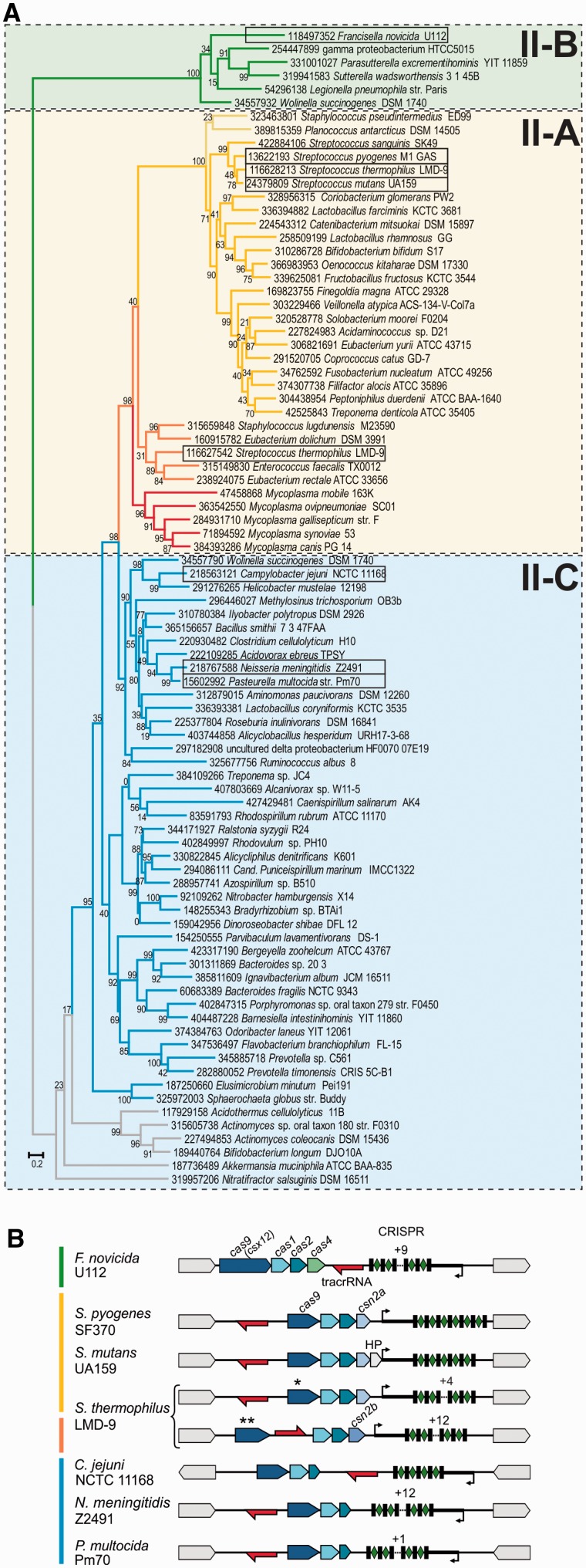
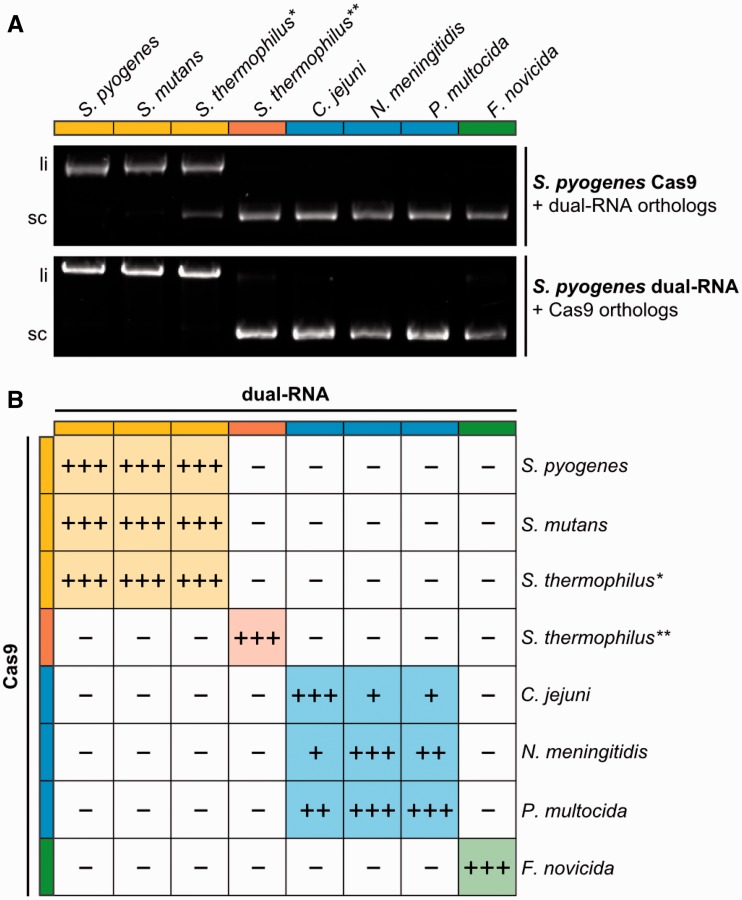
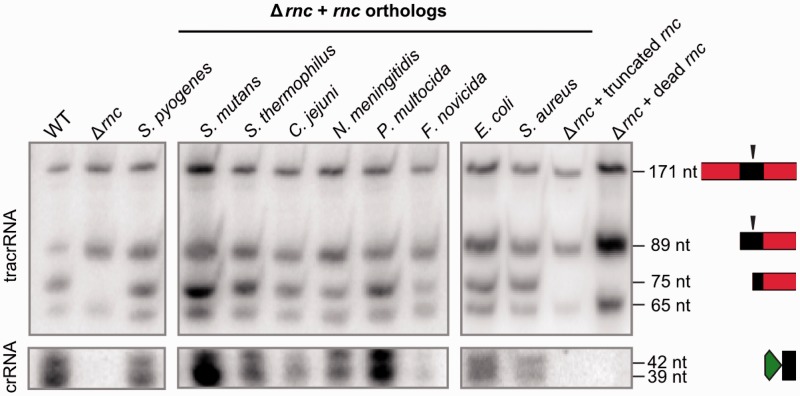
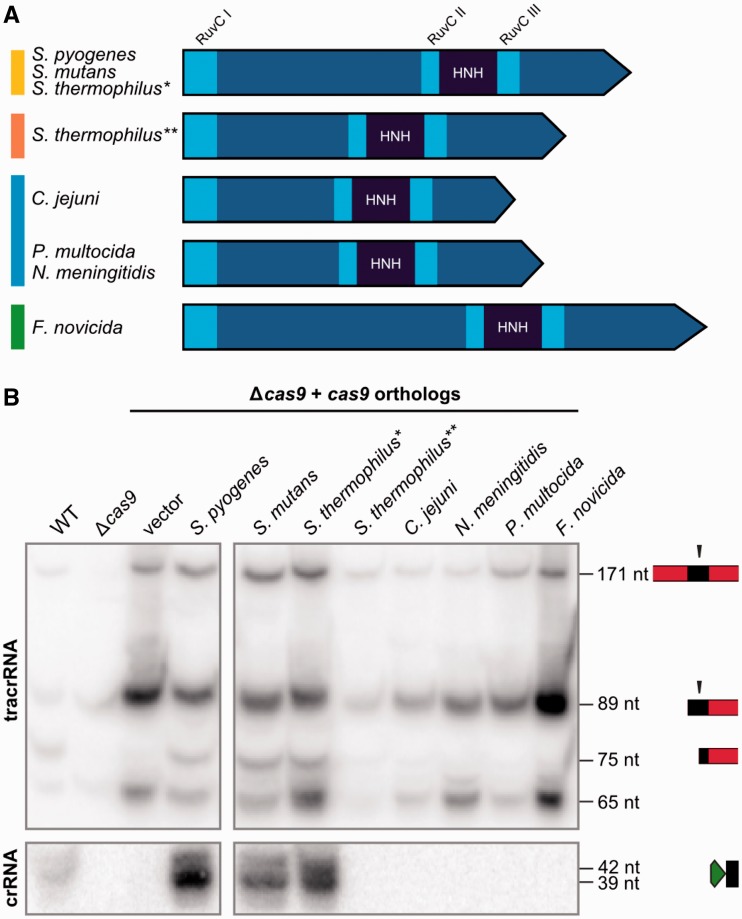
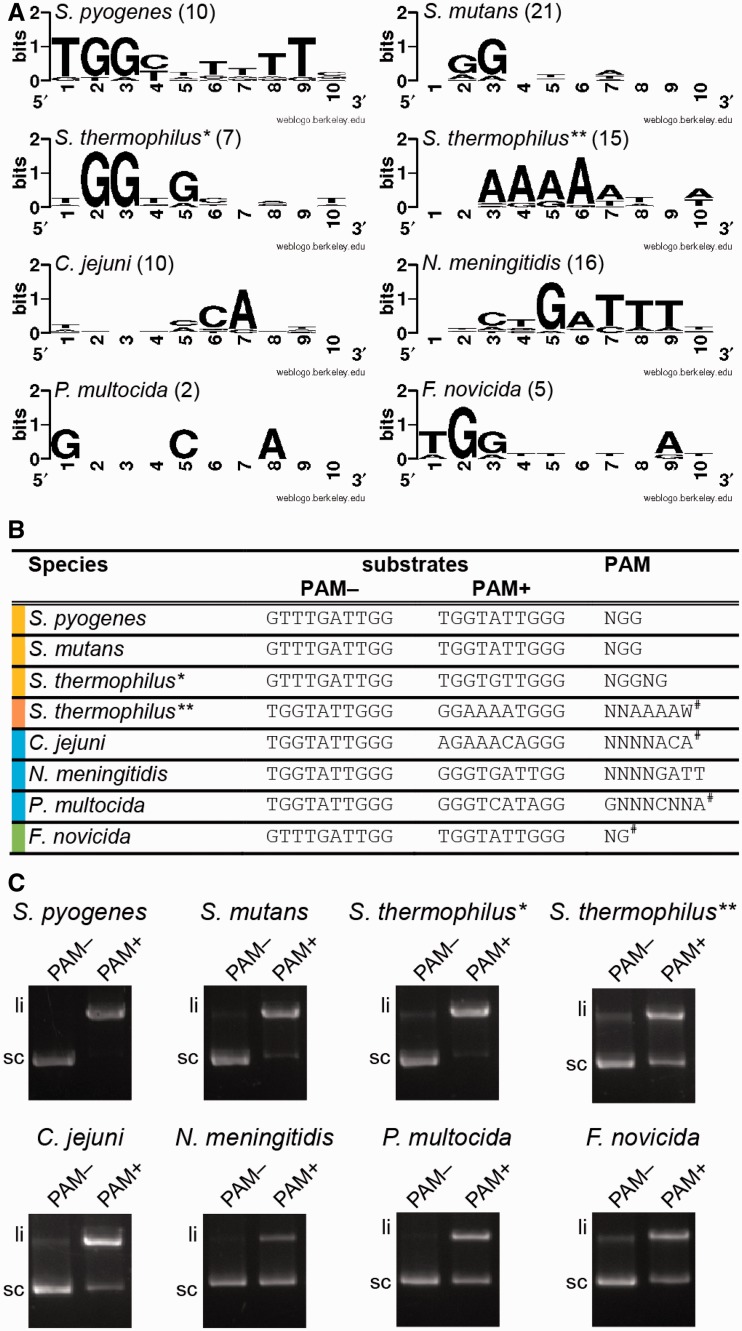
The CRISPR-Cas-derived RNA-guided Cas9 endonuclease is the key element of an emerging promising technology for genome engineering in a broad range of cells and organisms. The DNA-targeting mechanism of the type II CRISPR-Cas system involves maturation of tracrRNA:crRNA duplex (dual-RNA), which directs Cas9 to cleave invading DNA in a sequence-specific manner, dependent on the presence of a Protospacer Adjacent Motif (PAM) on the target. We show that evolution of dual-RNA and Cas9 in bacteria produced remarkable sequence diversity. We selected eight representatives of phylogenetically defined type II CRISPR-Cas groups to analyze possible coevolution of Cas9 and dual-RNA. We demonstrate that these two components are interchangeable only between closely related type II systems when the PAM sequence is adjusted to the investigated Cas9 protein. Comparison of the taxonomy of bacterial species that harbor type II CRISPR-Cas systems with the Cas9 phylogeny corroborates horizontal transfer of the CRISPR-Cas loci. The reported collection of dual-RNA:Cas9 with associated PAMs expands the possibilities for multiplex genome editing and could provide means to improve the specificity of the RNA-programmable Cas9 tool.
CRISPR-Cas 衍生的 RNA 指导的 Cas9 内切酶是一种新兴的有前途的基因组工程技术的关键要素,可广泛应用于各种细胞和生物。II 型 CRISPR-Cas 系统的 DNA 靶向机制涉及 tracrRNA:crRNA 双链体(双 RNA)的成熟,该双链体指导 Cas9 以依赖于靶标上存在的前间区序列邻近基序(PAM)的序列特异性方式切割入侵 DNA。我们表明,细菌中双 RNA 和 Cas9 的进化产生了显著的序列多样性。我们选择了八个具有系统发育定义的 II 型 CRISPR-Cas 组的代表来分析 Cas9 和双 RNA 的可能共同进化。我们证明,当 PAM 序列调整为所研究的 Cas9 蛋白时,这两个组件仅在密切相关的 II 型系统之间可互换。与 Cas9 系统发育相比较,具有 II 型 CRISPR-Cas 系统的细菌种的分类学表明了 CRISPR-Cas 基因座的水平转移。报道的带有相关 PAM 的双 RNA:Cas9 集合扩展了多重基因组编辑的可能性,并可能提供提高 RNA 可编程 Cas9 工具特异性的手段。