
变应性鼻炎患者鼻内变应原激发后 MIG(CXCL9)、IP-10(CXCL10)和 I-TAC(CXCL11)的浓度。
MIG (CXCL9), IP-10 (CXCL10) and I-TAC (CXCL11) concentrations after nasal allergen challenge in patients with allergic rhinitis.
机构信息
Department of Internal Diseases, Asthma and Allergy, Medical University of Lodz, Poland.
出版信息
Arch Med Sci. 2013 Oct 31;9(5):849-53. doi: 10.5114/aoms.2013.37198. Epub 2013 Aug 26.
INTRODUCTION
The role of monokine induced by interferon-γ (IFN-γ, MIG/CXCL9), IFN-γ-inducible protein (IP-10/CXCL10), and IFN-inducible T cell α chemoattractant (I-TAC/CXCL11) in allergic inflammation has not been explored in detail in vivo. The aim of the study was to examine the changes in concentrations of MIG/CXCL9, IP-10/CXCL10 and I-TAC/CXCL11 in nasal lavages collected from healthy and allergic subjects during nasal allergen challenge.
MATERIAL AND METHODS
Subjects allergic to grass pollen and healthy controls were included. Nasal allergen challenge preceded by placebo administration was performed outside the pollen season. Nasal lavages were collected before and 30 min after application of the placebo and 30 min after allergen administration. Concentrations of chemokines were determined using ELISA.
RESULTS
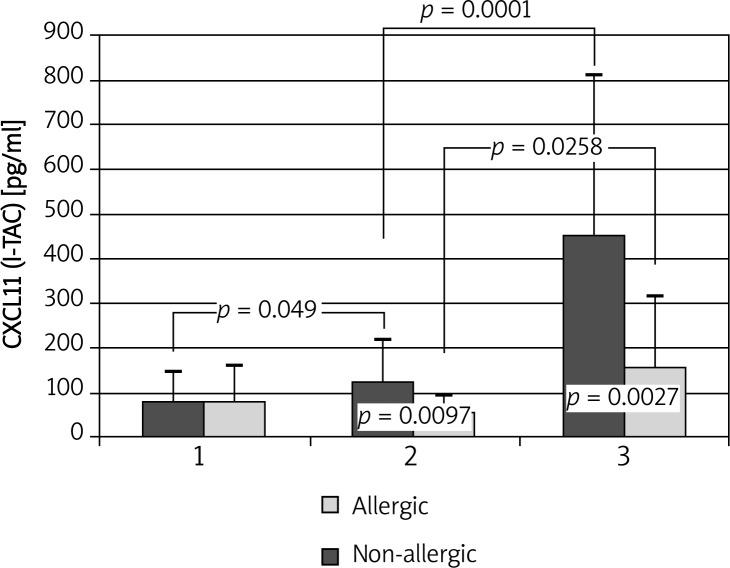
We observed significantly higher concentrations of IP-10/CXCL10 in allergic patients compared to the healthy subjects before (354.49 ±329.24 vs. 164.62 ±175.94 pg/ml; p = 0.036), 30 min after placebo (420.3 ±421.28 vs. 246.88 ±353.24 pg/ml; p = 0.021) and 30 min after allergen administration (403.28 ±359.29 vs. 162.68 ±148.69 pg/ml; p = 0.025). IP-10/CXCL10 levels did not change 30 min after allergen provocation. In contrast, MIG/CXCL9 levels were similar in both groups before and after placebo. However, a significant rise in MIG/CXCL9 concentration was noted in allergic patients 30 min after the allergen (138.88 ±109.59 vs. 395.8 ±301.2 pg/ml; p = 0.00026). I-TAC/CXCL11 concentrations increased after placebo as well as the allergen in both groups.
CONCLUSIONS
IP-10/CXCL10 concentrations are elevated in nasal lavages from allergic patients and this chemokine may play a role in chronic allergic inflammation. MIG/CXCL9 levels increase rapidly after allergen application, which may suggest its role in the early allergic response. Results on I-TAC/CXCL11 concentrations remain inconclusive.
简介
干扰素-γ(IFN-γ,MIG/CXCL9)、干扰素-γ诱导蛋白(IP-10/CXCL10)和 IFN-γ诱导的 T 细胞α趋化因子(I-TAC/CXCL11)在过敏炎症中的作用尚未在体内进行详细研究。本研究的目的是检测健康和过敏受试者在鼻变应原激发期间鼻灌洗液中 MIG/CXCL9、IP-10/CXCL10 和 I-TAC/CXCL11 浓度的变化。
材料和方法
纳入对草花粉过敏的患者和健康对照者。在花粉季节外进行鼻变应原激发前的安慰剂给药。在应用安慰剂前、应用安慰剂 30 分钟后和应用变应原后 30 分钟收集鼻灌洗液。使用 ELISA 测定趋化因子浓度。
结果
与健康受试者相比,我们观察到过敏患者的 IP-10/CXCL10 浓度在应用安慰剂前(354.49±329.24 与 164.62±175.94 pg/ml;p=0.036)、应用安慰剂后 30 分钟(420.3±421.28 与 246.88±353.24 pg/ml;p=0.021)和应用变应原后 30 分钟(403.28±359.29 与 162.68±148.69 pg/ml;p=0.025)均显著升高。变应原激发后 30 分钟 IP-10/CXCL10 水平未发生变化。相反,两组在应用安慰剂前后 MIG/CXCL9 水平相似。然而,过敏患者在应用变应原后 30 分钟时 MIG/CXCL9 浓度明显升高(138.88±109.59 与 395.8±301.2 pg/ml;p=0.00026)。两组在应用安慰剂和变应原后 I-TAC/CXCL11 浓度均增加。
结论
过敏患者的鼻灌洗液中 IP-10/CXCL10 浓度升高,该趋化因子可能在慢性过敏炎症中发挥作用。MIG/CXCL9 水平在应用变应原后迅速升高,这可能提示其在早期过敏反应中的作用。关于 I-TAC/CXCL11 浓度的结果尚无定论。


 Zotero 插件