Ruderfer Douglas M, Fanous Ayman H, Ripke Stephan, McQuillin Andrew, Amdur Richard L, Gejman Pablo V, O'Donovan Michael C, Andreassen Ole A, Djurovic Srdjan, Hultman Christina M, Kelsoe John R, Jamain Stephane, Landén Mikael, Leboyer Marion, Nimgaonkar Vishwajit, Nurnberger John, Smoller Jordan W, Craddock Nick, Corvin Aiden, Sullivan Patrick F, Holmans Peter, Sklar Pamela, Kendler Kenneth S
Division of Psychiatric Genomics, Department of Psychiatry, Mount Sinai School of Medicine, New York, New York, USA.
Washington DC VA Medical Center, Washington DC, USA.
Mol Psychiatry. 2014 Sep;19(9):1017-1024. doi: 10.1038/mp.2013.138. Epub 2013 Nov 26.
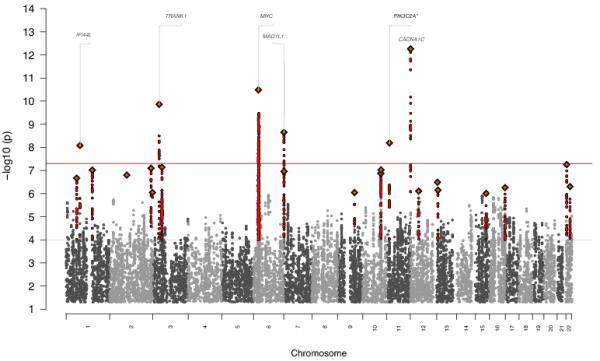
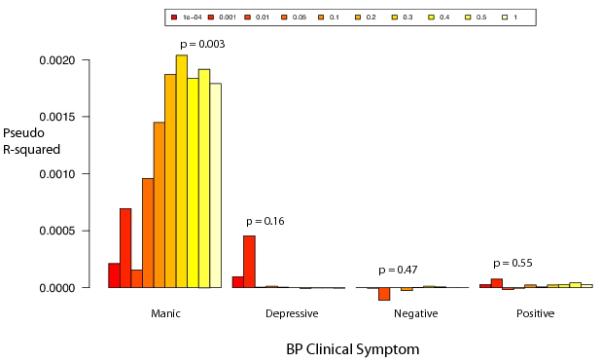
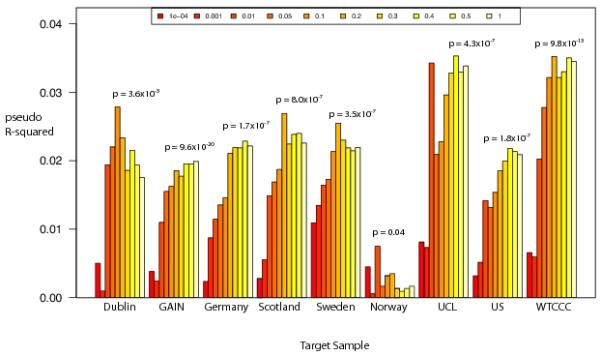
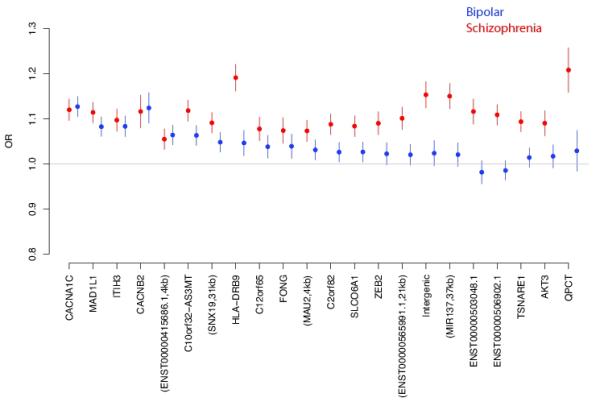
Bipolar disorder and schizophrenia are two often severe disorders with high heritabilities. Recent studies have demonstrated a large overlap of genetic risk loci between these disorders but diagnostic and molecular distinctions still remain. Here, we perform a combined genome-wide association study (GWAS) of 19 779 bipolar disorder (BP) and schizophrenia (SCZ) cases versus 19 423 controls, in addition to a direct comparison GWAS of 7129 SCZ cases versus 9252 BP cases. In our case-control analysis, we identify five previously identified regions reaching genome-wide significance (CACNA1C, IFI44L, MHC, TRANK1 and MAD1L1) and a novel locus near PIK3C2A. We create a polygenic risk score that is significantly different between BP and SCZ and show a significant correlation between a BP polygenic risk score and the clinical dimension of mania in SCZ patients. Our results indicate that first, combining diseases with similar genetic risk profiles improves power to detect shared risk loci and second, that future direct comparisons of BP and SCZ are likely to identify loci with significant differential effects. Identifying these loci should aid in the fundamental understanding of how these diseases differ biologically. These findings also indicate that combining clinical symptom dimensions and polygenic signatures could provide additional information that may someday be used clinically.
双相情感障碍和精神分裂症是两种通常较为严重且遗传度较高的疾病。近期研究表明,这些疾病之间存在大量遗传风险位点重叠,但诊断和分子差异仍然存在。在此,我们对19779例双相情感障碍(BP)和精神分裂症(SCZ)患者与19423例对照进行了全基因组关联研究(GWAS)联合分析,此外还对7129例SCZ患者与9252例BP患者进行了直接比较GWAS分析。在病例对照分析中,我们确定了五个先前已确定达到全基因组显著性的区域(CACNA1C、IFI44L、MHC、TRANK1和MAD1L1)以及一个位于PIK3C2A附近的新位点。我们创建了一个在BP和SCZ之间有显著差异的多基因风险评分,并显示BP多基因风险评分与SCZ患者躁狂的临床维度之间存在显著相关性。我们的结果表明,首先,将具有相似遗传风险特征的疾病合并分析可提高检测共享风险位点的效能;其次,未来对BP和SCZ的直接比较可能会识别出具有显著差异效应的位点。识别这些位点应有助于从根本上理解这些疾病在生物学上的差异。这些发现还表明,结合临床症状维度和多基因特征可以提供一些可能在未来用于临床的额外信息。