Caso Francesco, Rigante Donato, Vitale Antonio, Lucherini Orso Maria, Costa Luisa, Atteno Mariangela, Compagnone Adele, Caso Paolo, Frediani Bruno, Galeazzi Mauro, Punzi Leonardo, Cantarini Luca
Rheumatology Unit, Department of Clinical and Experimental Medicine, University of Padua, Padova, Italy.
Int J Rheumatol. 2013;2013:513782. doi: 10.1155/2013/513782. Epub 2013 Oct 24.
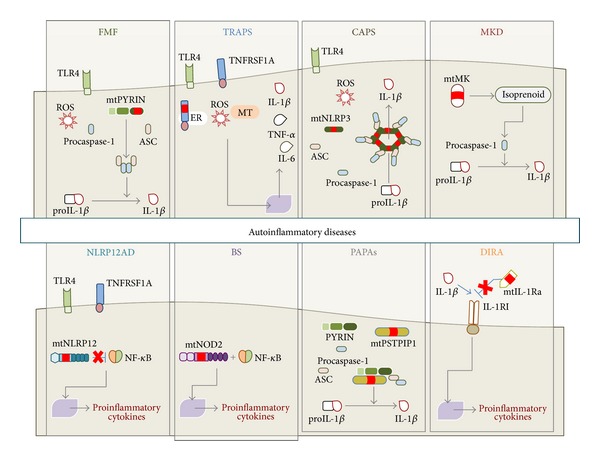
Monogenic autoinflammatory syndromes (MAISs) are caused by innate immune system dysregulation leading to aberrant inflammasome activation and episodes of fever and involvement of skin, serous membranes, eyes, joints, gastrointestinal tract, and nervous system, predominantly with a childhood onset. To date, there are twelve known MAISs: familial Mediterranean fever, tumor necrosis factor receptor-associated periodic syndrome, familial cold urticaria syndrome, Muckle-Wells syndrome, CINCA syndrome, mevalonate kinase deficiency, NLRP12-associated autoinflammatory disorder, Blau syndrome, early-onset sarcoidosis, PAPA syndrome, Majeed syndrome, and deficiency of the interleukin-1 receptor antagonist. Each of these conditions may manifest itself with more or less severe inflammatory symptoms of variable duration and frequency, associated with findings of increased inflammatory parameters in laboratory investigation. The purpose of this paper is to describe the main genetic, clinical, and therapeutic aspects of MAISs and their most recent classification with the ultimate goal of increasing awareness of autoinflammation among various internal medicine specialists.
单基因自身炎症综合征(MAISs)是由先天性免疫系统失调引起的,导致炎性小体异常激活,出现发热症状,并累及皮肤、浆膜、眼睛、关节、胃肠道和神经系统,主要发病于儿童期。迄今为止,已知的MAISs有十二种:家族性地中海热、肿瘤坏死因子受体相关周期性综合征、家族性冷性荨麻疹综合征、穆克-韦尔斯综合征、慢性婴儿神经皮肤关节综合征、甲羟戊酸激酶缺乏症、NLRP12相关自身炎症性疾病、布劳综合征、早发性结节病、化脓性无菌性关节炎-坏疽性脓皮病-痤疮综合征、马吉德综合征以及白细胞介素-1受体拮抗剂缺乏症。这些病症中的每一种都可能表现出程度不同、持续时间和频率各异的严重炎症症状,并伴有实验室检查中炎症参数升高的结果。本文旨在描述MAISs的主要遗传、临床和治疗方面及其最新分类,最终目标是提高各内科专家对自身炎症的认识。