Laboratory for the Modeling of Biological and Socio-technical Systems, Northeastern University, Boston 02115, MA, USA.
BMC Med. 2013 Nov 28;11:252. doi: 10.1186/1741-7015-11-252.
The recent work on the modified H5N1 has stirred an intense debate on the risk associated with the accidental release from biosafety laboratory of potential pandemic pathogens. Here, we assess the risk that the accidental escape of a novel transmissible influenza strain would not be contained in the local community.
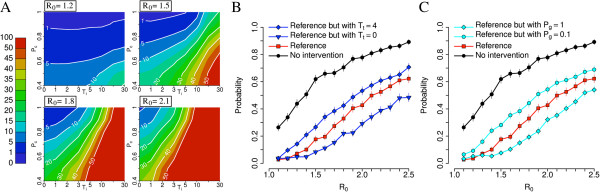
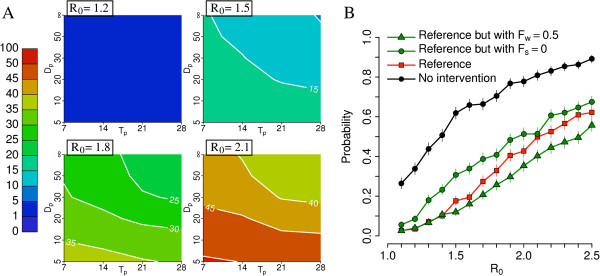
We develop here a detailed agent-based model that specifically considers laboratory workers and their contacts in microsimulations of the epidemic onset. We consider the following non-pharmaceutical interventions: isolation of the laboratory, laboratory workers' household quarantine, contact tracing of cases and subsequent household quarantine of identified secondary cases, and school and workplace closure both preventive and reactive.
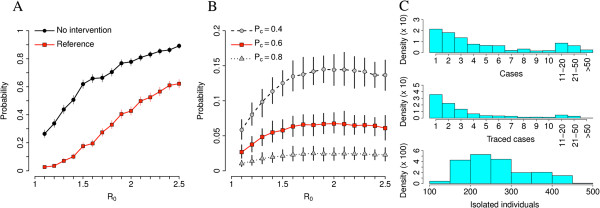
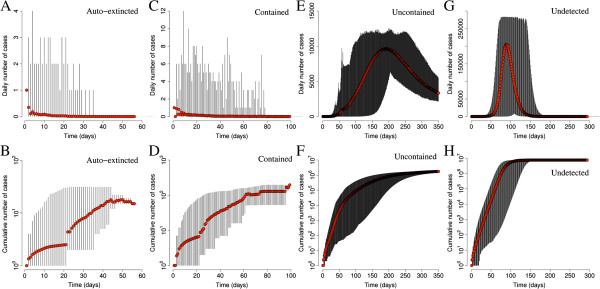
Model simulations suggest that there is a non-negligible probability (5% to 15%), strongly dependent on reproduction number and probability of developing clinical symptoms, that the escape event is not detected at all. We find that the containment depends on the timely implementation of non-pharmaceutical interventions and contact tracing and it may be effective (>90% probability per event) only for pathogens with moderate transmissibility (reproductive number no larger than R₀ = 1.5). Containment depends on population density and structure as well, with a probability of giving rise to a global event that is three to five times lower in rural areas.
Results suggest that controllability of escape events is not guaranteed and, given the rapid increase of biosafety laboratories worldwide, this poses a serious threat to human health. Our findings may be relevant to policy makers when designing adequate preparedness plans and may have important implications for determining the location of new biosafety laboratories worldwide.
最近关于改良型 H5N1 的研究引发了一场激烈的辩论,即潜在大流行病原体从生物安全实验室意外释放所带来的风险。在这里,我们评估了新型可传播流感毒株在当地社区意外传播而无法得到控制的风险。
我们在这里开发了一个详细的基于代理的模型,该模型特别考虑了实验室工作人员及其在疫情爆发微模拟中的接触者。我们考虑了以下非药物干预措施:隔离实验室、实验室工作人员的家庭检疫、病例的接触者追踪以及随后对已确定的二级病例进行家庭检疫、以及学校和工作场所的关闭(无论是预防性还是反应性的)。
模型模拟表明,存在不可忽视的可能性(5%至 15%),这强烈依赖于繁殖数和出现临床症状的概率,即逃逸事件根本没有被发现。我们发现,遏制取决于非药物干预措施和接触者追踪的及时实施,并且只有在传播力适中(繁殖数不超过 R₀=1.5)的病原体时才可能有效(每次事件的概率大于 90%)。遏制还取决于人口密度和结构,在农村地区引发全球事件的概率要低三到五倍。
结果表明,逃逸事件的可控性无法保证,而且考虑到全球生物安全实验室的快速增加,这对人类健康构成了严重威胁。我们的研究结果可能对政策制定者在制定适当的准备计划时具有重要意义,并可能对确定全球新的生物安全实验室的位置具有重要意义。