Centro de Ciências da Saúde e do Desporto, Universidade Federal do Acre, Campus Universitário, BR 364, Km 04, Bairro Distrito Industrial, Rio Branco, AC, Brazil.
BMC Public Health. 2013 Nov 28;13:1098. doi: 10.1186/1471-2458-13-1098.
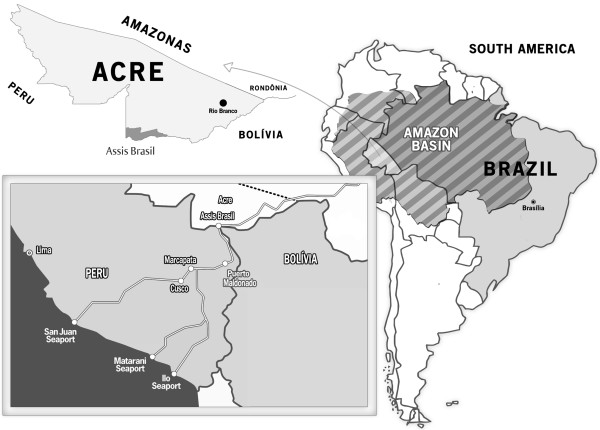
The aim of this study was to analyse the prevalence of undernutrition, overweight and associated factors, before and after the implementation of the Interoceanic Highway.
A population-based cross-sectional study on children under 5 years of age was conducted in the municipality of Assis Brasil, AC, Brazil, in 2003 and 2010. Prevalence of undernutrition was observed by using height-for-age Z-scores (HAZ) and adopting a cut-off point equal to or lower than a -2 Z-score. Overweight prevalence was defined by a cut-off point equal to or greater than a +2 Z-score of the WHZ index. Z-scores were calculated relative to WHO 2006 reference data. Semi-structured questionnaires were applied to the children's guardians, investigating family socio-economic and demographic characteristics, morbidities, access to services and child care. Associated factors were identified by hierarchical multiple logistic regression analysis.
The prevalence of low HAZ (undernutrition) was 7.0% in 2003 and 12.2% in 2010. The prevalence of high WHZ (overweight) was 1.0% and 6.6% for 2003 and 2010, respectively. It was not possible to adjust the multiple model for the year 2003. The factors associated with low HAZ in 2010 were: wealth index, the situation of living with biological parents, maternal height and presence of open sewage, whereas the factors associated with a high WHZ in the same year were: child's age, mother's time of residence in the location, mother's body mass index.
Overweight increase within this undernutrition scenario reveals that the process of nutritional transition began in this Amazonian city only in the last decade, and therefore, it is delayed when compared to overweight in other parts of Brazil. Such nutritional transition in Assis Brasil may have been facilitated by the construction of the Interoceanic Highway.
本研究旨在分析在修建跨洋公路前后,该地区五岁以下儿童的营养不足、超重和相关因素的流行情况。
本研究为 2003 年和 2010 年在巴西阿克里州阿西斯·布拉西尔市进行的一项基于人群的五岁以下儿童横断面研究。采用身高年龄 Z 评分(HAZ)来观察营养不足的流行情况,并采用等于或低于-2 Z 评分的截断值。超重的流行率通过 WHZ 指数等于或大于+2 Z 评分的截断值来定义。Z 评分是相对于世卫组织 2006 年参考数据计算得出的。半结构式问卷被应用于儿童的监护人,调查家庭社会经济和人口统计学特征、发病率、获得服务和儿童保健的情况。通过分层多逻辑回归分析确定相关因素。
2003 年低 HAZ(营养不足)的流行率为 7.0%,2010 年为 12.2%。2003 年高 WHZ(超重)的流行率为 1.0%,2010 年为 6.6%。无法为 2003 年的多模型进行调整。2010 年与低 HAZ 相关的因素包括:财富指数、与亲生父母一起生活的情况、母亲身高和存在开放污水,而同年与高 WHZ 相关的因素包括:儿童年龄、母亲在该地点居住的时间、母亲的体重指数。
在这种营养不足的情况下超重的增加表明,营养转型过程仅在过去十年才开始在这座亚马逊城市出现,因此与巴西其他地区的超重相比,这一过程有所延迟。阿西斯·布拉西尔的这种营养转型可能是由于跨洋公路的建设而得以促进。