Arthritis Res Ther. 2013 Sep 16;15(5):R120. doi: 10.1186/ar4300.
Recent advances suggest that the cellular redox state may play a significant role in the progression of fibrosis in systemic sclerosis (SSc). Another, and as yet poorly accounted for, feature of SSc is its overlap with thyroid abnormalities. Previous reports demonstrate that hypothyroidism reduces oxidant stress. The aim of this study was therefore to evaluate the effect of propylthiouracil (PTU), and of the hypothyroidism induced by it, on the development of cutaneous and pulmonary fibrosis in the oxidant stress murine model of SSc.
Chronic oxidant stress SSc was induced in BALB/c mice by daily subcutaneous injections of hypochlorous acid (HOCl) for 6 weeks. Mice (n = 25) were randomized into three arms: HOCl (n = 10), HOCl plus PTU (n = 10) or vehicle alone (n = 5). PTU administration was initiated 30 minutes after HOCl subcutaneous injection and continued daily for 6 weeks. Skin and lung fibrosis were evaluated by histologic methods. Immunohistochemical staining for alpha-smooth muscle actin (α-SMA) in cutaneous and pulmonary tissues was performed to evaluate myofibroblast differentiation. Lung and skin concentrations of vascular endothelial growth factor (VEGF), extracellular signal-related kinase (ERK), rat sarcoma protein (Ras), Ras homolog gene family (Rho), and transforming growth factor (TGF) β were analyzed by Western blot.
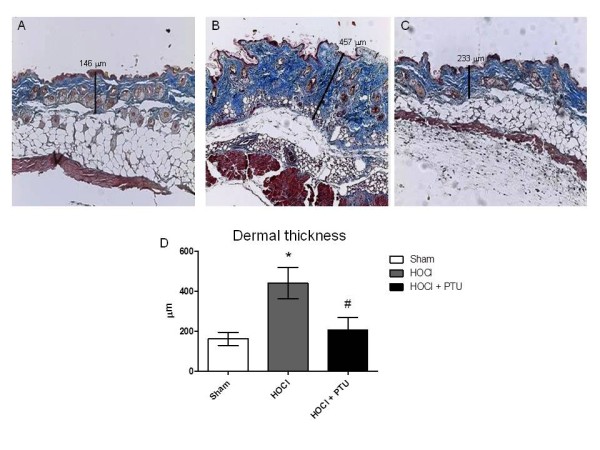
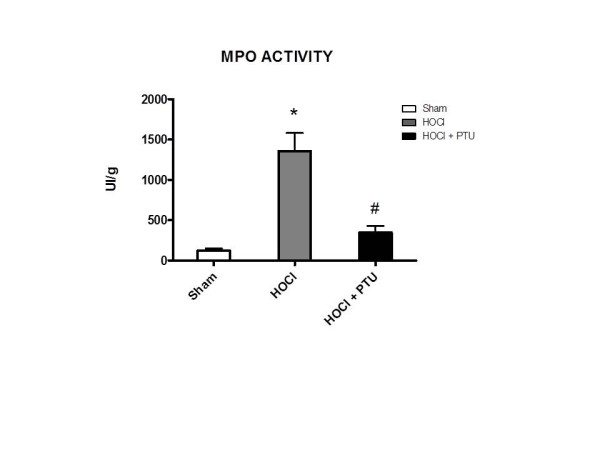
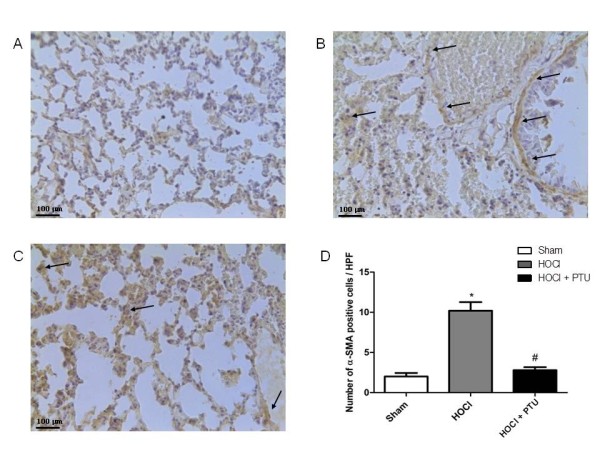
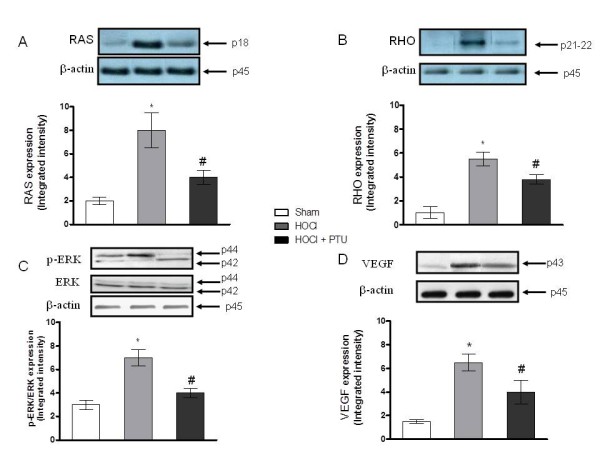
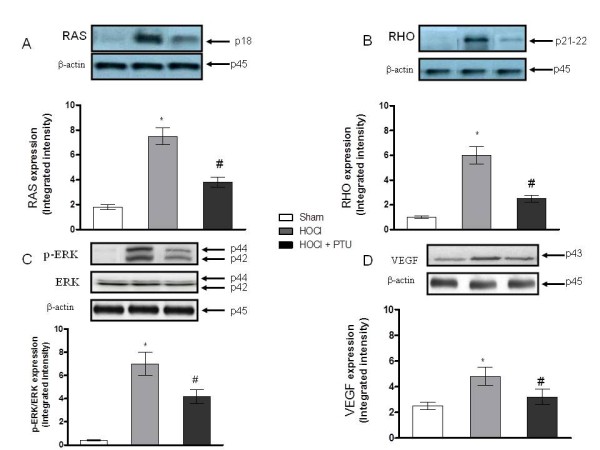
Injections of HOCl induced cutaneous and lung fibrosis in BALB/c mice. PTU treatment prevented both dermal and pulmonary fibrosis. Myofibroblast differentiation was also inhibited by PTU in the skin and lung. The increase in cutaneous and pulmonary expression of VEGF, ERK, Ras, and Rho in mice treated with HOCl was significantly prevented in mice co-administered with PTU.
PTU, probably through its direct effect on reactive oxygen species or indirectly through thyroid function inhibition, prevents the development of cutaneous and pulmonary fibrosis by blocking the activation of the Ras-ERK pathway in the oxidant-stress animal model of SSc.
最近的研究进展表明,细胞氧化还原状态可能在系统性硬化症(SSc)纤维化的进展中发挥重要作用。SSc 的另一个特征是其与甲状腺异常的重叠,目前尚未得到充分解释。先前的报告表明,甲状腺功能减退症可降低氧化应激。因此,本研究旨在评估丙硫氧嘧啶(PTU)及其引起的甲状腺功能减退症对氧化应激诱导的 SSc 小鼠模型皮肤和肺纤维化发展的影响。
通过每周皮下注射次氯酸(HOCl)6 周,在 BALB/c 小鼠中诱导慢性氧化应激 SSc。将小鼠(n=25)随机分为三组:HOCl(n=10)、HOCl+PTU(n=10)或单独载体(n=5)。HOCl 皮下注射后 30 分钟开始给予 PTU 给药,持续 6 周。通过组织学方法评估皮肤和肺纤维化。对皮肤和肺组织中的α-平滑肌肌动蛋白(α-SMA)进行免疫组织化学染色,以评估肌成纤维细胞分化。通过 Western blot 分析肺和皮肤中血管内皮生长因子(VEGF)、细胞外信号调节激酶(ERK)、大鼠肉瘤蛋白(Ras)、Ras 同源基因家族(Rho)和转化生长因子(TGF)β的浓度。
HOCl 注射诱导 BALB/c 小鼠皮肤和肺纤维化。PTU 治疗可预防皮肤和肺部纤维化。PTU 还可抑制皮肤和肺部的肌成纤维细胞分化。HOCl 处理小鼠皮肤和肺中 VEGF、ERK、Ras 和 Rho 的表达增加,而与 PTU 共同给药的小鼠中则明显受到抑制。
PTU 可能通过直接作用于活性氧或通过抑制甲状腺功能,通过阻断氧化应激 SSc 动物模型中 Ras-ERK 通路的激活,预防皮肤和肺纤维化的发展。