Bien Alexander G, Cress Marshall C, Nguyen Susan B, Westgate Steven J, Nanda Ashish
Department of Otolaryngology-Head and Neck Surgery, University of Missouri-Columbia School of Medicine, Columbia, Missouri, United States ; Department of Neurosurgery, University of Missouri-Columbia School of Medicine, Columbia, Missouri, United States.
J Neurol Surg Rep. 2013 Dec;74(2):88-91. doi: 10.1055/s-0033-1348954. Epub 2013 Jul 12.
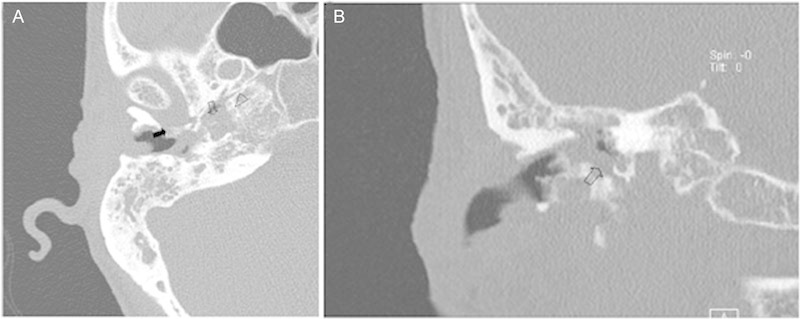
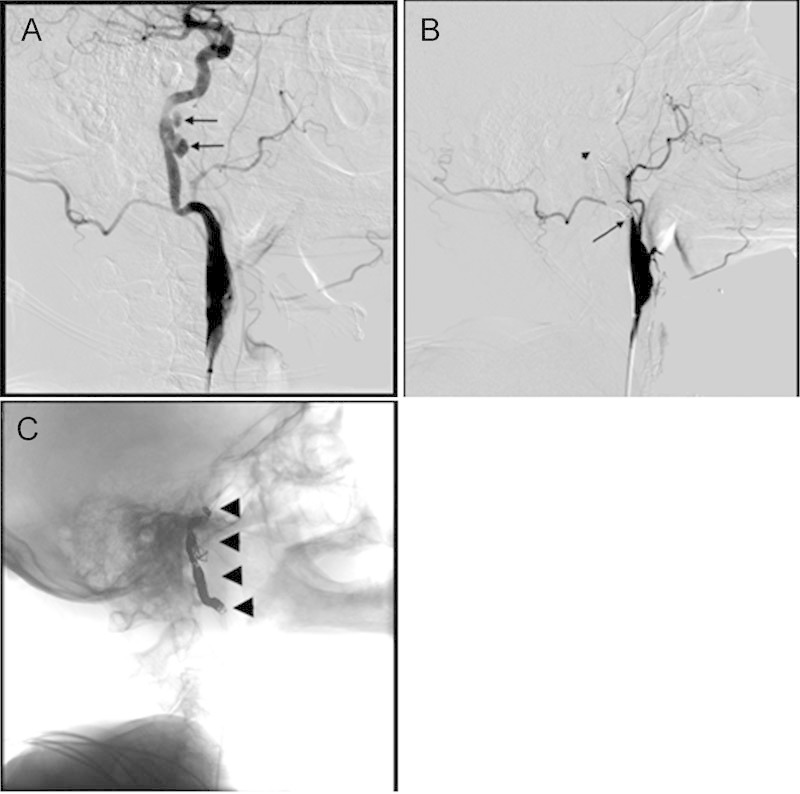
Objective This case report is designed to illustrate an uncommon presentation of osteoradionecrosis (ORN) of the temporal bone and a treatment method for bloody otorrhea from a pseudoaneurysm of the internal carotid artery (ICA). Design This is a single patient case report Setting University of Missouri-Columbia Hospital and Clinics. Participants The report describes a patient with a history of hypopharyngeal squamous cell carcinoma (SCCA) who was previously treated with chemoradiation therapy and salvage bilateral neck dissections and then presented in a delayed fashion with profuse, episodic bloody otorrhea. Computed tomography (CT) was consistent with ORN of the temporal bone. The patient underwent emergent cerebral angiography. A pseudoaneurysm of the cervicopetrous ICA was confirmed to be the source of the patient's bloody otorrhea. The lesion was treated by endovascular sacrifice of the ICA using the two-catheter coiling technique. Results The patient had no neurologic sequelae or further bleeding after treatment. Conclusions Bloody otorrhea is an uncommon presentation of ORN. Sacrifice of the internal carotid can be considered as a treatment when the source is pseudoaneurysmal.
目的 本病例报告旨在阐述颞骨放射性骨坏死(ORN)的一种罕见表现形式以及针对颈内动脉(ICA)假性动脉瘤所致血性耳漏的治疗方法。
设计 这是一份单病例报告
地点 密苏里大学哥伦比亚分校医院及诊所
参与者 该报告描述了一名下咽鳞状细胞癌(SCCA)患者,此前接受了放化疗及挽救性双侧颈部淋巴结清扫术,随后出现迟发性大量发作性血性耳漏。计算机断层扫描(CT)结果与颞骨ORN相符。患者接受了急诊脑血管造影。经证实,颈岩段ICA假性动脉瘤是患者血性耳漏的来源。采用双导管弹簧圈栓塞技术对病变进行了颈内动脉血管内闭塞治疗。
结果 患者治疗后无神经后遗症或再次出血。
结论 血性耳漏是ORN的一种罕见表现形式。当病因是假性动脉瘤时,可考虑行颈内动脉闭塞治疗。