Institute of Biotechnology, University of Lausanne, Lausanne, Switzerland.
BMC Mol Biol. 2013 Dec 2;14:26. doi: 10.1186/1471-2199-14-26.
The in vivo transfer of naked plasmid DNA into organs such as muscles is commonly used to assess the expression of prophylactic or therapeutic genes in animal disease models.
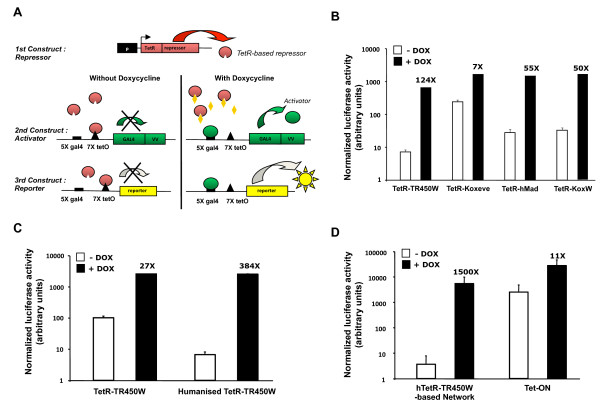
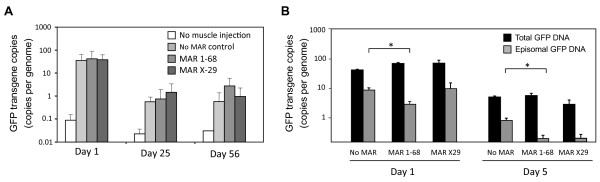
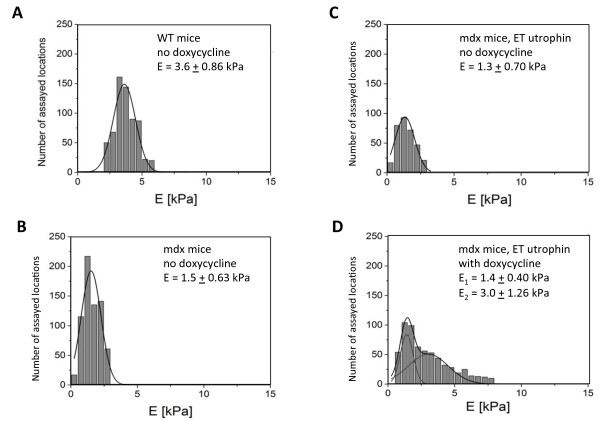
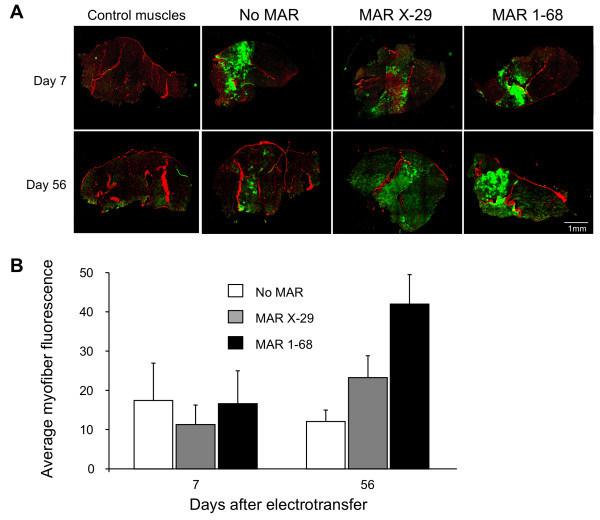
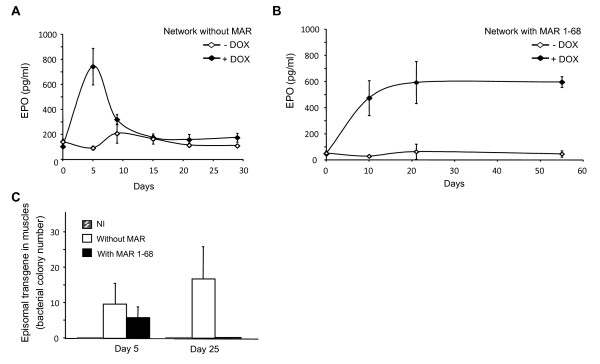
In this study, we devised vectors allowing a tight regulation of transgene expression in mice from such non-viral vectors using a doxycycline-controlled network of activator and repressor proteins. Using these vectors, we demonstrate proper physiological response as consequence of the induced expression of two therapeutically relevant proteins, namely erythropoietin and utrophin. Kinetic studies showed that the induction of transgene expression was only transient, unless epigenetic regulatory elements termed Matrix Attachment Regions, or MAR, were inserted upstream of the regulated promoters. Using episomal plasmid rescue and quantitative PCR assays, we observed that similar amounts of plasmids remained in muscles after electrotransfer with or without MAR elements, but that a significant portion had integrated into the muscle fiber chromosomes. Interestingly, the MAR elements were found to promote plasmid genomic integration but to oppose silencing effects in vivo, thereby mediating long-term expression.
This study thus elucidates some of the determinants of transient or sustained expression from the use of non-viral regulated vectors in vivo.
将裸露质粒 DNA 体内转移到肌肉等器官中,常用于评估预防性或治疗性基因在动物疾病模型中的表达。
在这项研究中,我们设计了载体,允许使用强力霉素控制的激活蛋白和阻遏蛋白网络,从这些非病毒载体中对小鼠进行转基因表达的紧密调控。使用这些载体,我们证明了两种治疗相关蛋白(即促红细胞生成素和 utrophin)诱导表达后的适当生理反应。动力学研究表明,除非插入称为基质附着区(MAR)的表观遗传调节元件,否则转基因表达的诱导是短暂的。使用游离质粒拯救和定量 PCR 分析,我们观察到电转后无论是否存在 MAR 元件,肌肉中仍有相似数量的质粒,但有很大一部分已整合到肌纤维染色体中。有趣的是,MAR 元件被发现可促进质粒基因组整合,但可在体内抵抗沉默效应,从而介导长期表达。
因此,本研究阐明了使用体内非病毒调控载体时瞬时或持续表达的一些决定因素。