
五种临床肌肉性能测试在有和无颈部疼痛患者中的组内和组间可靠性。
The intra- and inter-rater reliability of five clinical muscle performance tests in patients with and without neck pain.
机构信息
Institute of Sports Science and Clinical Biomechanics, The University of Southern Denmark, Odense, Denmark.
出版信息
BMC Musculoskelet Disord. 2013 Dec 3;14:339. doi: 10.1186/1471-2474-14-339.
BACKGROUND
This study investigates the reliability of muscle performance tests using cost- and time-effective methods similar to those used in clinical practice. When conducting reliability studies, great effort goes into standardising test procedures to facilitate a stable outcome. Therefore, several test trials are often performed. However, when muscle performance tests are applied in the clinical setting, clinicians often only conduct a muscle performance test once as repeated testing may produce fatigue and pain, thus variation in test results. We aimed to investigate whether cervical muscle performance tests, which have shown promising psychometric properties, would remain reliable when examined under conditions similar to those of daily clinical practice.
METHODS
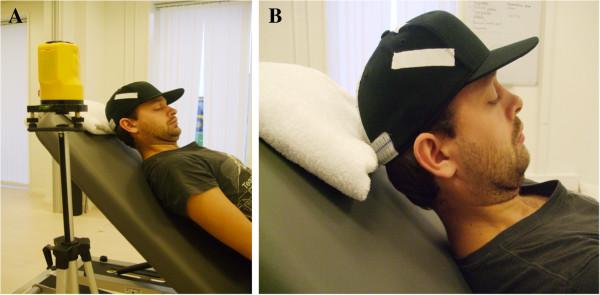
The intra-rater (between-day) and inter-rater (within-day) reliability was assessed for five cervical muscle performance tests in patients with (n = 33) and without neck pain (n = 30). The five tests were joint position error, the cranio-cervical flexion test, the neck flexor muscle endurance test performed in supine and in a 45°-upright position and a new neck extensor test.
RESULTS
Intra-rater reliability ranged from moderate to almost perfect agreement for joint position error (ICC ≥ 0.48-0.82), the cranio-cervical flexion test (ICC ≥ 0.69), the neck flexor muscle endurance test performed in supine (ICC ≥ 0.68) and in a 45°-upright position (ICC ≥ 0.41) with the exception of a new test (neck extensor test), which ranged from slight to moderate agreement (ICC = 0.14-0.41). Likewise, inter-rater reliability ranged from moderate to almost perfect agreement for joint position error (ICC ≥ 0.51-0.75), the cranio-cervical flexion test (ICC ≥ 0.85), the neck flexor muscle endurance test performed in supine (ICC ≥ 0.70) and in a 45°-upright position (ICC ≥ 0.56). However, only slight to fair agreement was found for the neck extensor test (ICC = 0.19-0.25).
CONCLUSIONS
Intra- and inter-rater reliability ranged from moderate to almost perfect agreement with the exception of a new test (neck extensor test), which ranged from slight to moderate agreement. The significant variability observed suggests that tests like the neck extensor test and the neck flexor muscle endurance test performed in a 45°-upright position are too unstable to be used when evaluating neck muscle performance.
背景
本研究旨在通过类似临床实践中使用的经济且有效的方法来研究肌肉性能测试的可靠性。在进行可靠性研究时,需要付出很大的努力来标准化测试程序,以确保结果稳定。因此,通常会进行多次测试。然而,当肌肉性能测试应用于临床环境中时,临床医生通常只进行一次肌肉性能测试,因为重复测试可能会导致疲劳和疼痛,从而导致测试结果发生变化。我们旨在研究在类似于日常临床实践的条件下,已显示出良好心理测量特性的颈椎肌肉性能测试是否仍然可靠。
方法
评估了 33 例颈痛患者和 30 例无颈痛患者的 5 项颈椎肌肉性能测试的内部(组内)和外部(组间)可靠性。这 5 项测试是关节位置误差、颅颈屈伸试验、仰卧位和 45°-直立位颈屈肌耐力试验以及新的颈伸肌试验。
结果
关节位置误差(ICC≥0.48-0.82)、颅颈屈伸试验(ICC≥0.69)、仰卧位颈屈肌耐力试验(ICC≥0.68)和 45°-直立位颈屈肌耐力试验(ICC≥0.41)的内部信度范围为中度至几乎完美一致,而新测试(颈伸肌试验)的内部信度范围为轻度至中度一致(ICC=0.14-0.41)。同样,关节位置误差(ICC≥0.51-0.75)、颅颈屈伸试验(ICC≥0.85)、仰卧位颈屈肌耐力试验(ICC≥0.70)和 45°-直立位颈屈肌耐力试验(ICC≥0.56)的外部信度范围为中度至几乎完美一致。然而,颈伸肌试验的外部信度仅为轻度至中度一致(ICC=0.19-0.25)。
结论
除新测试(颈伸肌试验)外,其余测试的内部和外部信度范围均为中度至几乎完美一致,新测试的信度范围为轻度至中度一致。观察到的显著变异性表明,像颈伸肌试验和 45°-直立位的颈屈肌耐力试验这样的测试不太稳定,无法用于评估颈部肌肉性能。


 Zotero 插件