Key Lab of Integrated Crop Pest Management of Shandong Province, College of Agronomy and Plant Protection, Qingdao Agricultural University, Qingdao, P. R. China.
PLoS One. 2013 Nov 26;8(11):e79997. doi: 10.1371/journal.pone.0079997. eCollection 2013.
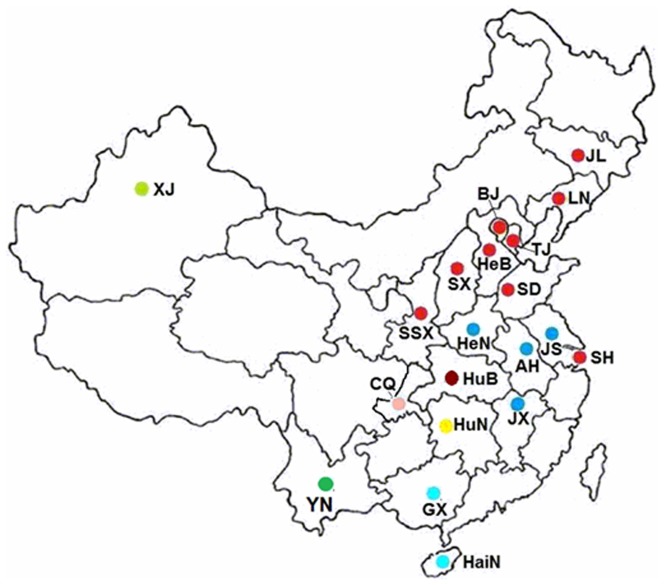
Even though introductions of exotic species provide ready-made experiments of rapid evolution, few studies have examined the genetic structure of an exotic species shortly after its initial introduction and subsequent spread. To determine the genetic structure of its populations during the initial introduction, we investigated the invasive sweet potato whitefly (Bemisia tabaci Q, commonly known as B. tabaci biotype Q) in China, which was introduced in approximately 2003. A total of 619 B. tabaci Q individuals in 20 provinces throughout China were collected and analyzed using five microsatellite loci.
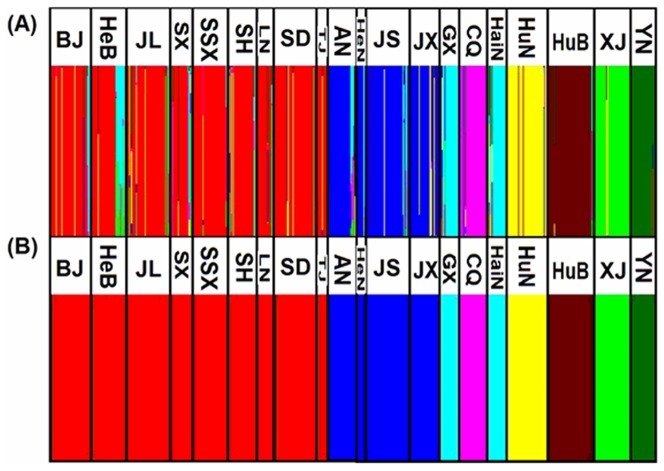
The introduced populations of B. tabaci Q in China represent eight genetic clusters with different geographic distributions. The populations in Yunnan Province, where B. tabaci Q was first detected, are genetically different from the other populations in China.
The introduced populations of B. tabaci Q in China have high spatial genetic heterogeneity. Additional research is required to determine whether the heterogeneity results from multiple introductions, rapid evolution following one or few introductions, or some combination of multiple introductions and rapid evolution. The heterogeneity, however, is inconsistent with a single introduction at Yunnan Province, where B. tabaci Q was first detected, followed by spread.
尽管引入外来物种提供了快速进化的现成实验,但很少有研究在其最初引入和随后传播后不久就检查外来物种的遗传结构。为了确定其种群在最初引入期间的遗传结构,我们调查了中国大约在 2003 年引入的入侵甘薯粉虱(Bemisia tabaci Q,通常称为 B. tabaci 生物型 Q)。在中国 20 个省份共收集了 619 只 B. tabaci Q 个体,并使用 5 个微卫星基因座进行了分析。
中国引入的 B. tabaci Q 种群代表了具有不同地理分布的八个遗传聚类。在首次检测到 B. tabaci Q 的云南省的种群与中国其他地区的种群在遗传上不同。
中国引入的 B. tabaci Q 种群具有很高的空间遗传异质性。需要进一步研究以确定这种异质性是由多次引入、一次或几次引入后的快速进化还是多次引入和快速进化的某种组合引起的。然而,这种异质性与在首次检测到 B. tabaci Q 的云南省的单一引入不一致,随后是传播。