Department of Medical Research (Upper Myanmar), Pyin Oo Lwin, Myanmar.
BMC Public Health. 2013 Dec 5;13:1122. doi: 10.1186/1471-2458-13-1122.
Globally, the proportion of youths has been steadily increasing, especially in Asia. This vulnerable population has limited exposure to sexual and reproductive health (SRH) information leading to various reproductive health (RH) problems including risky sexual debut, unwanted pregnancy, unsafe abortion as well as STI/HIV infections. Among known social variations which influence youth's RH, gender differences are critical for planning necessary gender appropriate interventions. This study aimed to identify gender differences in exposure to SRH information and risky sexual debut as well as associated factors among Myanmar youths in poor suburban communities of Mandalay City.
A total of 444 randomly selected youths (aged 15-24 years) from all poor, suburban communities in Mandalay City took part in our survey. Gender differences in exposure to SRH information and risky sexual debut were assessed by bivariate analysis. Multivariate logistic regression was used to confirm gender differences and identify independent factors associated with main outcomes separately for males and females as well as for both.
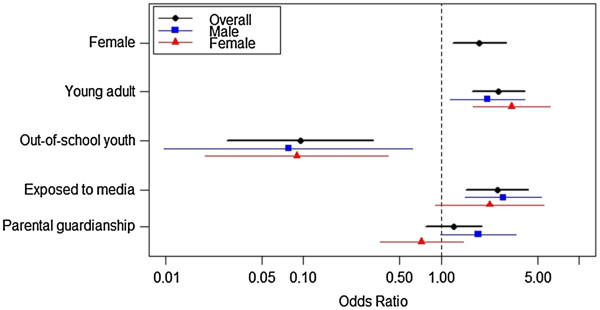
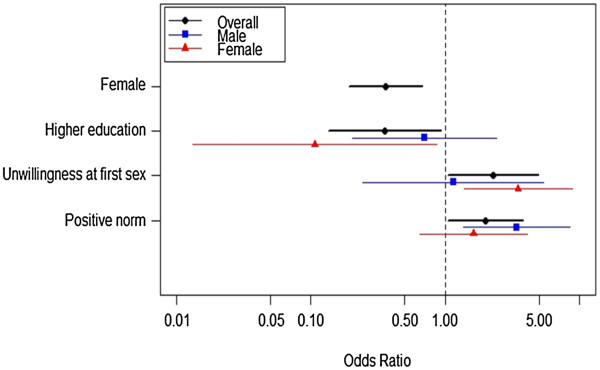
Of 444 youths interviewed, 215 were males and 229 were females. Gender differences were seen in both exposures to SRH information (p = 0.013) and risky sexual debut (p = 0.003). These gender differences were confirmed by multivariate analysis even after adjusting for other risk factors. For exposure to SRH information, only age group and schooling status were significant factors for females. As well as those two factors, media exposure and parental guardianship were significant factors among males. Only positive norm of premarital sex increased the likelihood of risky sexual debut among males. In contrast, unwillingness at sexual debut was a risk factor and a higher education level was a protective factor for risky sexual debut among females.
Limited exposure to SRH information and high risky sexual debut among poor youths were found. There were different influential factors for RH behaviors between males and females. Policy makers as well as local RH care providers should be aware of these differences. Dissemination of reliable SRH information among youths through possible mass media, especially among males, is an urgent issue.
在全球范围内,青年人口的比例一直在稳步上升,尤其是在亚洲。这个脆弱的群体接触性与生殖健康(SRH)信息的机会有限,导致各种生殖健康(RH)问题,包括性行为过早、意外怀孕、不安全堕胎以及性传播感染/艾滋病感染。在影响年轻人 RH 的已知社会差异中,性别差异对于规划必要的性别适宜干预措施至关重要。本研究旨在确定缅甸曼德勒市贫困郊区社区青年在性与生殖健康信息的获取和首次性行为方面的性别差异,以及相关因素。
从曼德勒市所有贫困郊区社区中随机抽取 444 名青年(年龄在 15-24 岁之间)参加了我们的调查。通过单变量分析评估了性与生殖健康信息获取和首次性行为方面的性别差异。多变量逻辑回归用于分别确认男性和女性以及两者的主要结局的性别差异,并确定与主要结局相关的独立因素。
在接受采访的 444 名青年中,男性 215 人,女性 229 人。在获取性与生殖健康信息(p=0.013)和首次性行为方面都存在性别差异(p=0.003)。即使在调整了其他风险因素后,多变量分析也证实了这些性别差异。对于获取性与生殖健康信息,只有年龄组和受教育程度是女性的重要因素。除了这两个因素,媒体接触和父母监护也是男性的重要因素。只有对婚前性行为的积极规范才会增加男性首次性行为的风险。相比之下,不愿意进行首次性行为是女性首次性行为的风险因素,而较高的教育水平是女性首次性行为的保护因素。
发现贫困青年中普遍存在性与生殖健康信息获取不足和首次性行为风险高的情况。男性和女性的 RH 行为有不同的影响因素。决策者和当地的 RH 护理提供者应该意识到这些差异。通过可能的大众媒体向年轻人传播可靠的性与生殖健康信息,尤其是向男性传播,是一个紧迫的问题。