Department of Global Health, School of Public Health, Peking University, No.38 Xueyuan Road, Haidian District, Beijing, China, 100191.
School of Basic Medical Sciences Peking University, Beijing, China.
Reprod Health. 2017 Aug 25;14(1):103. doi: 10.1186/s12978-017-0368-4.
A growing prevalence of unexpected pregnancies and younger age of sexual debut is observed among Chinese young people, while they lack formal sexuality education from schools and parents. It is necessary to measure their knowledge level of sexual and reproductive health, and how such knowledge associates with their sexual behaviors and reproductive health outcomes, which would shed light on the effectiveness of sexuality education in China.
An Internet-based questionnaire survey was conducted from January to August, 2015. 130 colleges were selected from eastern, central, and western parts China with a good balance of geographic distributions. The survey link was subsequently delivered to the focal points in each college for voluntary participation, targeting on undergraduates aged 18 ~ 25. Information on demographics, experience of school-based sexuality education (defined as any course introducing information on sexual and reproductive health) and SRH knowledge quiz was collected. Multivariate linear regression and logistic regression were applied to explore the relationship between students' SRH knowledge, sexual behaviors and reproductive health outcomes, such as sexual intercourse (penetrative sex by vaginal or anal), unprotected sex, pregnancy and abortion, etc.
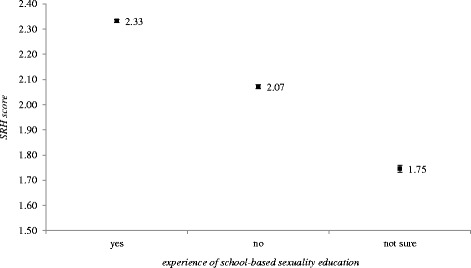
A total sample of 17,966 Chinese college students (mean age = 20.2, 60.4% female) eventually entered the analysis. Only 55.6% of the respondents self-reported having received sexuality education before, and they scored significantly higher (2.33/4.00) in the SRH knowledge quiz than those who had not (1.75/4.00). Among the sexually experienced students (n = 3639, 20.2%), both males and females with higher SRH knowledge were less likely to report having experience of (partner's) pregnancy or abortion (OR < 1, p < 0.05). In the group of sexually experienced males, those with higher SRH knowledge had a slightly later age of sexual debut (coefficient = 0.28, p < 0.001), and were less likely to have unprotected sex during the last or in most sexual intercourses (OR = 0.82, 95%C.I.: 0.69 ~ 0.96).
Students' experience of school-based sexuality education may be positively associated with their SRH knowledge level as well as with their sexual behaviors and reproductive health outcomes, but such associations were stronger among males than females. A more effective implementation of school-based sexuality education needs to be scaled up, and a gender-sensitive education strategy to different needs is desirable for SRH promotion among Chinese young people.
在中国年轻人中,意外怀孕和性初潮年龄较小的情况越来越普遍,而他们缺乏学校和家长提供的正规性教育。有必要衡量他们的性与生殖健康知识水平,以及这种知识如何与他们的性行为和生殖健康结果相关,这将为了解中国的性教育效果提供依据。
2015 年 1 月至 8 月,我们进行了一项基于互联网的问卷调查。从中国东部、中部和西部地区选择了 130 所高校,以实现地理分布的良好平衡。随后,将调查链接发送给每所高校的联络人,供他们自愿参与,调查对象为年龄在 18 至 25 岁的本科生。收集了人口统计学信息、学校性教育经历(定义为任何介绍性与生殖健康信息的课程)以及 SRH 知识测验的信息。采用多元线性回归和逻辑回归方法,探索学生的 SRH 知识、性行为和生殖健康结果之间的关系,如性交(阴道或肛门的插入性性交)、无保护性行为、怀孕和流产等。
最终纳入 17966 名中国大学生(平均年龄 20.2 岁,60.4%为女性)进行分析。只有 55.6%的受访者表示之前接受过性教育,他们在 SRH 知识测验中的得分(2.33/4.00)明显高于未接受过性教育的受访者(1.75/4.00)。在有性经验的学生中(n=3639,20.2%),性知识水平较高的男性和女性报告怀孕或流产经历的可能性均较低(OR<1,p<0.05)。在有性经验的男性中,性知识水平较高者的性初潮年龄略晚(系数=0.28,p<0.001),且在最近或大多数性行为中无保护性行为的可能性较低(OR=0.82,95%CI:0.69~0.96)。
学生接受学校性教育的经历可能与他们的 SRH 知识水平以及性行为和生殖健康结果呈正相关,但这种关联在男性中比女性更强。需要扩大学校性教育的有效实施,并针对不同需求制定性别敏感的教育策略,以促进中国年轻人的性与生殖健康。