Principle Investigator of the Lab of Tumor Immunology, the Department of Anatomy and Histology & Embryology, Shanghai Medical College, Fudan University, 138 Yixueyuan Road, Shanghai 200032, P R China.
Mol Cancer. 2013 Dec 5;12(1):153. doi: 10.1186/1476-4598-12-153.
Secondary lymphoid tissue chemokine (SLC) is a key CC chemokine for chemotaxis of immune cells and has been an attractive candidate for anti-tumor treatments. However, among the immune cells recruited by SLC to tumors, the CD25+ Foxp3+ regulatory T cells (Tregs) compromise the anti-tumor effects. In this study, we proposed the combination therapy of intratumoral co-administration of SLC and anti-CD25 monoclonal antibodies (mAbs). We hypothesized that the intratumoral injections of SLC and depletion of Tregs would have stronger inhibition effects on the progression of hepatocellular carcinoma (HCC) in mice.
C57BL/6 mice were inoculated subcutaneously with the murine HCC cell line, and mice with visible tumors were treated intratumorally with SLC, SLC plus anti-CD25 mAbs or the control antibodies. The percentages of Tregs, effector CD8+ T cells and CD4+ T cells were checked in the tumors, lymph nodes, spleen and liver at regular intervals. The levels of intratumoral IL-12, IFN-γ, IL-10 and TGF-β1 were evaluated. The final anti-tumor effects were measured by the tumor volume and weight as well as the intratumoral activity of MMP2 and MMP9. Bone-marrow-derived dendritic cells were used to explore the mechanisms of maturation induced by SLC in vitro.
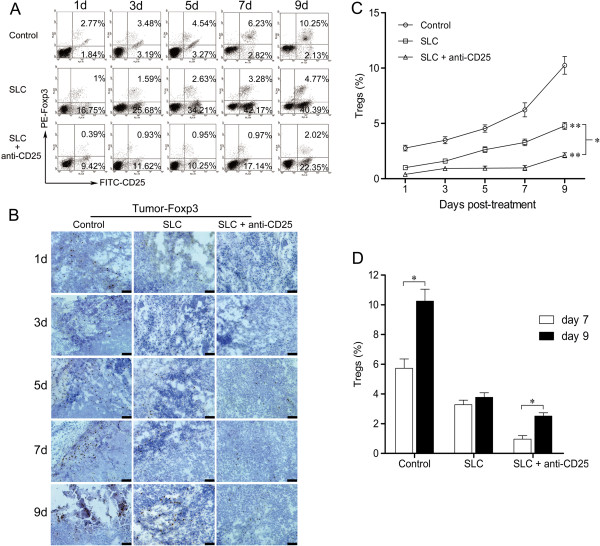
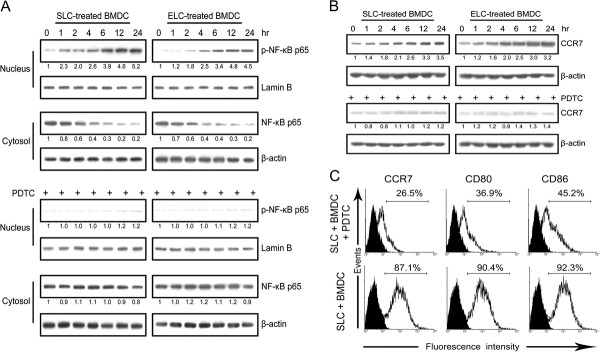
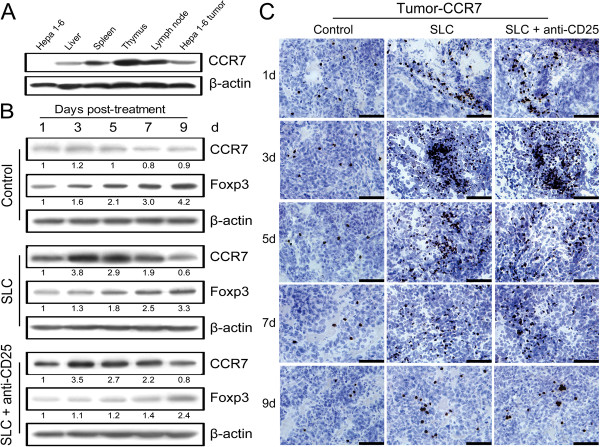
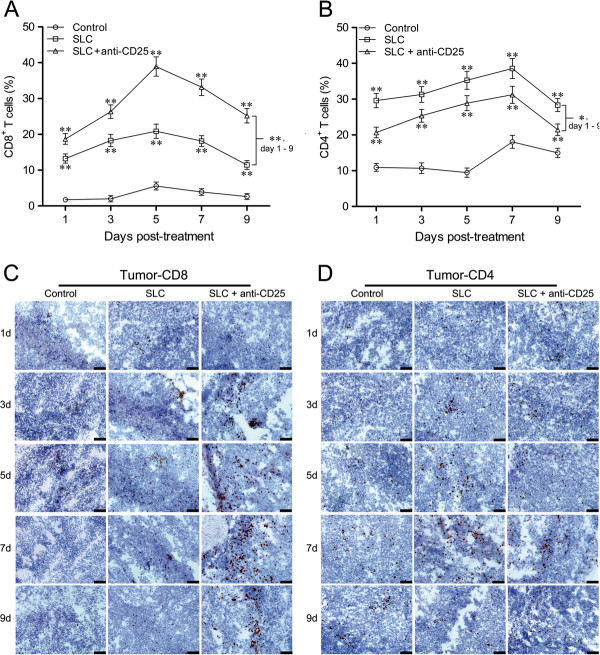
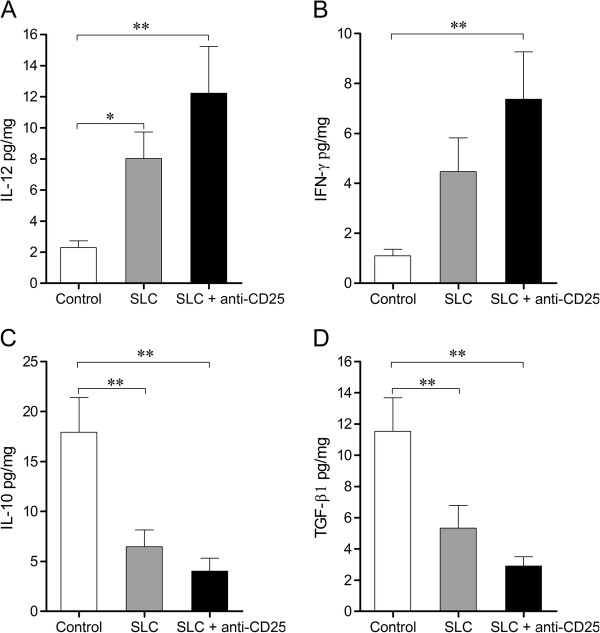
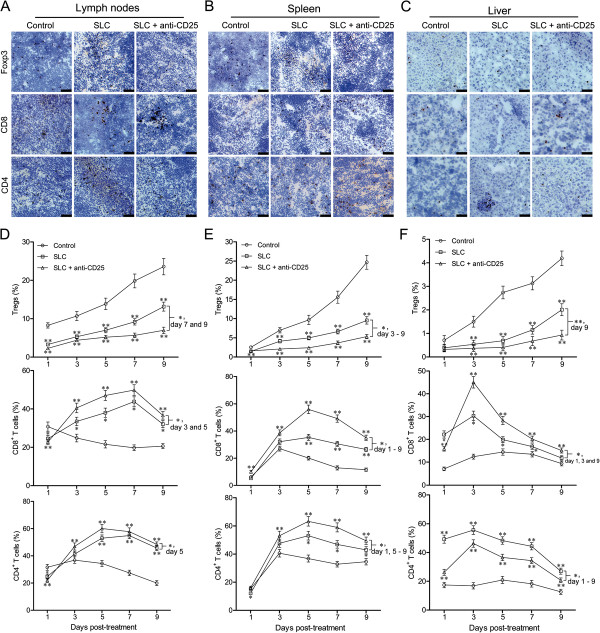
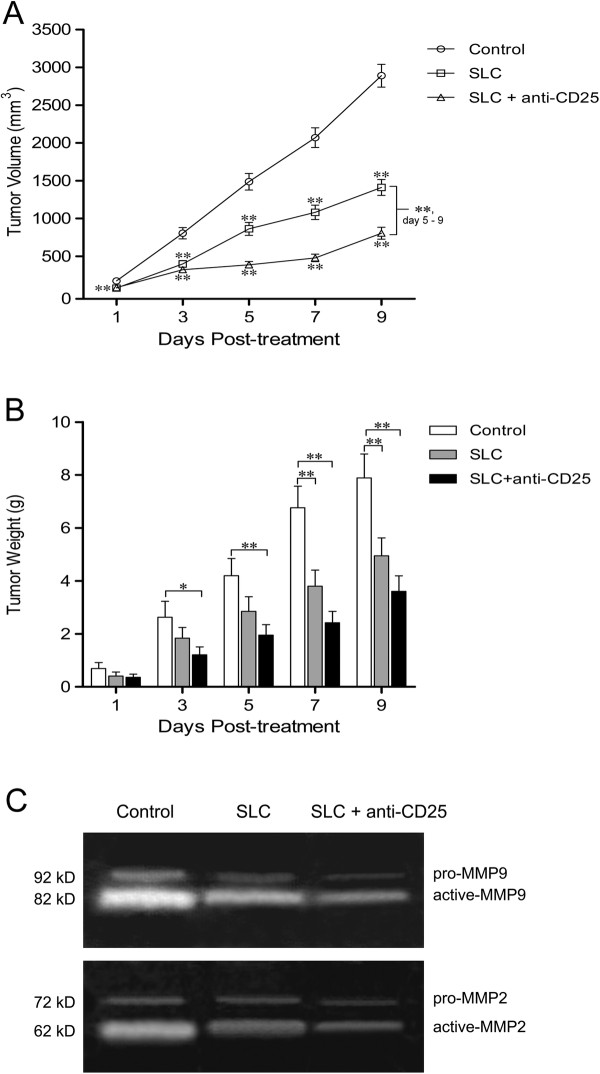
Our experiments showed the combination therapy significantly decreased the frequency of Tregs, and increased CD8+ T cells and CD4+ T cells at tumor sites. These alterations were accompanied by an increased level of IL-12 and IFN-γ, and decreased level of IL-10 and TGF-β1. Unexpectedly, we observed a significantly decreased percentage of Tregs, and increased CD8+ T cells and CD4+ T cells in the lymph nodes, spleen and liver after the combination therapy. The growth and invasiveness of HCC was also maximally inhibited in the combination therapy compared with the SLC alone. Furthermore, we confirmed SLC induced the maturation of DCs via NF-κB p65 and this maturation would benefit the combination therapy.
Our data demonstrated that intratumoral co-administration of SLC and anti-CD25 mAbs was an effective treatment for HCC, which was correlated with the altered tumor microenvironment and systemically optimized percentages of Tregs, CD8+ T cells and CD4+ T cells in peripheral immune organs.
次级淋巴组织趋化因子(SLC)是趋化免疫细胞的关键 CC 趋化因子,一直是抗肿瘤治疗的有吸引力的候选物。然而,在 SLC 募集到肿瘤中的免疫细胞中,CD25+Foxp3+调节性 T 细胞(Tregs)会损害抗肿瘤作用。在这项研究中,我们提出了 SLC 与抗 CD25 单克隆抗体(mAbs)联合肿瘤内给药的联合治疗方法。我们假设 SLC 的肿瘤内注射和 Treg 的耗竭将对小鼠肝癌(HCC)的进展具有更强的抑制作用。
将 C57BL/6 小鼠皮下接种小鼠 HCC 细胞系,并用可见肿瘤的小鼠进行 SLC、SLC 加抗 CD25 mAbs 或对照抗体的肿瘤内治疗。定期检查肿瘤、淋巴结、脾脏和肝脏中的 Tregs、效应 CD8+T 细胞和 CD4+T 细胞的百分比。评估肿瘤内 IL-12、IFN-γ、IL-10 和 TGF-β1 的水平。通过肿瘤体积和重量以及 MMP2 和 MMP9 的肿瘤内活性来衡量最终的抗肿瘤作用。使用骨髓来源的树突状细胞体外探索 SLC 诱导成熟的机制。
我们的实验表明,联合治疗显著降低了肿瘤部位 Tregs 的频率,并增加了 CD8+T 细胞和 CD4+T 细胞。这些变化伴随着 IL-12 和 IFN-γ水平的升高和 IL-10 和 TGF-β1 水平的降低。出乎意料的是,我们观察到联合治疗后淋巴结、脾脏和肝脏中的 Tregs 百分比、CD8+T 细胞和 CD4+T 细胞显著降低。与单独使用 SLC 相比,HCC 的生长和侵袭性也得到了最大抑制。此外,我们证实 SLC 通过 NF-κB p65 诱导 DC 成熟,这种成熟有利于联合治疗。
我们的数据表明,SLC 与抗 CD25 mAbs 的肿瘤内联合给药是治疗 HCC 的有效方法,这与肿瘤微环境的改变以及外周免疫器官中 Tregs、CD8+T 细胞和 CD4+T 细胞的比例得到系统优化有关。