NIHR Nottingham Hearing Biomedical Research Unit, School of Medicine, University of Nottingham, Ropewalk House, 113 The Ropewalk, Nottingham, UK.
Trials. 2013 Dec 5;14:417. doi: 10.1186/1745-6215-14-417.
One in ten people aged between 55 to 74 years have a significant hearing impairment in their better hearing ear (as defined by audiometric hearing thresholds). However, it is becoming increasingly clear that the challenges faced by older listeners cannot be explained by the audiogram alone. The ability for people with hearing loss to use cognition to support speech perception allows for compensation of the degraded auditory input. This in turn offers promise for new cognitive-based rehabilitative interventions. Working memory is known to be highly associated with language comprehension and recent evidence has shown significant generalization of learning from trained working memory tasks to improvements in sentence-repetition skills of children with severe to profound hearing loss. This evidence offers support for further investigation into the potential benefits of working memory training to improve speech perception abilities in other hearing impaired populations.
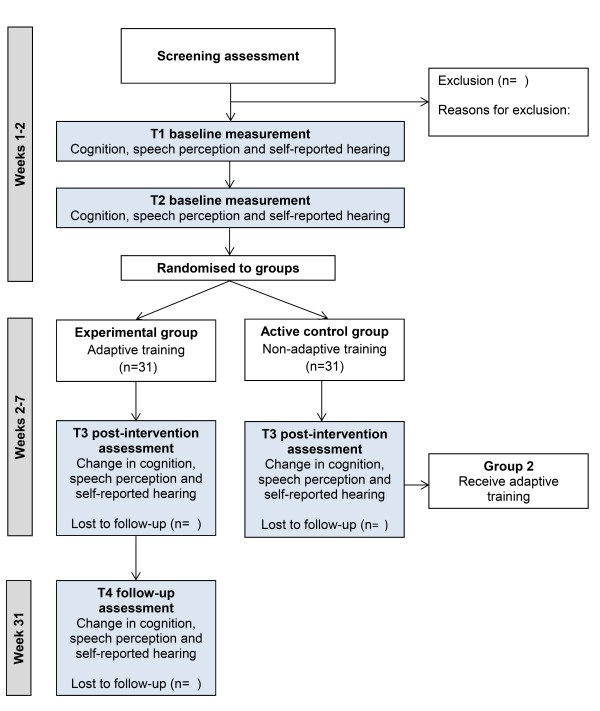
METHODS/DESIGN: This is a double-blind randomized active controlled trial aiming to assess whether a program of working memory training results in improvements in untrained measures of cognition, speech perception and self-reported hearing abilities in adult hearing aid users aged (50 to 74 years) with mild-to-moderate hearing loss hearing aid users, compared with an active control group who receive a placebo version of the working memory training program.
The present study aims to generate high-quality preliminary evidence for the efficacy of working memory training for adult hearing aid users with mild-to-moderate sensorineural hearing loss who are existing hearing aid users. This trial addresses a number of gaps in the published literature assessing training interventions for people with hearing loss, and in the general literature surrounding working memory training, such as the inclusion of an active control group, participant and tester blinding, and increased transparency in reporting.
ClinicalTrials.gov identifier: NCT01892007. Date of registration: 27 June 2013.
在 55 岁至 74 岁的人群中,每 10 人就有 1 人在较好耳(根据听力阈值定义)存在明显的听力障碍。然而,越来越明显的是,老年人所面临的挑战不能仅用听力图来解释。听力损失者利用认知能力来支持言语感知的能力允许对退化的听觉输入进行补偿。这反过来为新的基于认知的康复干预措施提供了希望。工作记忆与语言理解高度相关,最近的证据表明,从经过训练的工作记忆任务中学习到的显著概括可以提高严重至极重度听力损失儿童的句子重复技能。这一证据为进一步研究工作记忆训练对改善其他听力障碍人群的言语感知能力的潜在益处提供了支持。
方法/设计:这是一项双盲随机对照活性对照试验,旨在评估工作记忆训练计划是否会导致轻度至中度听力损失的成年助听器使用者(50 至 74 岁)的未训练认知、言语感知和自我报告听力能力的改善,与接受工作记忆训练计划的安慰剂版本的活性对照组相比。
本研究旨在为轻度至中度感音神经性听力损失的成年助听器使用者提供工作记忆训练的有效性的高质量初步证据,这些使用者是现有的助听器使用者。该试验解决了评估听力损失人群的训练干预措施以及一般文献中围绕工作记忆训练的许多空白,例如包括活性对照组、参与者和测试者的盲法以及提高报告的透明度。
ClinicalTrials.gov 标识符:NCT01892007。注册日期:2013 年 6 月 27 日。