Gouras Gunnar K
Department of Experimental Medical Science, Experimental Dementia Research Unit, Wallenberg Neuroscience Center, Lund University, 221 84 Lund, Sweden.
Int J Cell Biol. 2013;2013:141083. doi: 10.1155/2013/141083. Epub 2013 Nov 7.
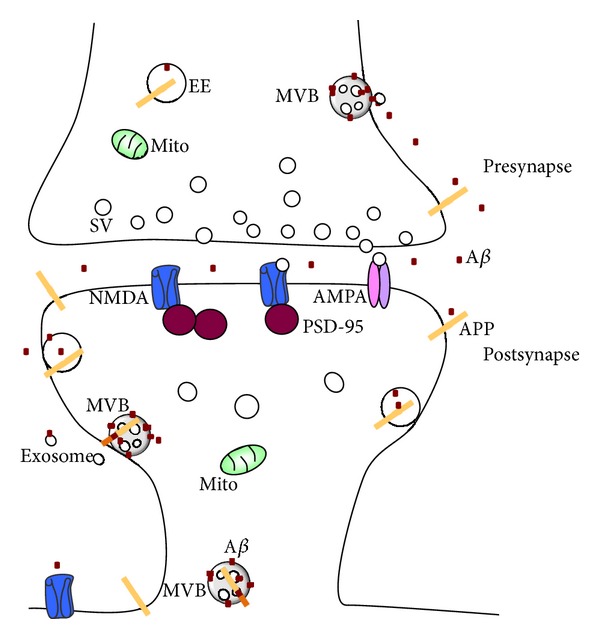
Age-related misfolding and aggregation of disease-linked proteins in selective brain regions is a characteristic of neurodegenerative diseases. Although neuropathological aggregates that characterize these various diseases are found at sites other than synapses, increasing evidence supports the idea that synapses are where the pathogenesis begins. Understanding these diseases is hampered by our lack of knowledge of what the normal functions of these proteins are and how they are affected by aging. Evidence has supported the idea that neurodegenerative disease-linked proteins have a common propensity for prion protein-like cell-to-cell propagation. However, it is not thought that the prion-like quality of these proteins/peptides that allows their cell-to-cell transmission implies a role for human-to-human spread in common age-related neurodegenerative diseases. It will be important to better understand the molecular and cellular mechanisms governing the role of these aggregating proteins in neural function, especially at synapses, how their propagation occurs and how pathogenesis is promoted by aging.
与年龄相关的疾病相关蛋白在选择性脑区的错误折叠和聚集是神经退行性疾病的一个特征。尽管表征这些不同疾病的神经病理聚集体在突触以外的部位被发现,但越来越多的证据支持这样一种观点,即突触是发病机制开始的地方。我们对这些蛋白质的正常功能以及它们如何受到衰老影响缺乏了解,这阻碍了我们对这些疾病的理解。有证据支持这样一种观点,即与神经退行性疾病相关的蛋白质具有类似朊病毒蛋白的细胞间传播的共同倾向。然而,人们并不认为这些蛋白质/肽的朊病毒样性质使其能够在细胞间传递意味着它们在常见的与年龄相关的神经退行性疾病中具有人际传播的作用。更好地理解控制这些聚集蛋白在神经功能中作用的分子和细胞机制将非常重要,尤其是在突触处,它们如何传播以及衰老如何促进发病机制。