Departments of Neurology, Physiology and Psychiatry, University of California, San Francisco, CA, USA.
Prog Brain Res. 2013;207:351-77. doi: 10.1016/B978-0-444-63327-9.00013-8.
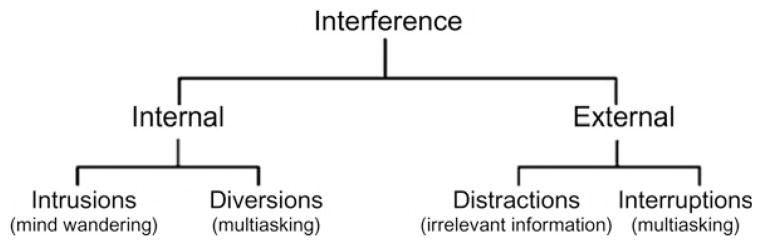
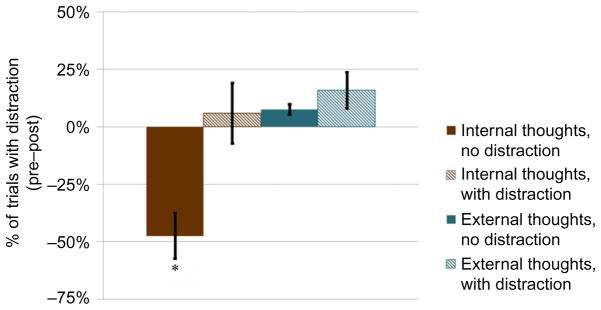
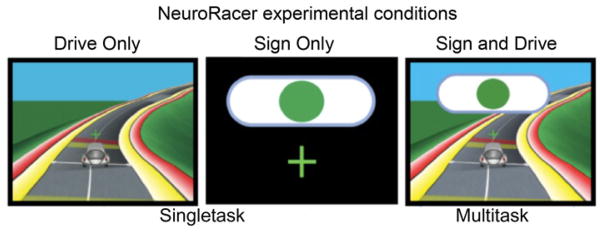
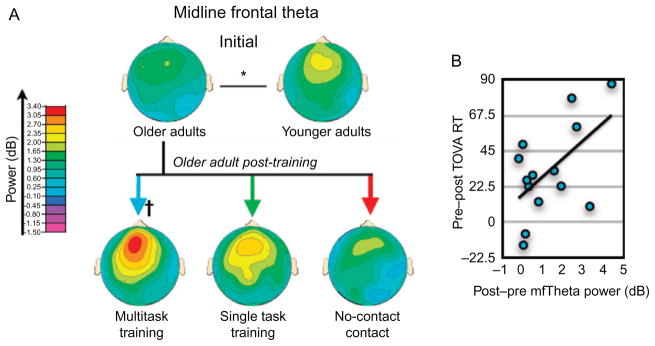
All of us are familiar with the negative impact of interference on achieving our task goals. We are referring to interference by information, which either impinges on our senses from an external environmental source or is internally generated by our thoughts. Informed by more than a decade of research on the cognitive and neural processing of interference, we have developed a framework for understanding how interference impacts our neural systems and especially how it is regulated and suppressed during efficient on-task performance. Importantly, externally and internally generated interferences have distinct neural signatures, and further, distinct neural processing emerges depending on whether individuals must ignore and suppress the interference, as for distractions, or engage with them in a secondary task, as during multitasking. Here, we elaborate on this cognitive framework and how it changes throughout the human lifespan, focusing mostly on research evidence from younger adults and comparing these findings to data from older adults, children, and cognitively impaired populations. With insights gleaned from our growing understanding, we then describe three novel translational efforts in our lab directed at improving distinct aspects of interference resolution using cognitive training. Critically, these training approaches were specifically developed to target improved interference resolution based on neuroplasticity principles and have shown much success in randomized controlled first version evaluations in healthy aging. Our results show not only on-task training improvements but also robust generalization of benefit to other cognitive control abilities. This research showcases how an in-depth understanding of neural mechanisms can then inform the development of effective deficit-targeted interventions, which can in turn benefit both healthy and cognitively impaired populations.
我们都熟悉干扰对实现任务目标的负面影响。我们指的是信息干扰,它要么来自外部环境源,要么是我们的思维内部产生的。在对干扰的认知和神经处理进行了十多年的研究之后,我们提出了一个框架,用于理解干扰如何影响我们的神经系统,特别是在高效完成任务时如何对其进行调节和抑制。重要的是,外部和内部产生的干扰具有不同的神经特征,而且根据个体是否必须忽略和抑制干扰(如分心)或在次要任务中处理干扰(如多任务处理),会出现不同的神经处理。在这里,我们详细阐述了这个认知框架,以及它在整个生命周期中是如何变化的,主要关注来自年轻成年人的研究证据,并将这些发现与来自老年人、儿童和认知障碍人群的数据进行比较。从我们日益增长的理解中汲取的见解,我们描述了我们实验室中的三个新的转化努力,旨在使用认知训练改善干扰分辨率的不同方面。至关重要的是,这些训练方法是根据神经可塑性原则专门开发的,旨在提高干扰分辨率,并在健康老龄化的随机对照初步评估中取得了很大的成功。我们的结果不仅显示了任务训练的改进,而且还显示了对其他认知控制能力的受益的稳健推广。这项研究展示了深入了解神经机制如何为有效的针对缺陷的干预措施的发展提供信息,从而使健康和认知障碍人群都受益。