Food Animal Health Research Program, Ohio Agricultural Research and Development Center, Department of Veterinary Preventive Medicine, The Ohio State University, Wooster, OH, USA.
Food Animal Health Research Program, Ohio Agricultural Research and Development Center, Department of Veterinary Preventive Medicine, The Ohio State University, Wooster, OH, USA.
Vet Microbiol. 2014 Jan 10;168(1):202-7. doi: 10.1016/j.vetmic.2013.11.008. Epub 2013 Nov 16.
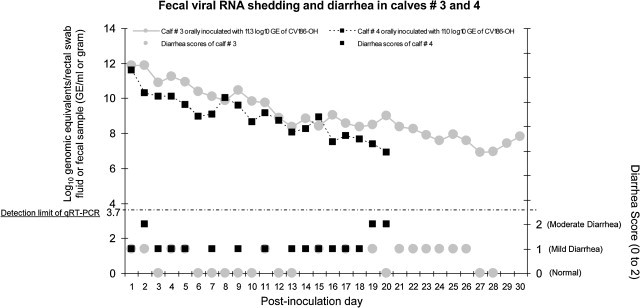
The pathogenesis of GIII.2 bovine norovirus (BoNoV) is not well understood. Our study demonstrated persisting diarrhea and prolonged fecal shedding, but with a lack of significant intestinal lesions in gnotobiotic (Gn) calves infected with GIII.2 BoNoV, CV186-OH/00/US strain. Nine 4 to 7-day-old Angus/Jersey crossbred Gn calves were orally inoculated with 10.0-11.9 log10 genomic equivalents (GE)/calf of CV186-OH (n=7) or mock (n=2). Calves were euthanized at post-inoculation day (PID) 1 (n=1) when moderate to severe lethargy was observed and at PIDs 2-6 (n=4) after lethargy had subsided. Two calves were kept longer term (until PID 30) for monitoring fecal shedding patterns by TaqMan real-time RT-PCR (qRT-PCR). Most infected calves exhibited two clinical signs: (i) acute but persisting diarrhea and (ii) acute moderate to severe lethargy. The two infected calves, followed longer-term, had prolonged fecal viral RNA shedding [peak average titer of 11.8 (± 0.2) log10GE/ml] at least until PID 20. By qRT-PCR, 5 infected calves had low viral RNA titers in serum, ranging from 4.0 to 5.8 log10GE/ml, at PIDs 1-5, but not (<2.7 log10GE/ml) at PIDs 6-30. The latter observation coincided with the presence of serum IgG antibody to BoNoV at PIDs 8-30. Collectively, the GIII.2 BoNoV strain CV186-OH induced only mild enteropathogenicity, evident by the lack of significant intestinal lesions, but it led to persisting mild diarrhea and prolonged fecal virus shedding in Gn calves. The prolonged fecal shedding of GIII.2 BoNoV might partially explain how this virus is maintained as endemic infections in cattle.
GIII.2 型牛诺如病毒(BoNoV)的发病机制尚不清楚。我们的研究表明,感染 GIII.2 型 BoNoV CV186-OH/00/US 株的无菌(Gn)小牛持续腹泻和粪便排泄延长,但肠道病变不明显。9 头 4 至 7 日龄的 Angus/Jersey 杂交 Gn 小牛经口接种 10.0-11.9 log10 基因组等效物(GE)/小牛 CV186-OH(n=7)或模拟物(n=2)。当观察到中度至重度嗜睡时,在接种后第 1 天(PID)1(n=1)处死小牛,并且在嗜睡消退后在 PID 2-6 天(n=4)处死。两只小牛被保留更长时间(直到 PID 30),通过 TaqMan 实时 RT-PCR(qRT-PCR)监测粪便脱落模式。大多数感染的小牛表现出两种临床症状:(i)急性但持续的腹泻和(ii)急性中度至重度嗜睡。两只感染时间较长的小牛,粪便病毒 RNA 脱落延长[峰值平均滴度为 11.8(±0.2)log10GE/ml],至少持续到 PID 20。通过 qRT-PCR,5 只感染小牛在 PID 1-5 时血清中的病毒 RNA 滴度较低,范围为 4.0 至 5.8 log10GE/ml,但在 PID 6-30 时则没有(<2.7 log10GE/ml)。后一种观察结果与 PID 8-30 时血清中存在抗 BoNoV IgG 抗体相符。总之,GIII.2 型 BoNoV 株 CV186-OH 仅引起轻度肠致病性,表现为肠道病变不明显,但导致 Gn 小牛持续轻度腹泻和粪便病毒排泄延长。GIII.2 型 BoNoV 的粪便持续排泄可能部分解释了该病毒如何在牛中维持地方性感染。