Weill Institute for Cell and Molecular Biology, Cornell University, 526 Campus Road, Ithaca, NY 14853, USA.
Department of Biomedical Engineering/Weill Institute for Cell and Molecular Biology, Cornell University, 526 Campus Road, Ithaca, NY 14853, USA.
Trends Cell Biol. 2014 Apr;24(4):247-56. doi: 10.1016/j.tcb.2013.11.004. Epub 2013 Dec 2.
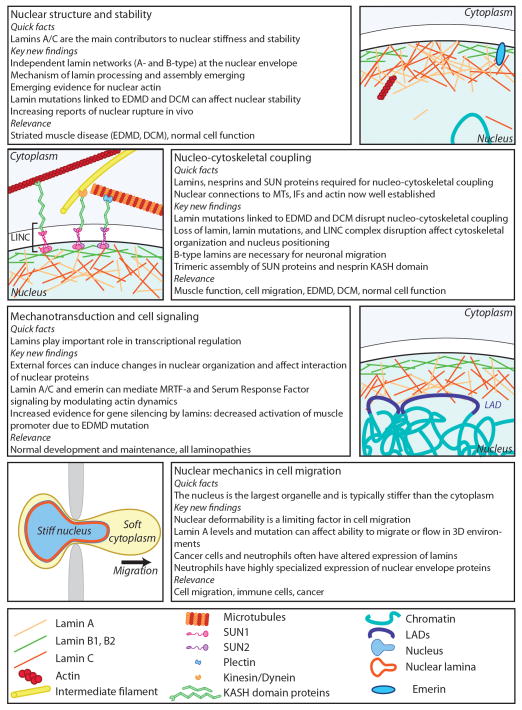
Mutations in lamins, which are ubiquitous nuclear intermediate filaments, lead to a variety of disorders including muscular dystrophy and dilated cardiomyopathy. Lamins provide nuclear stability, help connect the nucleus to the cytoskeleton, and can modulate chromatin organization and gene expression. Nonetheless, the diverse functions of lamins remain incompletely understood. We focus here on the role of lamins on nuclear mechanics and their involvement in human diseases. Recent findings suggest that lamin mutations can decrease nuclear stability, increase nuclear fragility, and disturb mechanotransduction signaling, possibly explaining the muscle-specific defects in many laminopathies. At the same time, altered lamin expression has been reported in many cancers, where the resulting increased nuclear deformability could enhance the ability of cells to transit tight interstitial spaces, thereby promoting metastasis.
突变的核纤层蛋白,作为普遍存在的核中间丝,导致多种疾病,包括肌肉萎缩症和扩张型心肌病。核纤层蛋白提供核稳定性,有助于将细胞核与细胞骨架连接,并可以调节染色质组织和基因表达。尽管如此,核纤层蛋白的多种功能仍不完全清楚。我们在这里关注核纤层蛋白在核力学中的作用及其在人类疾病中的作用。最近的研究结果表明,核纤层蛋白的突变会降低核稳定性,增加核脆性,并干扰机械转导信号,这可能解释了许多核纤层蛋白病中的肌肉特异性缺陷。同时,许多癌症中报道了核纤层蛋白表达的改变,其中增加的核变形性可能增强细胞穿过紧密的细胞间质的能力,从而促进转移。