Pilkington Suzanne M, Rhodes Lesley E, Al-Aasswad Naser M I, Massey Karen A, Nicolaou Anna
Dermatology Centre, Institute of Inflammation and Repair, Manchester Academic Health Science Centre, Salford Royal NHS Foundation Hospital, University of Manchester, Manchester, UK.
Mol Nutr Food Res. 2014 Mar;58(3):580-90. doi: 10.1002/mnfr.201300405. Epub 2013 Dec 5.
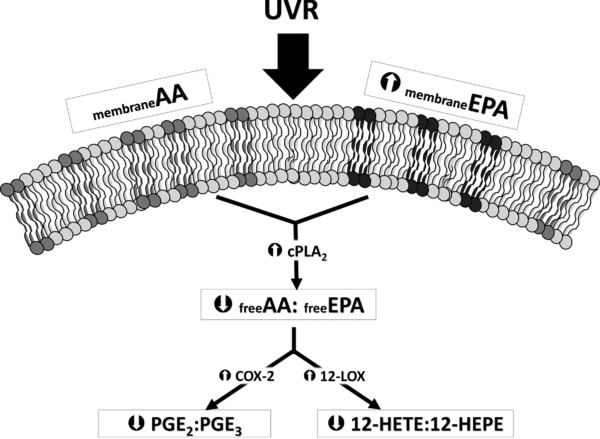
Eicosapentaenoic acid (EPA), abundant in oily fish, is reported to reduce skin inflammation and provide photoprotection, potential mechanisms include competition with arachidonic acid (AA) for metabolism by cyclooxygenases/lipoxygenases to less pro-inflammatory mediators. We thus examine impact of EPA intake on levels of AA, EPA and their resulting eicosanoids in human skin with or without ultraviolet radiation (UVR) challenge.
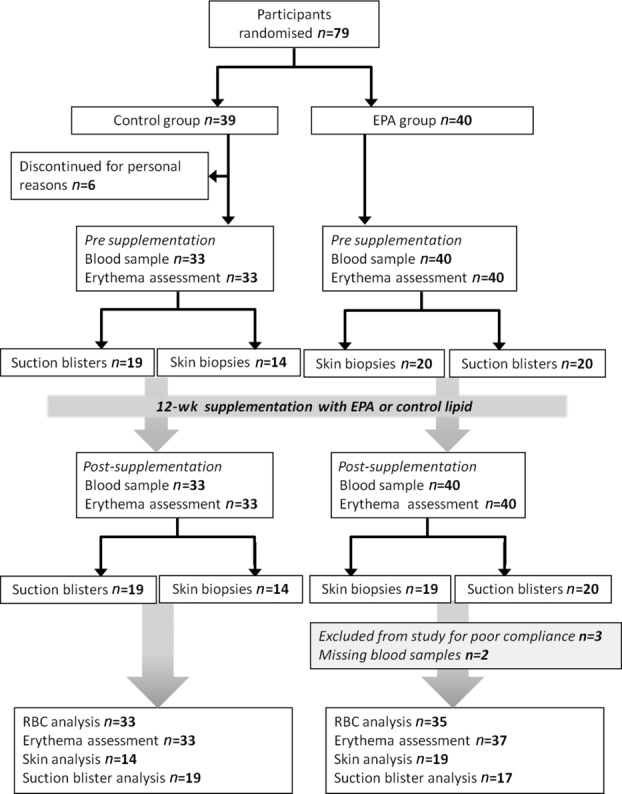
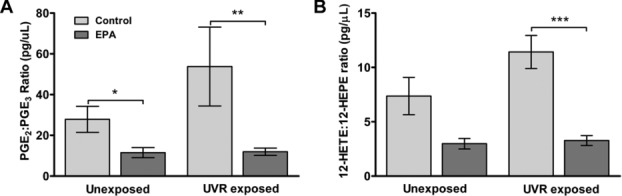
In a double-blind randomised controlled study, 79 females took 5 g EPA-rich or control lipid for 12 wk. Pre- and post-supplementation, red blood cell and skin polyunsaturated fatty acids were assessed by GC, and eicosanoids from unexposed and UVR-exposed skin by LC-MS/MS. Active supplementation increased red blood cell and dermal EPA versus control (both p < 0.001), lowering relative AA:EPA content (4:1 versus 15:1 and 5:1 versus 11:1, respectively; both p < 0.001). Pre-supplementation, UVR increased PGE2, 12-hydroxyeicosatetraenoic acids, 12-HEPE (all p < 0.001) and PGE3 (p < 0.05). Post-EPA, PGE2 was reduced in unchallenged skin (p < 0.05) while EPA-derived PGE3 (non-sign) and 12-HEPE (p < 0.01) were elevated post-UVR. Thus, post-EPA, PGE2 :PGE3 was lower in unchallenged (12:1 versus 28:1; p < 0.05) and UVR exposed (12:1 versus 54:1; p < 0.01) skin; 12-hydroxyeicosatetraenoic acids:12-HEPE was lower in UVR-exposed skin (3:1 versus 11:1; p < 0.001).
Dietary EPA augments skin EPA:AA content, shifting eicosanoid synthesis towards less pro-inflammatory species, and promoting a regulatory milieu under basal conditions and in response to inflammatory insult.
二十碳五烯酸(EPA)在油性鱼类中含量丰富,据报道它能减轻皮肤炎症并提供光保护作用,其潜在机制包括与花生四烯酸(AA)竞争,通过环氧化酶/脂氧合酶代谢生成炎症性较低的介质。因此,我们研究了摄入EPA对有或无紫外线辐射(UVR)刺激的人体皮肤中AA、EPA及其衍生的类二十烷酸水平的影响。
在一项双盲随机对照研究中,79名女性连续12周服用5克富含EPA的脂质或对照脂质。在补充前后,通过气相色谱法评估红细胞和皮肤中的多不饱和脂肪酸,并通过液相色谱 - 串联质谱法评估未暴露和UVR暴露皮肤中的类二十烷酸。与对照组相比,积极补充EPA可增加红细胞和皮肤中的EPA含量(均p < 0.001),降低相对的AA:EPA含量(分别从4:1降至15:1和从5:1降至11:1;均p < 0.001)。补充前,UVR会增加前列腺素E2(PGE2)、12 - 羟基二十碳四烯酸(12 - HETEs)、12 - 羟基二十碳五烯酸(12 - HEPE)(均p < 0.001)和前列腺素E3(PGE3)(p < 0.05)的水平。补充EPA后,未受刺激皮肤中的PGE2水平降低(p < 0.05),而UVR照射后EPA衍生的PGE3(无统计学意义)和12 - HEPE水平升高(p < 0.01)。因此,补充EPA后,未受刺激皮肤(从12:1降至28:1;p < 0.05)和UVR暴露皮肤(从12:1降至54:1;p < 0.01)中的PGE2:PGE3比值降低;UVR暴露皮肤中的12 - 羟基二十碳四烯酸:12 - HEPE比值降低(从3:1降至11:1;p < 0.001)。
膳食中的EPA可增加皮肤中EPA:AA的含量,使类二十烷酸合成向炎症性较低的种类转变,并在基础条件下以及应对炎症损伤时促进调节环境的形成。