Kobeissy Firas, Mondello Stefania, Tümer Nihal, Toklu Hale Z, Whidden Melissa A, Kirichenko Nataliya, Zhang Zhiqun, Prima Victor, Yassin Walid, Anagli John, Chandra Namas, Svetlov Stan, Wang Kevin K W
Department of Psychiatry, Center of Neuroproteomics & Biomarker Research, University of Florida , Gainesville, FL , USA ; Department of Biochemistry and Molecular Genetics, American University of Beirut Medical Center , Beirut , Lebanon.
Front Neurol. 2013 Nov 21;4:186. doi: 10.3389/fneur.2013.00186.
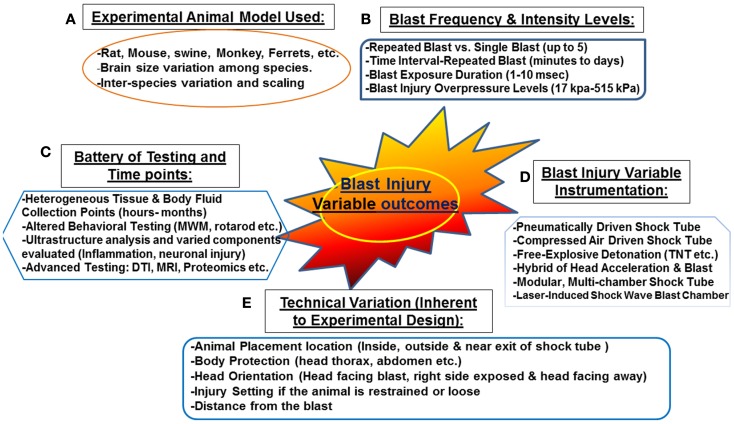
Among the U.S. military personnel, blast injury is among the leading causes of brain injury. During the past decade, it has become apparent that even blast injury as a form of mild traumatic brain injury (mTBI) may lead to multiple different adverse outcomes, such as neuropsychiatric symptoms and long-term cognitive disability. Blast injury is characterized by blast overpressure, blast duration, and blast impulse. While the blast injuries of a victim close to the explosion will be severe, majority of victims are usually at a distance leading to milder form described as mild blast TBI (mbTBI). A major feature of mbTBI is its complex manifestation occurring in concert at different organ levels involving systemic, cerebral, neuronal, and neuropsychiatric responses; some of which are shared with other forms of brain trauma such as acute brain injury and other neuropsychiatric disorders such as post-traumatic stress disorder. The pathophysiology of blast injury exposure involves complex cascades of chronic psychological stress, autonomic dysfunction, and neuro/systemic inflammation. These factors render blast injury as an arduous challenge in terms of diagnosis and treatment as well as identification of sensitive and specific biomarkers distinguishing mTBI from other non-TBI pathologies and from neuropsychiatric disorders with similar symptoms. This is due to the "distinct" but shared and partially identified biochemical pathways and neuro-histopathological changes that might be linked to behavioral deficits observed. Taken together, this article aims to provide an overview of the current status of the cellular and pathological mechanisms involved in blast overpressure injury and argues for the urgent need to identify potential biomarkers that can hint at the different mechanisms involved.
在美国军事人员中,爆炸伤是脑损伤的主要原因之一。在过去十年中,很明显,即使是作为轻度创伤性脑损伤(mTBI)形式的爆炸伤也可能导致多种不同的不良后果,如神经精神症状和长期认知残疾。爆炸伤的特征是爆炸超压、爆炸持续时间和爆炸冲量。虽然靠近爆炸的受害者的爆炸伤会很严重,但大多数受害者通常处于一定距离,导致较轻的形式,称为轻度爆炸创伤性脑损伤(mbTBI)。mbTBI的一个主要特征是其复杂的表现,在不同器官水平同时出现,涉及全身、大脑、神经元和神经精神反应;其中一些与其他形式的脑创伤如急性脑损伤以及其他神经精神障碍如创伤后应激障碍有共同之处。爆炸伤暴露的病理生理学涉及慢性心理应激、自主神经功能障碍和神经/全身炎症的复杂级联反应。这些因素使得爆炸伤在诊断和治疗以及识别区分mTBI与其他非TBI病理和具有相似症状的神经精神障碍的敏感和特异性生物标志物方面成为一项艰巨的挑战。这是由于可能与观察到的行为缺陷相关的“独特”但共享且部分确定的生化途径和神经组织病理学变化。综上所述,本文旨在概述爆炸超压损伤所涉及的细胞和病理机制的现状,并主张迫切需要识别能够提示所涉及的不同机制的潜在生物标志物。