Boschert Verena, van Dinther Maarten, Weidauer Stella, van Pee Katharina, Muth Eva-Maria, Ten Dijke Peter, Mueller Thomas D
Department of Molecular Plant Physiology and Biophysics, Julius-von-Sachs Institute of the University Wuerzburg, Wuerzburg, Germany.
PLoS One. 2013 Nov 29;8(11):e81710. doi: 10.1371/journal.pone.0081710. eCollection 2013.
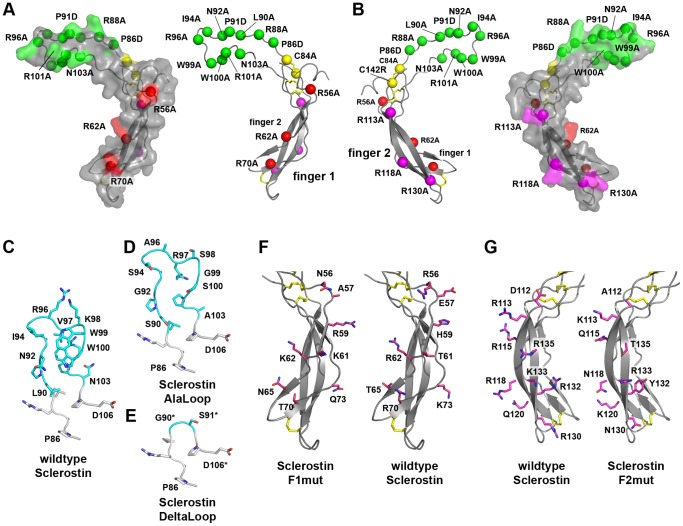
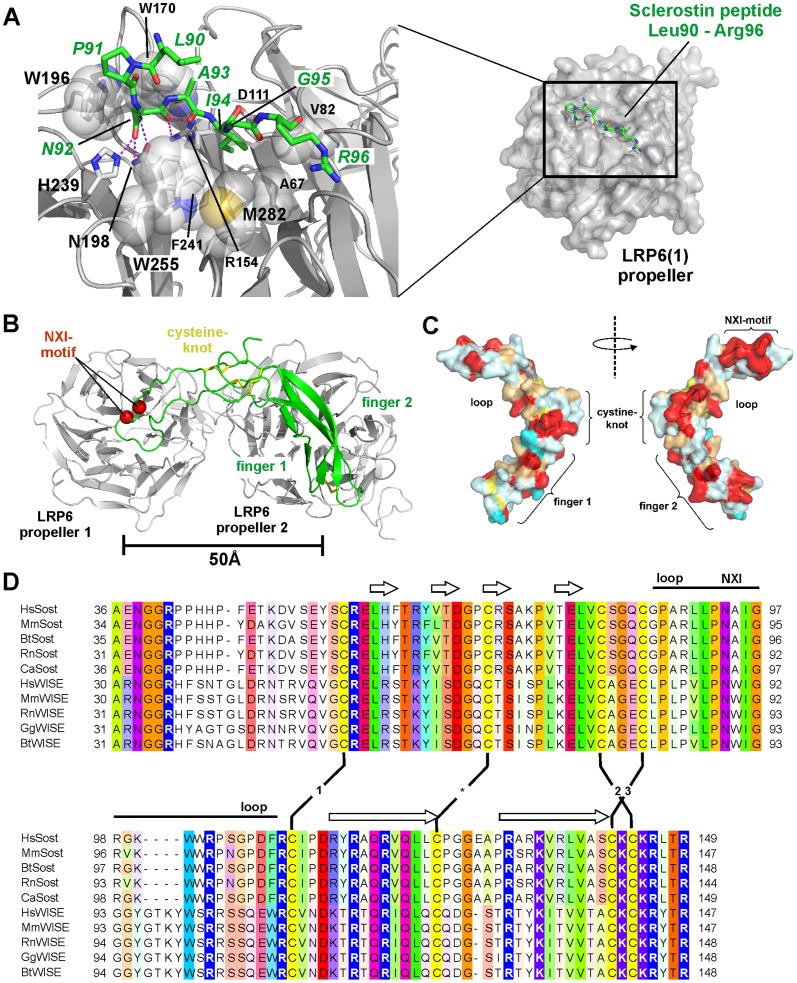
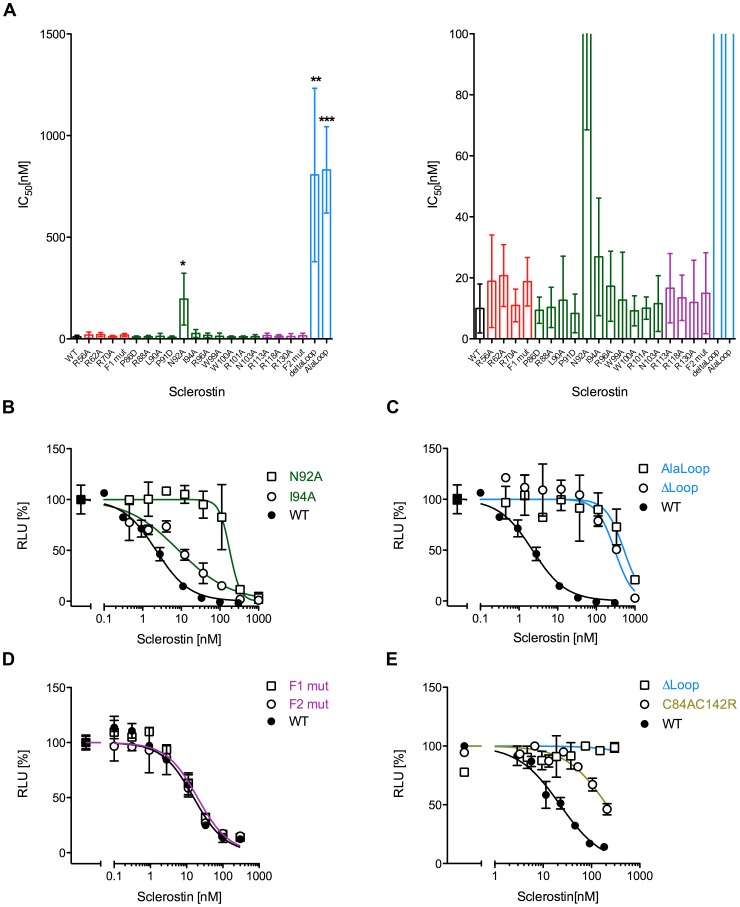
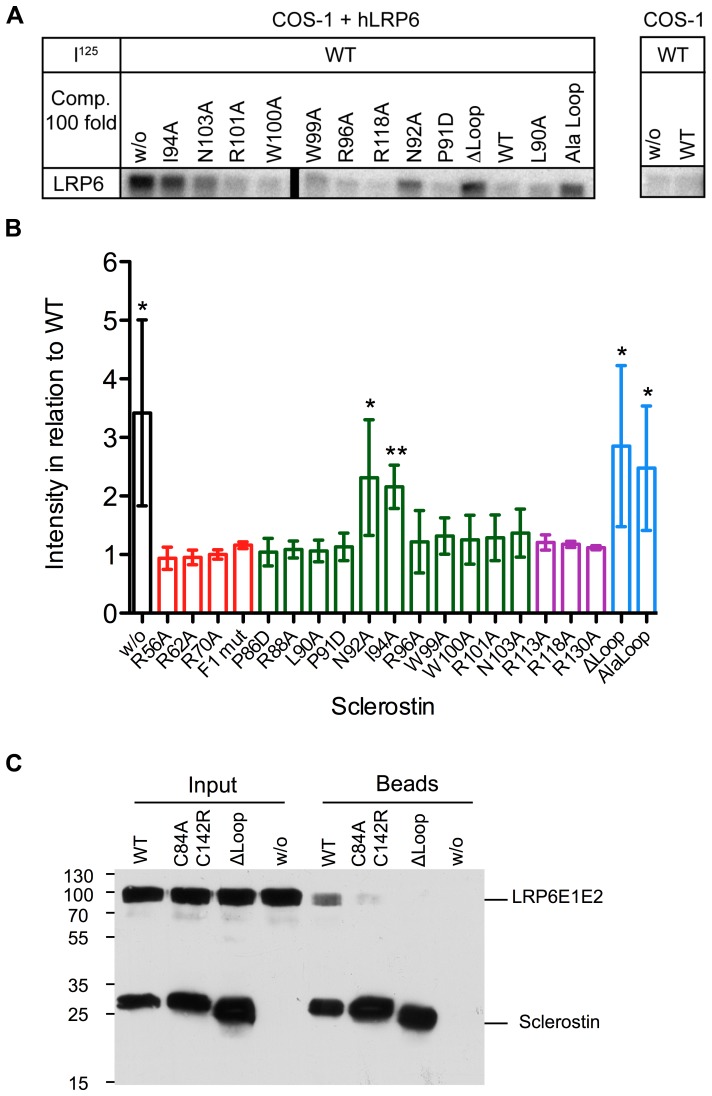
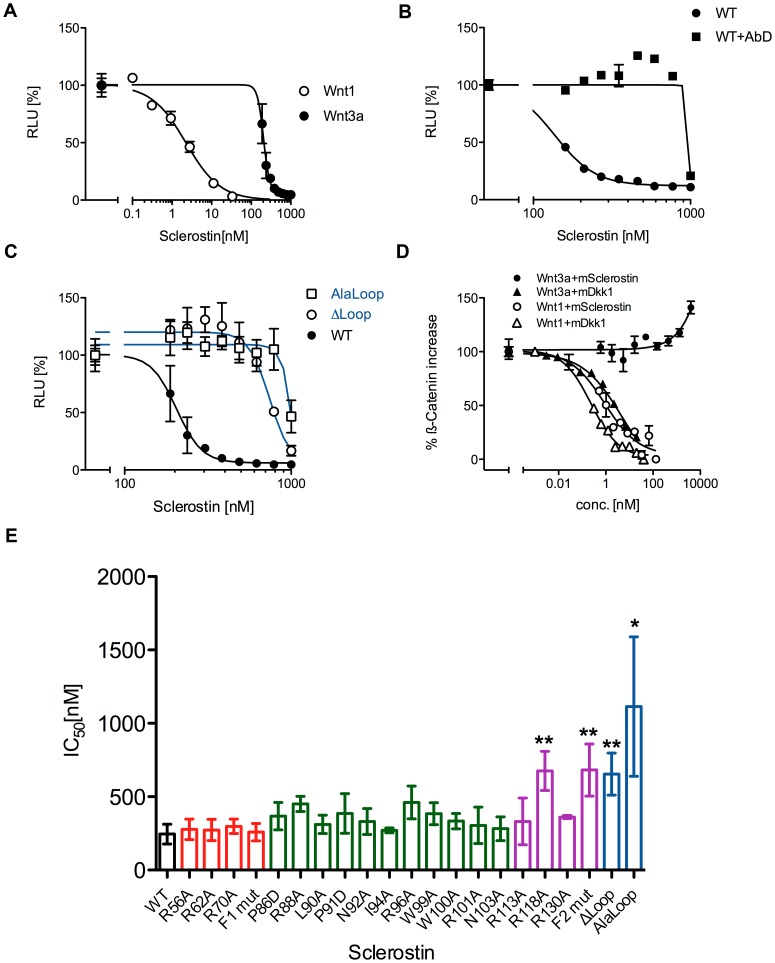
The cystine-knot containing protein Sclerostin is an important negative regulator of bone growth and therefore represents a promising therapeutic target. It exerts its biological task by inhibiting the Wnt (wingless and int1) signaling pathway, which participates in bone formation by promoting the differentiation of mesenchymal stem cells to osteoblasts. The core structure of Sclerostin consists of three loops with the first and third loop (Finger 1 and Finger 2) forming a structured β-sheet and the second loop being unstructured and highly flexible. Biochemical data showed that the flexible loop is important for binding of Sclerostin to Wnt co-receptors of the low-density lipoprotein related-protein family (LRP), by interacting with the Wnt co-receptors LRP5 or -6 it inhibits Wnt signaling. To further examine the structural requirements for Wnt inhibition, we performed an extensive mutational study within all three loops of the Sclerostin core domain involving single and multiple mutations as well as truncation of important regions. By this approach we could confirm the importance of the second loop and especially of amino acids Asn92 and Ile94 for binding to LRP6. Based on a Sclerostin variant found in a Turkish family suffering from Sclerosteosis we generated a Sclerostin mutant with cysteines 84 and 142 exchanged thereby removing the third disulfide bond of the cystine-knot. This mutant binds to LRP6 with reduced binding affinity and also exhibits a strongly reduced inhibitory activity against Wnt1 thereby showing that also elements outside the flexible loop are important for inhibition of Wnt by Sclerostin. Additionally, we examined the effect of the mutations on the inhibition of two different Wnt proteins, Wnt3a and Wnt1. We could detect clear differences in the inhibition of these proteins, suggesting that the mechanism by which Sclerostin antagonizes Wnt1 and Wnt3a is fundamentally different.
含胱氨酸结蛋白硬化蛋白是骨生长的重要负调节因子,因此是一个很有前景的治疗靶点。它通过抑制Wnt(无翅型MMTV整合位点家族成员1)信号通路来发挥其生物学功能,该信号通路通过促进间充质干细胞向成骨细胞分化参与骨形成。硬化蛋白的核心结构由三个环组成,第一个和第三个环(指1和指2)形成一个结构化的β折叠,第二个环无结构且高度灵活。生化数据表明,这个灵活的环对于硬化蛋白与低密度脂蛋白相关蛋白家族(LRP)的Wnt共受体结合很重要,通过与Wnt共受体LRP5或LRP6相互作用,它抑制Wnt信号。为了进一步研究抑制Wnt的结构要求,我们对硬化蛋白核心结构域的所有三个环进行了广泛的突变研究,包括单突变和多突变以及重要区域的截短。通过这种方法,我们可以证实第二个环尤其是氨基酸Asn92和Ile94对于与LRP6结合的重要性。基于在一个患有骨硬化症的土耳其家族中发现的一种硬化蛋白变体,我们生成了一个将半胱氨酸84和142进行交换的硬化蛋白突变体,从而去除了胱氨酸结的第三个二硫键。这个突变体与LRP6的结合亲和力降低,并且对Wnt1的抑制活性也显著降低,从而表明灵活环之外的元件对于硬化蛋白抑制Wnt也很重要。此外,我们研究了这些突变对两种不同Wnt蛋白Wnt3a和Wnt1抑制的影响。我们可以检测到对这些蛋白抑制的明显差异,这表明硬化蛋白拮抗Wnt1和Wnt3a的机制根本不同。