Rubia Katya, Alegria Analucia A, Cubillo Ana I, Smith Anna B, Brammer Michael J, Radua Joaquim
Departments of Child and Adolescent Psychiatry (KR, AAA, AIC, AS) and Neuroimaging (MJB), Institute of Psychiatry, King's College London, United Kingdom.
Departments of Child and Adolescent Psychiatry (KR, AAA, AIC, AS) and Neuroimaging (MJB), Institute of Psychiatry, King's College London, United Kingdom.
Biol Psychiatry. 2014 Oct 15;76(8):616-28. doi: 10.1016/j.biopsych.2013.10.016. Epub 2013 Oct 24.
Psychostimulant medication, most commonly the catecholamine agonist methylphenidate, is the most effective treatment for attention-deficit/hyperactivity disorder (ADHD). However, relatively little is known on the mechanisms of action. Acute effects on brain function can elucidate underlying neurocognitive effects. We tested methylphenidate effects relative to placebo in functional magnetic resonance imaging (fMRI) during three disorder-relevant tasks in medication-naïve ADHD adolescents. In addition, we conducted a systematic review and meta-analysis of the fMRI findings of acute stimulant effects on ADHD brain function.
The fMRI study compared 20 adolescents with ADHD under either placebo or methylphenidate in a randomized controlled trial while performing stop, working memory, and time discrimination tasks. The meta-analysis was conducted searching PubMed, ScienceDirect, Web of Knowledge, Google Scholar, and Scopus databases. Peak coordinates of clusters of significant effects of stimulant medication relative to placebo or off medication were extracted for each study.
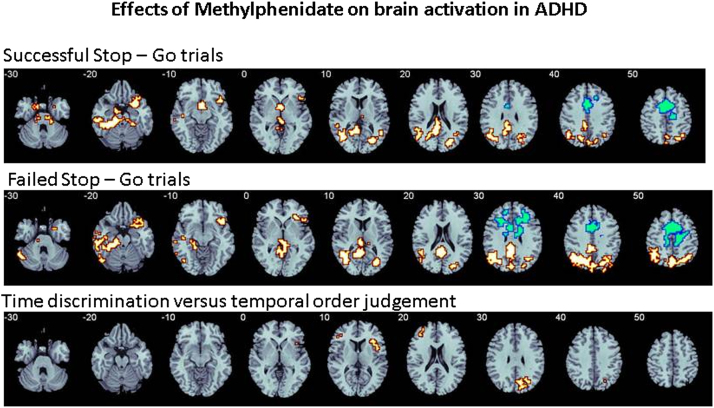
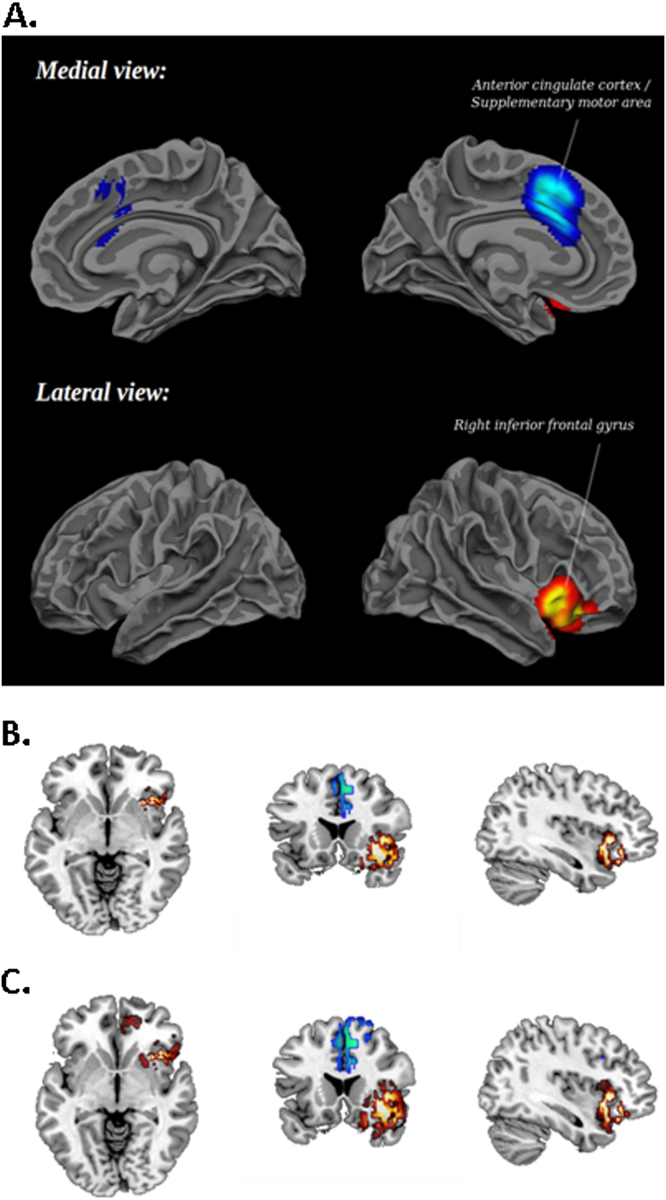
The fMRI analysis showed that methylphenidate significantly enhanced activation in bilateral inferior frontal cortex (IFC)/insula during inhibition and time discrimination but had no effect on working memory networks. The meta-analysis, including 14 fMRI datasets and 212 children with ADHD, showed that stimulants most consistently enhanced right IFC/insula activation, which also remained for a subgroup analysis of methylphenidate effects alone. A more lenient threshold also revealed increased putamen activation.
Psychostimulants most consistently increase right IFC/insula activation, which are key areas of cognitive control and also the most replicated neurocognitive dysfunction in ADHD. These neurocognitive effects may underlie their positive clinical effects.
精神振奋药物,最常见的是儿茶酚胺激动剂哌甲酯,是治疗注意力缺陷多动障碍(ADHD)最有效的方法。然而,其作用机制相对鲜为人知。对脑功能的急性影响可以阐明潜在的神经认知效应。我们在未服用过药物的ADHD青少年患者执行三项与疾病相关的任务期间,通过功能磁共振成像(fMRI)测试了哌甲酯相对于安慰剂的效果。此外,我们对急性兴奋剂对ADHD脑功能影响的fMRI研究结果进行了系统评价和荟萃分析。
在一项随机对照试验中,fMRI研究比较了20名患有ADHD的青少年在服用安慰剂或哌甲酯的情况下执行停止、工作记忆和时间辨别任务时的情况。荟萃分析通过检索PubMed、ScienceDirect、Web of Knowledge、Google Scholar和Scopus数据库进行。为每项研究提取兴奋剂药物相对于安慰剂或未用药时显著效应簇的峰值坐标。
fMRI分析表明,哌甲酯在抑制和时间辨别过程中显著增强了双侧额下回(IFC)/脑岛的激活,但对工作记忆网络没有影响。荟萃分析包括14个fMRI数据集和212名患有ADHD的儿童,结果表明兴奋剂最一致地增强了右侧IFC/脑岛的激活,这在单独对哌甲酯效应的亚组分析中也依然存在。一个更宽松的阈值还显示壳核激活增加。
精神振奋药物最一致地增加右侧IFC/脑岛的激活,这些区域是认知控制的关键区域,也是ADHD中最反复出现的神经认知功能障碍区域。这些神经认知效应可能是其积极临床效果的基础。