Thankamony Ajay, Lek Ngee, Carroll Dan, Williams Martyn, Dunger David B, Acerini Carlo L, Ong Ken K, Hughes Ieuan A
Department of Paediatrics, University of Cambridge, Addenbrooke's Hospital, Cambridge, United Kingdom.
Environ Health Perspect. 2014 Feb;122(2):207-11. doi: 10.1289/ehp.1307178. Epub 2013 Dec 6.
Anogenital distance (AGD) in animals is a sensitive biomarker of fetal endocrine disruption and the associated testicular dysgenesis syndrome (TDS). However, AGD in human infants with cryptorchidism and hypospadias, which are potential manifestations of TDS during childhood, is not clearly described.
Our aim was to compare AGD in boys with cryptorchidism or hypospadias against normative data.
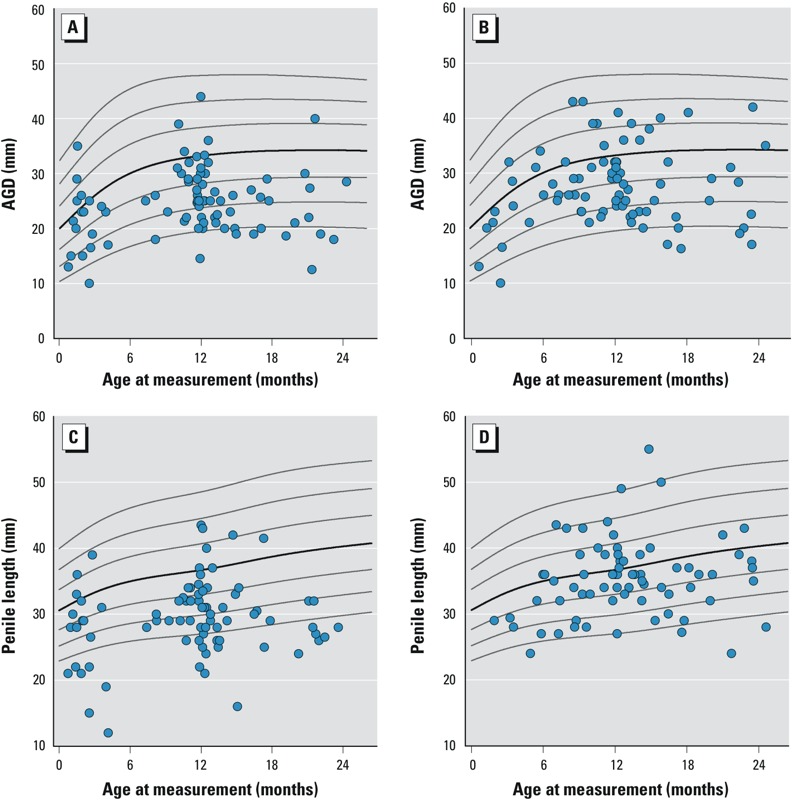
Boys with isolated cryptorchidism (n = 71, age 13.4 ± 5.8 months) or hypospadias (n = 81, age 11.4 ± 6.2 months) were recruited from a tertiary center for measurement of AGD and penile length; they were compared with 487 healthy full-term boys from a birth cohort by deriving age-specific standard deviation scores (SDS).
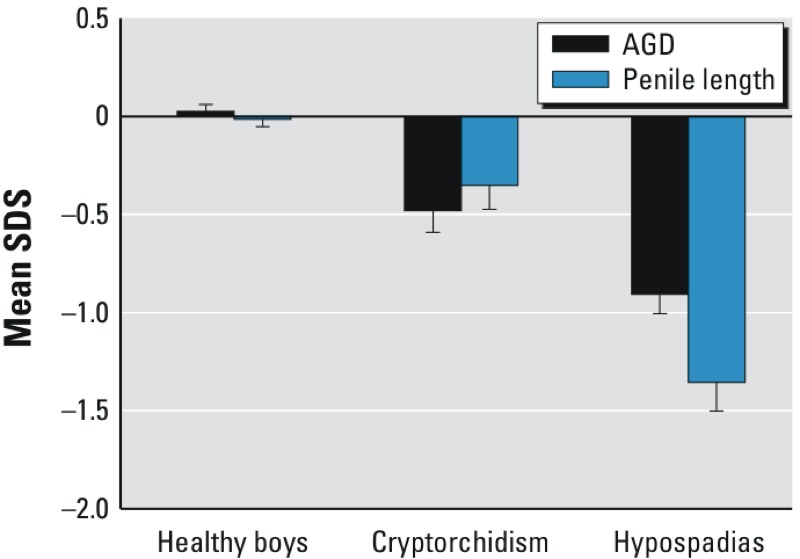
Boys with cryptorchidism were older (p = 0.048) compared with boys with hypospadias. Boys with hypospadias had shorter mean AGD and penile length SDS than healthy boys (both p < 0.0001). Mean AGD and penile length SDS values in boys with cryptorchidism were longer than mean values in boys with hypospadias (both p < 0.01) and shorter than mean values in healthy boys (both p < 0.0001). Mean penile length SDS decreased as the severity of hypospadias increased (ptrend = 0.078).
In the study population, AGD and penile length were reduced in boys with hypospadias or cryptorchidism relative to normative data derived from a longitudinal birth cohort. The findings support the use of AGD as a quantitative biomarker to examine the prenatal effects of exposure to endocrine disruptors on the development of the male reproductive tract.
动物的肛门生殖距(AGD)是胎儿内分泌干扰及相关睾丸发育不全综合征(TDS)的敏感生物标志物。然而,隐睾症和尿道下裂患儿的AGD尚未得到明确描述,而这两种疾病是儿童期TDS的潜在表现形式。
我们的目的是将患有隐睾症或尿道下裂的男孩的AGD与标准数据进行比较。
从一家三级医疗中心招募了患有单纯性隐睾症(n = 71,年龄13.4 ± 5.8个月)或尿道下裂(n = 81,年龄11.4 ± 6.2个月)的男孩,测量他们的AGD和阴茎长度;通过计算年龄特异性标准差分数(SDS),将他们与来自一个出生队列的487名健康足月男孩进行比较。
与患有尿道下裂的男孩相比,患有隐睾症的男孩年龄更大(p = 0.048)。患有尿道下裂的男孩的平均AGD和阴茎长度SDS低于健康男孩(两者p < 0.0001)。患有隐睾症的男孩的平均AGD和阴茎长度SDS值长于患有尿道下裂的男孩(两者p < 0.01),但短于健康男孩的平均值(两者p < 0.0001)。随着尿道下裂严重程度的增加,平均阴茎长度SDS降低(p趋势 = 0.078)。
在该研究人群中,相对于来自纵向出生队列的标准数据,患有尿道下裂或隐睾症的男孩的AGD和阴茎长度降低。这些发现支持将AGD用作定量生物标志物,以研究产前接触内分泌干扰物对男性生殖道发育的影响。