Department of Pediatrics (Neurology), Duke University Medical Center, Durham, NC.
Ann Neurol. 2014 Feb;75(2):178-85. doi: 10.1002/ana.24081. Epub 2014 Mar 1.
Whether febrile status epilepticus (FSE) produces hippocampal sclerosis (HS) and temporal lobe epilepsy (TLE) has long been debated. Our objective is to determine whether FSE produces acute hippocampal injury that evolves to HS.
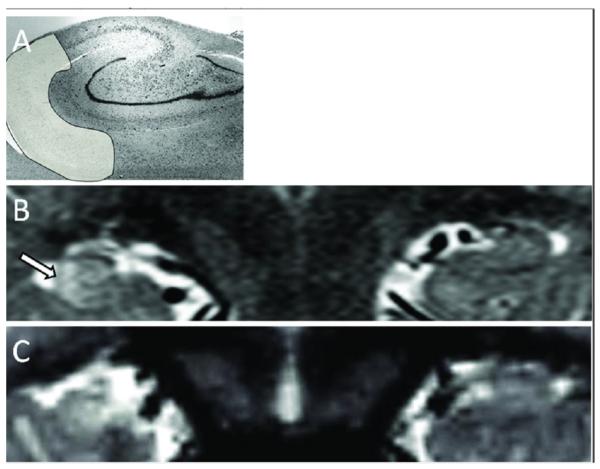
FEBSTAT and 2 affiliated studies prospectively recruited 226 children aged 1 month to 6 years with FSE and controls with simple febrile seizures. All had acute magnetic resonance imaging (MRI), and follow-up MRI was obtained approximately 1 year later in the majority. Visual interpretation by 2 neuroradiologists informed only of subject age was augmented by hippocampal volumetrics, analysis of the intrahippocampal distribution of T2 signal, and apparent diffusion coefficients.
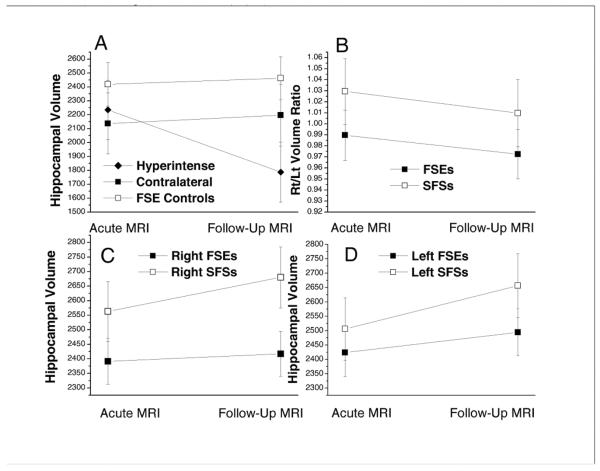
Hippocampal T2 hyperintensity, maximum in Sommer's sector, occurred acutely after FSE in 22 of 226 children in association with increased volume. Follow-up MRI obtained on 14 of the 22 with acute T2 hyperintensity showed HS in 10 and reduced hippocampal volume in 12. In contrast, follow-up of 116 children without acute hyperintensity showed abnormal T2 signal in only 1 (following another episode of FSE). Furthermore, compared to controls with simple febrile seizures, FSE subjects with normal acute MRI had abnormally low right to left hippocampal volume ratios, smaller hippocampi initially, and reduced hippocampal growth.
Hippocampal T2 hyperintensity after FSE represents acute injury often evolving to a radiological appearance of HS after 1 year. Furthermore, impaired growth of normal-appearing hippocampi after FSE suggests subtle injury even in the absence of T2 hyperintensity. Longer follow-up is needed to determine the relationship of these findings to TLE.
发热性癫痫持续状态(FSE)是否会导致海马硬化(HS)和颞叶癫痫(TLE)一直存在争议。我们的目的是确定 FSE 是否会导致急性海马损伤,进而发展为 HS。
FEBSTAT 及其 2 项相关研究前瞻性招募了 226 名年龄在 1 个月至 6 岁之间的 FSE 患儿和单纯热性惊厥的对照组患儿。所有患儿均行急性磁共振成像(MRI)检查,其中大部分患儿在大约 1 年后进行了随访 MRI。2 位仅了解患者年龄的神经放射科医生进行了视觉解读,并通过海马体积测量、海马内 T2 信号分布分析和表观扩散系数进行了补充。
226 例患儿中有 22 例在 FSE 后出现急性海马 T2 高信号,以 Sommer 区最为明显,同时伴有体积增加。在 22 例急性 T2 高信号的患儿中,有 14 例进行了随访 MRI,其中 10 例显示 HS,12 例显示海马体积减小。相比之下,在 116 例无急性高信号的患儿中,仅有 1 例(在发生另一次 FSE 后)出现异常 T2 信号。此外,与单纯热性惊厥的对照组相比,FSE 患儿中即使急性 MRI 正常,右侧到左侧海马体积比也异常低,海马初始体积较小,且海马生长减少。
FSE 后海马 T2 高信号代表急性损伤,1 年后常发展为 HS 的影像学表现。此外,FSE 后正常外观的海马生长受损表明即使没有 T2 高信号,也存在轻微损伤。需要更长时间的随访来确定这些发现与 TLE 的关系。