Tao Qian, Chan Chetwyn C H, Luo Yue-jia, Li Jian-jun, Ting Kin-hung, Wang Jun, Lee Tatia M C
Applied Cognitive Neuroscience Laboratory, Department of Rehabilitation Sciences, The Hong Kong Polytechnic University, Hung Hom, Kowloon, Hong Kong, China.
Brain Topogr. 2015 May;28(3):506-19. doi: 10.1007/s10548-013-0339-1. Epub 2013 Dec 10.
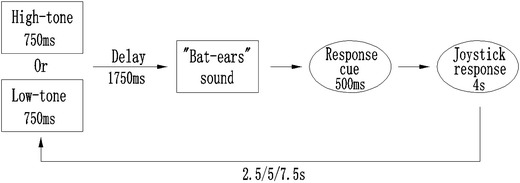
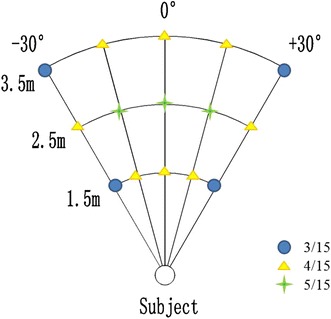
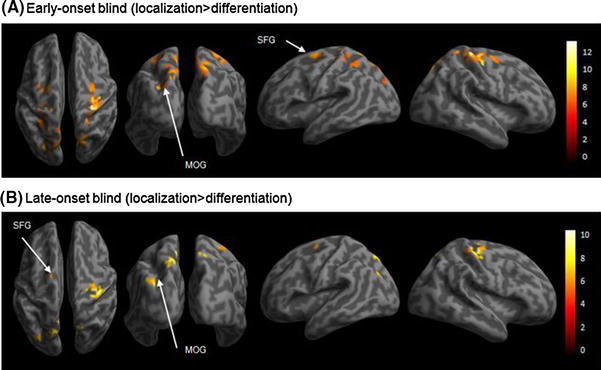
Comparing early- and late-onset blindness in individuals offers a unique model for studying the influence of visual experience on neural processing. This study investigated how prior visual experience would modulate auditory spatial processing among blind individuals. BOLD responses of early- and late-onset blind participants were captured while performing a sound localization task. The task required participants to listen to novel "Bat-ears" sounds, analyze the spatial information embedded in the sounds, and specify out of 15 locations where the sound would have been emitted. In addition to sound localization, participants were assessed on visuospatial working memory and general intellectual abilities. The results revealed common increases in BOLD responses in the middle occipital gyrus, superior frontal gyrus, precuneus, and precentral gyrus during sound localization for both groups. Between-group dissociations, however, were found in the right middle occipital gyrus and left superior frontal gyrus. The BOLD responses in the left superior frontal gyrus were significantly correlated with accuracy on sound localization and visuospatial working memory abilities among the late-onset blind participants. In contrast, the accuracy on sound localization only correlated with BOLD responses in the right middle occipital gyrus among the early-onset counterpart. The findings support the notion that early-onset blind individuals rely more on the occipital areas as a result of cross-modal plasticity for auditory spatial processing, while late-onset blind individuals rely more on the prefrontal areas which subserve visuospatial working memory.
比较个体的早发性和迟发性失明为研究视觉经验对神经加工的影响提供了一个独特的模型。本研究调查了先前的视觉经验如何调节盲人的听觉空间加工。在执行声音定位任务时,记录了早发性和迟发性失明参与者的脑血氧水平依赖(BOLD)反应。该任务要求参与者聆听新颖的“蝙蝠耳”声音,分析声音中嵌入的空间信息,并从15个位置中指定声音发出的位置。除了声音定位外,还对参与者的视觉空间工作记忆和一般智力能力进行了评估。结果显示,两组在声音定位过程中枕中回、额上回、楔前叶和中央前回的BOLD反应均普遍增加。然而,在右侧枕中回和左侧额上回发现了组间差异。左侧额上回的BOLD反应与迟发性失明参与者的声音定位准确性和视觉空间工作记忆能力显著相关。相比之下,早发性失明参与者的声音定位准确性仅与右侧枕中回的BOLD反应相关。这些发现支持了这样一种观点,即早发性失明个体由于听觉空间加工的跨模态可塑性而更多地依赖枕叶区域,而迟发性失明个体则更多地依赖于服务于视觉空间工作记忆的前额叶区域。