Department of Neurology and 2 Program in Immunology, University of California, San Francisco, San Francisco, CA 94158.
J Exp Med. 2013 Dec 16;210(13):2921-37. doi: 10.1084/jem.20130699. Epub 2013 Dec 9.
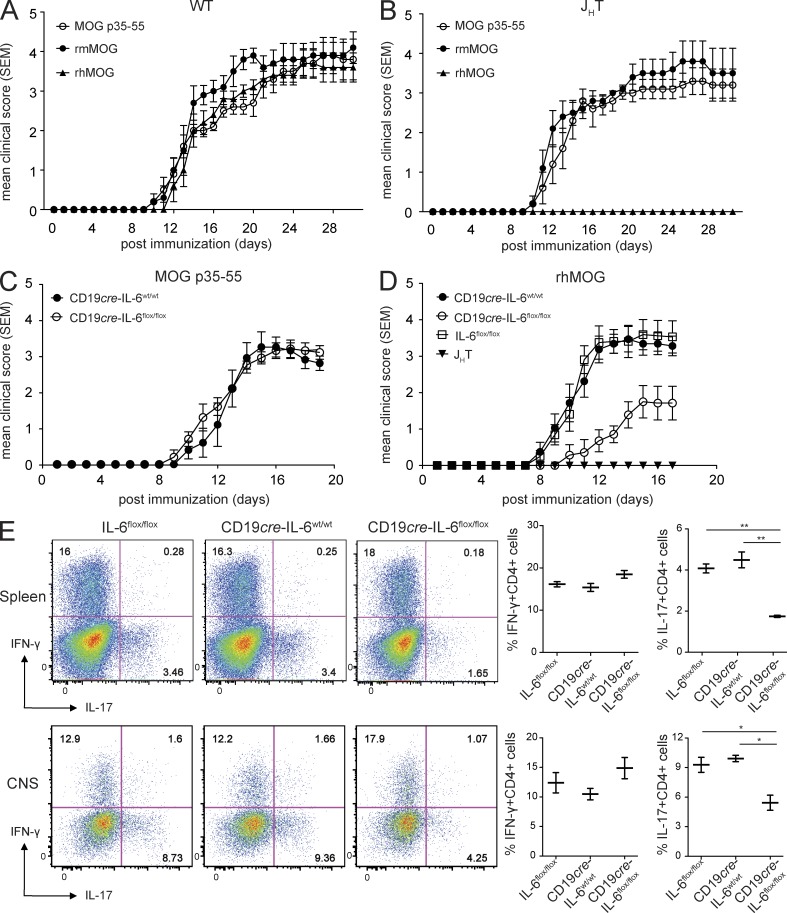
Whether B cells serve as antigen-presenting cells (APCs) for activation of pathogenic T cells in the multiple sclerosis model experimental autoimmune encephalomyelitis (EAE) is unclear. To evaluate their role as APCs, we engineered mice selectively deficient in MHC II on B cells (B-MHC II(-/-)), and to distinguish this function from antibody production, we created transgenic (Tg) mice that express the myelin oligodendrocyte glycoprotein (MOG)-specific B cell receptor (BCR; IgH(MOG-mem)) but cannot secrete antibodies. B-MHC II(-/-) mice were resistant to EAE induced by recombinant human MOG (rhMOG), a T cell- and B cell-dependent autoantigen, and exhibited diminished Th1 and Th17 responses, suggesting a role for B cell APC function. In comparison, selective B cell IL-6 deficiency reduced EAE susceptibility and Th17 responses alone. Administration of MOG-specific antibodies only partially restored EAE susceptibility in B-MHC II(-/-) mice. In the absence of antibodies, IgH(MOG-mem) mice, but not mice expressing a BCR of irrelevant specificity, were fully susceptible to acute rhMOG-induced EAE, also demonstrating the importance of BCR specificity. Spontaneous opticospinal EAE and meningeal follicle-like structures were observed in IgH(MOG-mem) mice crossed with MOG-specific TCR Tg mice. Thus, B cells provide a critical cellular function in pathogenesis of central nervous system autoimmunity independent of their humoral involvement, findings which may be relevant to B cell-targeted therapies.
B 细胞是否作为抗原呈递细胞(APCs)在多发性硬化症模型实验性自身免疫性脑脊髓炎(EAE)中激活致病性 T 细胞尚不清楚。为了评估它们作为 APC 的作用,我们设计了选择性缺乏 MHC II 的 B 细胞(B-MHC II(-/-))的小鼠,并为了将这种功能与抗体产生区分开来,我们创建了表达髓鞘少突胶质细胞糖蛋白(MOG)特异性 B 细胞受体(BCR;IgH(MOG-mem))但不能分泌抗体的转基因(Tg)小鼠。B-MHC II(-/-)小鼠对重组人 MOG(rhMOG)诱导的 EAE 具有抗性,rhMOG 是一种 T 细胞和 B 细胞依赖性自身抗原,并且表现出 Th1 和 Th17 反应的减弱,表明 B 细胞 APC 功能的作用。相比之下,选择性 B 细胞 IL-6 缺乏仅单独降低 EAE 易感性和 Th17 反应。MOG 特异性抗体的给药仅部分恢复 B-MHC II(-/-)小鼠的 EAE 易感性。在没有抗体的情况下,IgH(MOG-mem)小鼠,但不是表达非特异性 BCR 的小鼠,对急性 rhMOG 诱导的 EAE 完全易感,这也证明了 BCR 特异性的重要性。在与 MOG 特异性 TCR Tg 小鼠交叉的 IgH(MOG-mem)小鼠中观察到自发的视神经脊髓 EAE 和脑膜滤泡样结构。因此,B 细胞在中枢神经系统自身免疫的发病机制中提供了一种关键的细胞功能,而与它们的体液参与无关,这些发现可能与针对 B 细胞的治疗有关。