Kothari Radha, Gafton Joseph, Treasure Janet, Micali Nadia
Behavioral and Brain Sciences Unit, UCL Institute of Child Health, London, United Kingdom.
Am J Hum Biol. 2014 Mar-Apr;26(2):176-82. doi: 10.1002/ajhb.22495. Epub 2013 Dec 10.
Markers of prenatal hormone exposure have been associated with the development of eating disorder (ED) behaviors. Our aim was to determine whether 2D:4D ratio, a marker for in utero testosterone exposure, is associated with risk for ED in a large population-based cohort: the Avon Longitudinal Study of Parents and Children (ALSPAC).
This is the first study to investigate prenatal testosterone exposure in children at high-risk for ED, using 2D:4D as a marker. We compared children whose mothers reported a lifetime ED (anorexia, bulimia, or both; N = 446) to children whose mothers did not (n = 5,367).
Daughters of women with lifetime bulimia nervosa (BN) had lower 2D:4D ratio (B: -0.01, 95% CI: -0.02 to -0.002, P = 0.02), indicating higher prenatal testosterone exposure, than daughters of mothers unaffected by ED. No differences were observed in the male children of women with an ED.
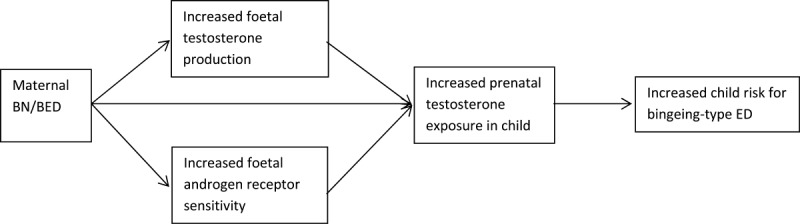
Findings suggest that children at high-risk for BN may be exposed to higher levels of testosterone in utero. Fetal exposure to androgen excess is thought to be causal in the development of polycystic ovary syndrome (PCOS), a disorder which is highly comorbid with binge eating and BN. Future research should investigate the potential role of testosterone exposure in utero as a risk factor for BN and binge eating.
产前激素暴露标志物与饮食失调(ED)行为的发展有关。我们的目的是确定二维与四维手指长度比值(2D:4D)这一子宫内睾酮暴露的标志物,是否与基于人群的大型队列研究——雅芳亲子纵向研究(ALSPAC)中的饮食失调风险相关。
这是第一项使用2D:4D作为标志物来研究饮食失调高危儿童产前睾酮暴露情况的研究。我们将母亲报告有终生饮食失调(神经性厌食症、神经性贪食症或两者皆有;N = 446)的儿童与母亲没有饮食失调的儿童(n = 5367)进行了比较。
患有终生神经性贪食症(BN)的女性的女儿,其2D:4D比值较低(B:-0.01,95%置信区间:-0.02至-0.002,P = 0.02),表明其产前睾酮暴露水平较高,高于未受饮食失调影响的母亲的女儿。饮食失调女性的儿子未观察到差异。
研究结果表明,神经性贪食症高危儿童在子宫内可能接触到更高水平的睾酮。胎儿雄激素暴露过多被认为是多囊卵巢综合征(PCOS)发展的原因,多囊卵巢综合征是一种与暴饮暴食和神经性贪食症高度共病的疾病。未来的研究应调查子宫内睾酮暴露作为神经性贪食症和暴饮暴食风险因素的潜在作用。