Department of Psychiatry, Icahn School of Medicine at Mount Sinai , New York, NY , USA.
Front Psychiatry. 2013 Nov 25;4:152. doi: 10.3389/fpsyt.2013.00152. eCollection 2013.
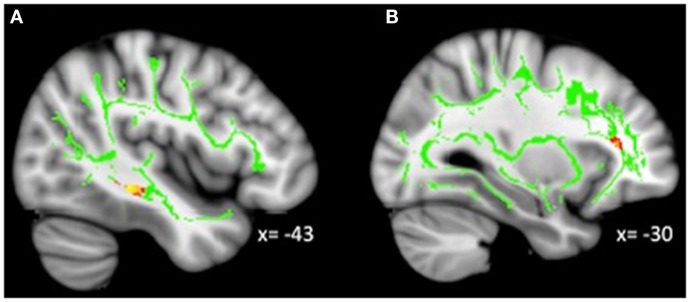
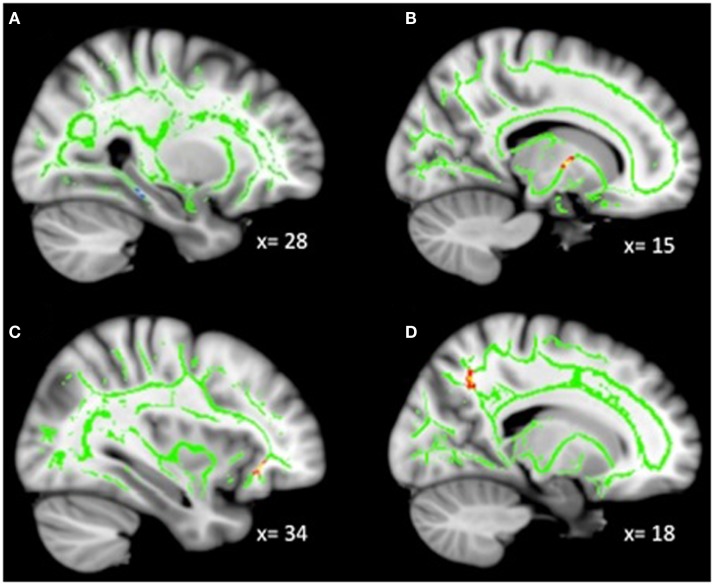
Major depressive disorder (MDD) during adolescence is a common and disabling psychiatric condition; yet, little is known about its neurobiological underpinning. Evidence indicates that MDD in adults involves alterations in white and gray matter; however, sparse research has focused on adolescent MDD. Similarly, little research has accounted for the wide variability of symptom severity among depressed teens. Here, we aimed to investigate white matter (WM) microstructure between 17 adolescents with MDD and 16 matched healthy controls (HC) using diffusion tensor imaging. We further assessed within the MDD group relationships between WM integrity and depression severity, as well as anhedonia and irritability - two core symptoms of adolescent MDD. As expected, adolescents with MDD manifested decreased WM integrity compared to HC in the anterior cingulum and anterior corona radiata. Within the MDD group, greater depression severity was correlated with reduced WM integrity in the genu of corpus callosum, anterior thalamic radiation, anterior cingulum, and sagittal stratum. However, anhedonia and irritability were associated with alterations in distinct WM tracts. Specifically, anhedonia was associated with disturbances in tracts related to reward processing, including the anterior limb of the internal capsule and projection fibers to the orbitofrontal cortex. Irritability was associated with decreased integrity in the sagittal stratum, anterior corona radiata, and tracts leading to prefrontal and temporal cortices. Overall, these preliminary findings provide further support for the hypotheses that there is a disconnect between prefrontal and limbic emotional regions in depression, and that specific clinical symptoms involve distinct alterations in WM tracts.
青少年重度抑郁症(MDD)是一种常见且使人丧失能力的精神疾病;然而,人们对其神经生物学基础知之甚少。有证据表明,成年人的 MDD 涉及白质和灰质的改变;然而,针对青少年 MDD 的研究很少。同样,很少有研究考虑到抑郁青少年症状严重程度的广泛差异。在这里,我们旨在使用弥散张量成像研究 17 名患有 MDD 的青少年和 16 名匹配的健康对照组(HC)之间的白质(WM)微观结构。我们进一步评估了 MDD 组中 WM 完整性与抑郁严重程度之间的关系,以及快感缺失和易激惹——青少年 MDD 的两个核心症状。正如预期的那样,与 HC 相比,患有 MDD 的青少年在前扣带束和前放射冠中表现出 WM 完整性降低。在 MDD 组中,抑郁严重程度与胼胝体膝部、前丘脑辐射、前扣带束和矢状层的 WM 完整性降低相关。然而,快感缺失和易激惹与不同的 WM 束变化有关。具体而言,快感缺失与与奖励处理相关的束的紊乱有关,包括内囊前肢和眶额皮质的投射纤维。易激惹与矢状层、前放射冠以及通向前额叶和颞叶的束的完整性降低有关。总的来说,这些初步发现进一步支持了以下假说:即抑郁症患者的前额叶和边缘情绪区域之间存在脱节,并且特定的临床症状涉及 WM 束的不同改变。