Yan Bo-Fang, Duan Wei, Liu Guo-Tian, Xu Hong-Guo, Wang Li-Jun, Li Shao-Hua
Beijing Key Laboratory of Grape Science and Enology and Key Laboratory of Plant Resources, Institute of Botany, the Chinese Academy of Sciences, Beijing, People's Republic of China ; University of Chinese Academy of Sciences, Beijing, People's Republic of China.
PLoS One. 2013 Dec 4;8(12):e80770. doi: 10.1371/journal.pone.0080770. eCollection 2013.
The decline of photosynthesis in plants under low sink demand is well known. Previous studies focused on the relationship between stomatal conductance (gs) and net photosynthetic rate (Pn). These studies investigated the effect of changes in Photosystem II (PSII) function on the Pn decline under low sink demand. However, little is known about its effects on different limiting steps of electron transport chain in PSII under this condition.
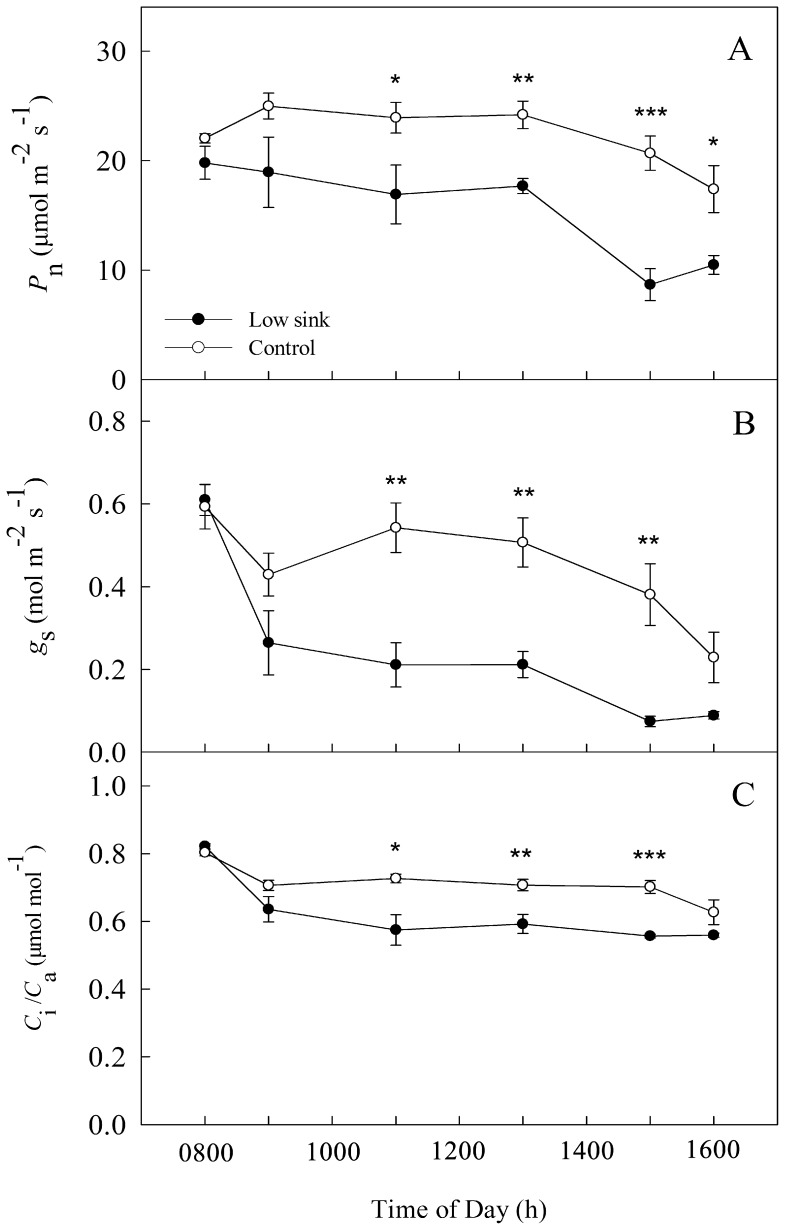
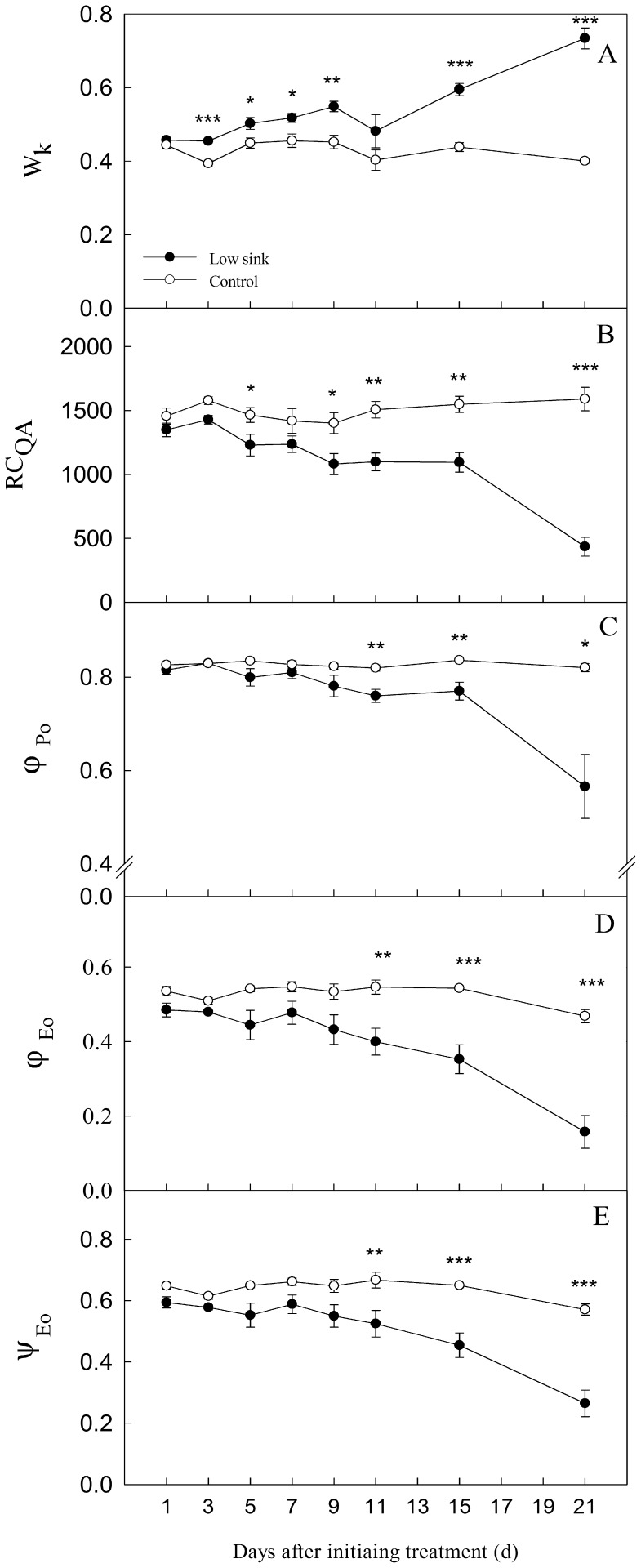
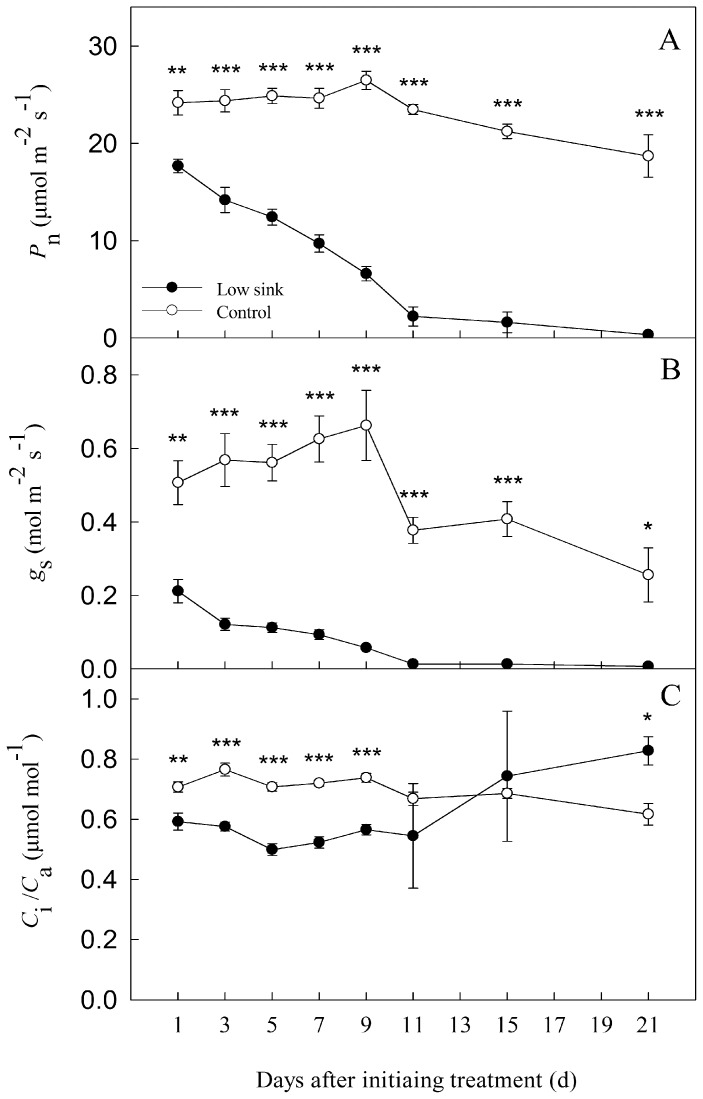
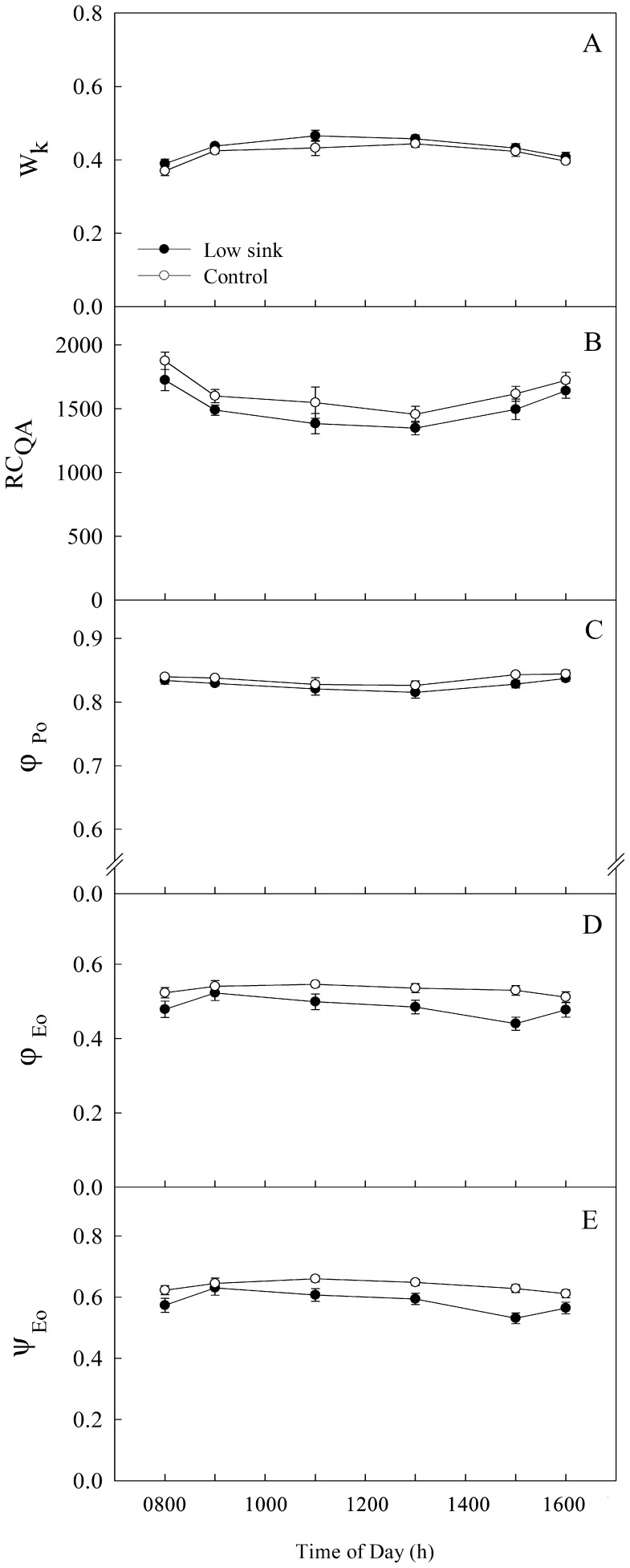
METHODOLOGY/PRINCIPAL FINDING: Two-month-old bean plants were processed by removing pods and flowers (low sink demand). On the 1(st) day after low sink demand treatment, a decline of Pn was accompanied by a decrease in gs and internal-to-ambient CO2 concentration ratio (Ci/Ca). From the 3(rd) to 9(th) day, Pn and gs declined continuously while Ci/Ca ratio remained stable in the treatment. Moreover, these values were lower than that of control. Wk (a parameter reflecting the damage to oxygen evolving complex of the donor side of PSII) values in the treatment were significantly higher than their corresponding control values. However, RCQA (a parameter reflecting the number of active RCs per excited cross-section of PSII) values in the treatment were significantly lower than control from the 5(th) day. From the 11(th) to 21(st) day, Pn and gs of the treatment continued to decline and were lower than control. This was accompanied by a decrease of RCQA, and an increase of Wk. Furthermore, the quantum yield parameters φPo, φEo and ψEo in the treatment were lower than in control; however, Ci/Ca values in the treatment gradually increased and were significantly higher than control on the 21(st) day.
Stomatal limitation during the early stage, whereas a combination of stomatal and non-stomatal limitation during the middle stage might be responsible for the reduction of Pn under low sink demand. Non-stomatal limitation during the late stages after the removal of the sink of roots and pods may also cause Pn reduction. The non-stomatal limitation was associated with the inhibition of PSII electron transport chain. Our data suggests that the donor side of PSII was the most sensitive to low sink demand followed by the reaction center of PSII. The acceptor side of PSII may be the least sensitive.
植物在低库需求下光合作用下降是众所周知的。先前的研究集中在气孔导度(gs)与净光合速率(Pn)之间的关系。这些研究调查了光系统II(PSII)功能变化对低库需求下Pn下降的影响。然而,在这种条件下,其对PSII中电子传递链不同限制步骤的影响却知之甚少。
方法/主要发现:对两个月大的豆类植物进行去荚和去花处理(低库需求)。在低库需求处理后的第1天,Pn下降伴随着gs和胞间与外界CO2浓度比(Ci/Ca)的降低。从第3天到第9天,处理组中Pn和gs持续下降,而Ci/Ca比值保持稳定。此外,这些值低于对照组。处理组中Wk(反映PSII供体侧放氧复合体损伤的参数)值显著高于相应的对照组值。然而,从第5天起,处理组中RCQA(反映PSII每个激发截面活性反应中心数量的参数)值显著低于对照组。从第11天到第21天,处理组的Pn和gs继续下降且低于对照组。这伴随着RCQA的降低和Wk的增加。此外,处理组中的量子产率参数φPo、φEo和ψEo低于对照组;然而,处理组中的Ci/Ca值逐渐增加,在第21天显著高于对照组。
早期为气孔限制,而中期气孔和非气孔限制共同作用可能是低库需求下Pn降低的原因。去除根和荚的库后后期的非气孔限制也可能导致Pn降低。非气孔限制与PSII电子传递链的抑制有关。我们的数据表明,PSII的供体侧对低库需求最敏感,其次是PSII的反应中心。PSII的受体侧可能最不敏感。