Nowotny Thomas, Rospars Jean-Pierre, Martinez Dominique, Elbanna Shereen, Anton Sylvia
Sussex Neuroscience and Centre for Computational Neuroscience and Robotics, University of Sussex, Brighton, United Kingdom.
PLoS One. 2013 Dec 4;8(12):e80838. doi: 10.1371/journal.pone.0080838. eCollection 2013.
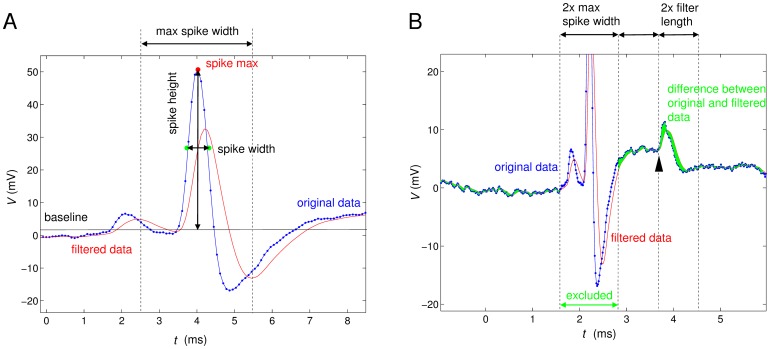
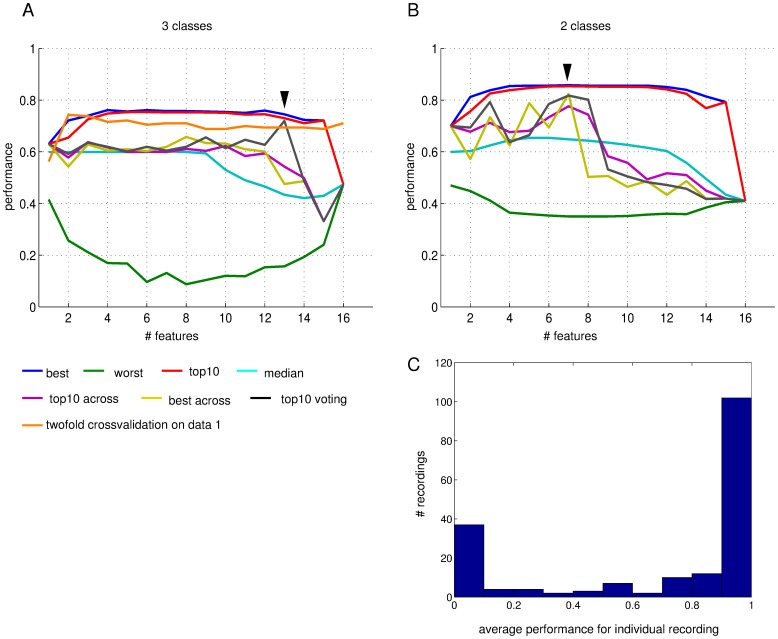
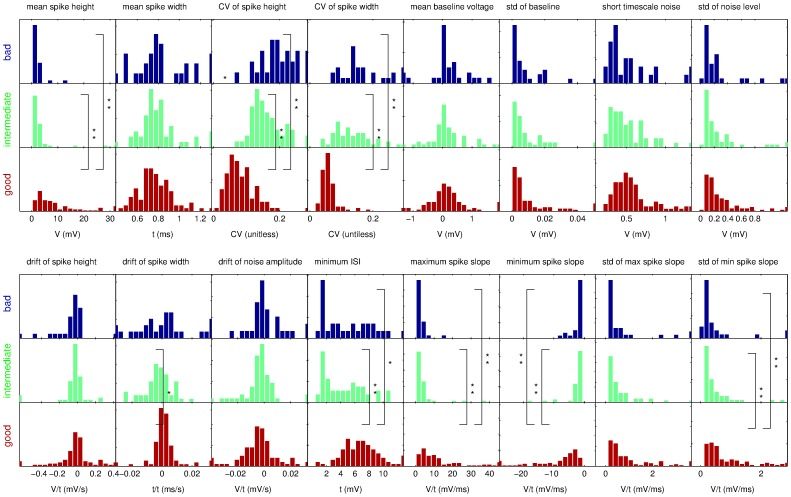
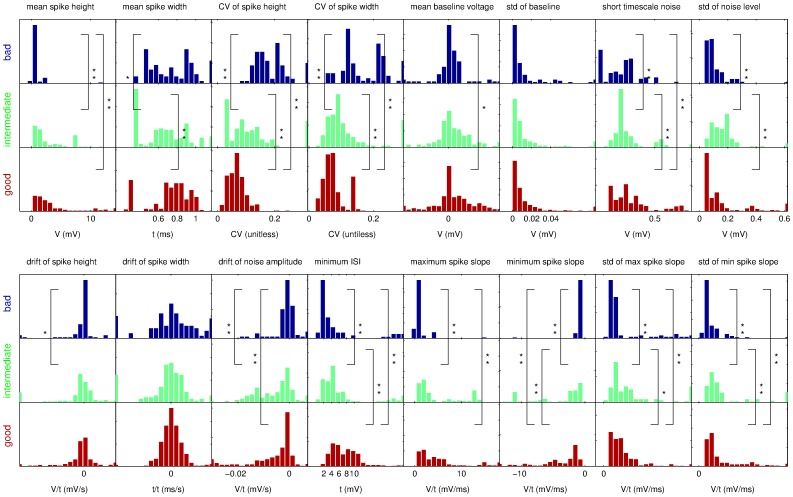
The quality of electrophysiological recordings varies a lot due to technical and biological variability and neuroscientists inevitably have to select "good" recordings for further analyses. This procedure is time-consuming and prone to selection biases. Here, we investigate replacing human decisions by a machine learning approach. We define 16 features, such as spike height and width, select the most informative ones using a wrapper method and train a classifier to reproduce the judgement of one of our expert electrophysiologists. Generalisation performance is then assessed on unseen data, classified by the same or by another expert. We observe that the learning machine can be equally, if not more, consistent in its judgements as individual experts amongst each other. Best performance is achieved for a limited number of informative features; the optimal feature set being different from one data set to another. With 80-90% of correct judgements, the performance of the system is very promising within the data sets of each expert but judgments are less reliable when it is used across sets of recordings from different experts. We conclude that the proposed approach is relevant to the selection of electrophysiological recordings, provided parameters are adjusted to different types of experiments and to individual experimenters.
由于技术和生物学变异性,电生理记录的质量差异很大,神经科学家不可避免地要选择“优质”记录进行进一步分析。这个过程既耗时又容易出现选择偏差。在此,我们研究用机器学习方法取代人工决策。我们定义了16个特征,如尖峰高度和宽度,使用包装法选择最具信息性的特征,并训练一个分类器来重现我们一位专家电生理学家的判断。然后在由同一位或另一位专家分类的未见数据上评估泛化性能。我们观察到,学习机器在判断上的一致性即使不比个别专家之间的一致性更高,也能与之相当。对于有限数量的信息性特征能实现最佳性能;最优特征集因数据集不同而不同。该系统在每位专家的数据集中有80%-90%的正确判断,性能很有前景,但在用于来自不同专家的记录集时,判断的可靠性较低。我们得出结论,只要针对不同类型的实验和个体实验者调整参数,所提出的方法与电生理记录的选择相关。