Parent Maxime J, Bedard Marc-Andre, Aliaga Arturo, Minuzzi Luciano, Mechawar Naguib, Soucy Jean-Paul, Schirrmacher Esther, Kostikov Alexey, Gauthier Serge G, Rosa-Neto Pedro
Translational Neuroimaging Laboratory, McGill Centre for Studies in Aging, Douglas Mental Health University Institute, Montreal, Canada H4H 1R3 ; Département de Psychologie, Université du Québec à Montreal (UQAM), Montreal, Canada H3C 3P8.
Int J Mol Imaging. 2013;2013:205045. doi: 10.1155/2013/205045. Epub 2013 Nov 10.
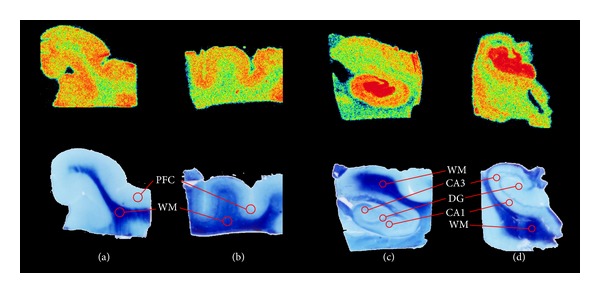
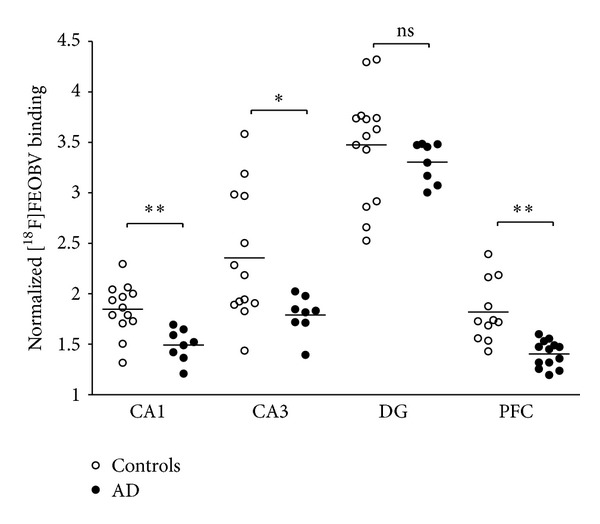
Rationale. Alzheimer's Disease (AD) is a neurodegenerative condition characterized in part by deficits in cholinergic basalocortical and septohippocampal pathways. [(18)F]Fluoroethoxybenzovesamicol ([(18)F]FEOBV), a Positron Emission Tomography ligand for the vesicular acetylcholine transporter (VAChT), is a potential molecular agent to investigate brain diseases associated with presynaptic cholinergic losses. Purpose. To demonstrate this potential, we carried out an [(18)F]FEOBV autoradiography study to compare postmortem brain tissues from AD patients to those of age-matched controls. Methods. [(18)F]FEOBV autoradiography binding, defined as the ratio between regional grey and white matter, was estimated in the hippocampus (13 controls, 8 AD) and prefrontal cortex (13 controls, 11 AD). Results. [(18)F]FEOBV binding was decreased by 33% in prefrontal cortex, 25% in CA3, and 20% in CA1. No changes were detected in the dentate gyrus of the hippocampus, possibly because of sprouting or upregulation toward the resilient glutamatergic neurons of the dentate gyrus. Conclusion. This is the first demonstration of [(18)F]FEOBV focal binding changes in cholinergic projections to the cortex and hippocampus in AD. Such cholinergic synaptic (and more specifically VAChT) alterations, in line with the selective basalocortical and septohippocampal cholinergic losses documented in AD, indicate that [(18)F]FEOBV is indeed a promising ligand to explore cholinergic abnormalities in vivo.
原理。阿尔茨海默病(AD)是一种神经退行性疾病,部分特征为胆碱能基底皮质和隔海马通路功能缺陷。[(18)F]氟乙氧基苯并维司那明([(18)F]FEOBV)是一种用于囊泡乙酰胆碱转运体(VAChT)的正电子发射断层扫描配体,是一种潜在的分子试剂,可用于研究与突触前胆碱能丧失相关的脑部疾病。目的。为了证明这种潜力,我们进行了一项[(18)F]FEOBV放射自显影研究,以比较AD患者的死后脑组织与年龄匹配的对照组。方法。在海马体(13名对照组,8名AD患者)和前额叶皮质(13名对照组,11名AD患者)中估计[(18)F]FEOBV放射自显影结合,定义为区域灰质与白质的比值。结果。前额叶皮质中[(18)F]FEOBV结合减少33%,CA3区减少25%,CA1区减少20%。海马齿状回未检测到变化,可能是由于向齿状回有弹性的谷氨酸能神经元发芽或上调。结论。这是首次证明[(18)F]FEOBV在AD患者大脑皮质和海马胆碱能投射中的局灶性结合变化。这种胆碱能突触(更具体地说是VAChT)改变,与AD中记录的选择性基底皮质和隔海马胆碱能丧失一致,表明[(18)F]FEOBV确实是一种有前途的配体,可用于体内探索胆碱能异常。