Center of Innovation to Implementation, VA Palo Alto Health Care System & Stanford Medical School, 795 Willow Rd, Menlo Park, CA 94025, USA.
BMC Health Serv Res. 2013 Dec 10;13:511. doi: 10.1186/1472-6963-13-511.
Health care systems initiating major behavioral health programs often face challenges with variable implementation and uneven patient engagement. One large health care system, Veterans Health Administration (VHA), recently initiated the MOVE!® Weight Management Program, but it is unclear if veterans most in need of MOVE!® services are accessing them. The purpose of this study was to examine patient and facility factors associated with MOVE!® utilization (defined as 1 or more visits) across all VHA facilities.
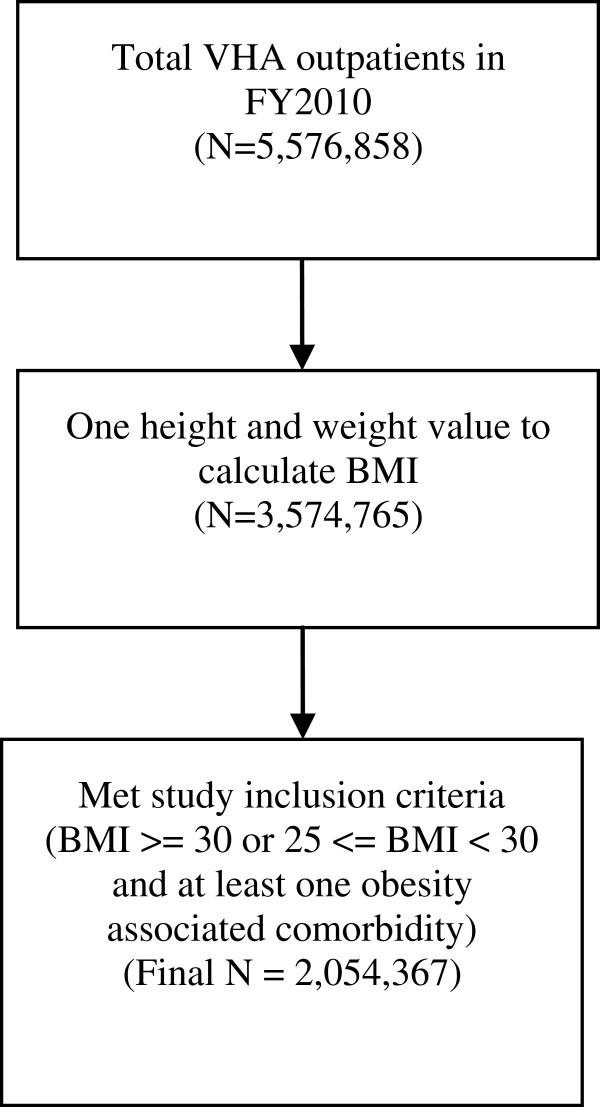
Using national administrative data in a retrospective cohort study of eligible overweight (25 < = body mass index (BMI) < 30 and at least one obesity associated comorbidity) and obese (BMI > =30) VHA outpatients, we examined variation in and predictors of MOVE!® utilization in fiscal year (FY) 2010 using generalized linear mixed models.
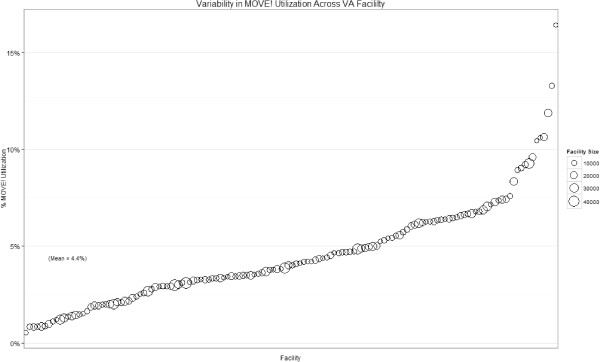
4.39% (n = 90,230) of all eligible overweight and obese patients using VHA services utilized MOVE!® services at least once in FY 2010. Facility-level MOVE! Utilization rates ranged from 0.05% to 16%. Veterans were more likely to have at least one MOVE!® visit if they had a higher BMI, were female, unmarried, younger, a minority, or had a psychiatric or obesity-related comorbidity.
Although substantial variation exists across VHA facilities in MOVE!® utilization rates, Veterans most in need of obesity management services were more likely to access MOVE!®, although at a low level. However, there may still be many Veterans who might benefit but are not accessing these services. More research is needed to examine the barriers and facilitators of MOVE!® utilization, particularly in facilities with unusually high and low reach.
启动主要行为健康项目的医疗保健系统通常面临实施情况可变和患者参与度不均衡的挑战。最近,一个大型医疗保健系统退伍军人健康管理局(VHA)启动了 MOVE!®体重管理计划,但尚不清楚最需要 MOVE!®服务的退伍军人是否正在使用这些服务。本研究的目的是检查与所有 VHA 设施的 MOVE!®使用(定义为 1 次或更多次就诊)相关的患者和设施因素。
在一项针对超重(25 < =体重指数(BMI)< 30 且至少有一种肥胖相关合并症)和肥胖(BMI > =30)VHA 门诊患者的回顾性队列研究中,我们使用全国性行政数据,使用广义线性混合模型检查 2010 财年(FY)MOVE!®使用的变化和预测因素。
在 FY2010 使用 VHA 服务的所有符合条件的超重和肥胖患者中,有 4.39%(n = 90,230)至少使用过一次 MOVE!®服务。设施级别的 MOVE!®使用率从 0.05%到 16%不等。如果退伍军人的 BMI 更高、女性、未婚、年轻、少数民族或患有精神疾病或肥胖相关合并症,则更有可能至少进行一次 MOVE!®就诊。
尽管在 VHA 设施中 MOVE!®使用率存在很大差异,但最需要肥胖管理服务的退伍军人更有可能使用 MOVE!®,尽管使用率较低。然而,可能仍有许多退伍军人可能受益但未使用这些服务。需要进一步研究以检查 MOVE!®使用的障碍和促进因素,特别是在使用率异常高和低的设施中。