Luzi Cesare, Luzi Valeriano, Melsen Birte
Via Savoia 35/a, Rome 00198, Italy.
Prog Orthod. 2013 Jul 31;14:21. doi: 10.1186/2196-1042-14-21.
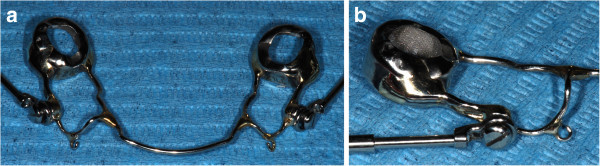
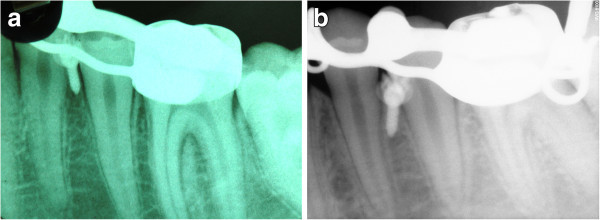
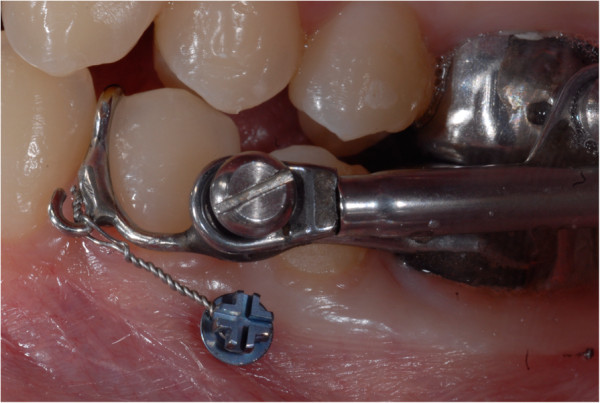
The purpose of this study is to present the use of a modified Herbst appliance in association with temporary anchorage devices (TADs) in order to enhance the correction of skeletal class II malocclusions.
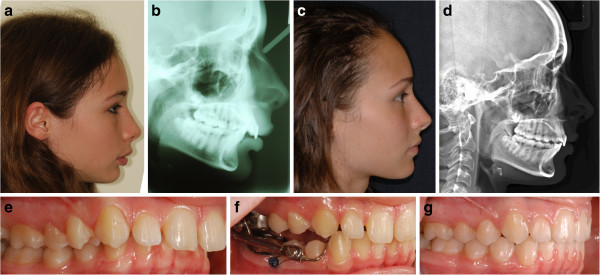
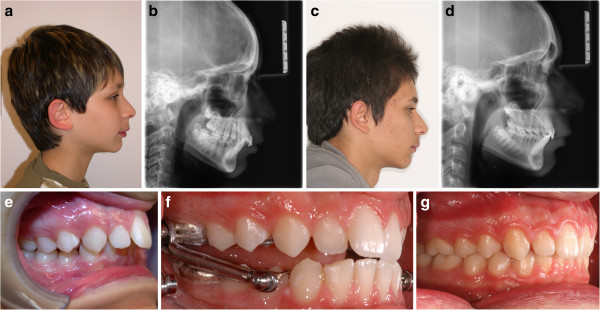
Ten consecutive adolescents scheduled for Herbst treatment were assigned to two treatment groups. Five cases were treated with a modified miniscrew-supported Herbst appliance (experimental group (EG)) and five cases with a conventional cast Herbst appliance (control group (CG)). In all cases, the Herbst was kept in place for 9 months and was followed by fixed appliances until class I relationships were achieved. The initial (T1) and final (T2) lower incisor inclination on lateral headfilms were analyzed for each case, and the mean increase for the five EG patients and the five CG patients were compared.
The mean increase in lower incisor inclination at the end of treatment was 1° (range 0° to 2°) for the EG and 7° (range 4° to 10°) for the CG.
The rational association of TADs with the Herbst appliance can optimize treatment efficiency and skeletal response by reducing the occurrence of excessive lower incisor proclination.
本研究的目的是介绍一种改良的Herbst矫治器与临时支抗装置(TADs)联合使用,以增强对骨性II类错牙合畸形的矫治效果。
将连续10例计划接受Herbst矫治的青少年分为两个治疗组。5例采用改良的微型螺钉支持的Herbst矫治器治疗(实验组(EG)),5例采用传统铸造Herbst矫治器治疗(对照组(CG))。所有病例中,Herbst矫治器均佩戴9个月,之后使用固定矫治器直至达到I类关系。分析每个病例在头颅侧位片上初始(T1)和最终(T2)下切牙倾斜度,并比较5例EG患者和5例CG患者的平均增加量。
治疗结束时,EG组下切牙倾斜度的平均增加量为1°(范围0°至2°),CG组为7°(范围4°至10°)。
TADs与Herbst矫治器的合理联合使用可通过减少下切牙过度前倾的发生,优化治疗效率和骨骼反应。